Nepal’s foreign policy credentials drew a mixed reaction in 2019 as Prime Minister KP Sharma Oli made a bombastic promise to review the country’s relations with immediate neighbours India and China and the countries that receive Nepali labour as well as important actors like the United States, the United Kingdom, and the European Union. At the end of year, Nepal’s major foreign policy engagements stagnated with India, China, and the US, particularly on the Washington-led Indo-Pacific Strategy, Beijing’s Belt and Road Initiative, and India’s new political map that places Nepal’s Kalapani within its territory. Here are a few events and controversies.
1- Indian Film Awards
The year 2019 began with the government’s controversial decision to host the Indian Film Academy Award in Kathmandu and its decision to meet some of the event’s expenses. Leaders of both the ruling and opposition parties strongly opposed the decision to host the Bollywood event in Kathmandu. The Nepali film fraternity also opposed the plan to host the glitzy Bollywood event in Kathmandu because it would cost the country millions without tangible outcomes for the promotion of Nepal’s tourism, a claim both the KP Sharma Oli administration and the Nepal Tourism Board made. On June 20, a Cabinet meeting had approved a proposal to host the Awards in Kathmandu at the end of August. As per the estimates, the event would require the Nepal Tourism Board to pay the organiser $4 million to $6 million in cash, excluding the costs of logistics and transportation. Due to the fierce opposition, the event did not take place in Kathmandu.
2- Diplomatic fiasco over Venezuela issue
A statement issued by Co-chair of the ruling Nepal Communist Party Pushpa Kamal Dahal caused huge diplomatic commotions in both Kathmandu and Washington at a time when Prime Minister KP Sharma Oli was in Davos.
In his statement, Dahal on behalf of the Nepal Communist Party (NCP), had categorically denounced what it called the United States and its allies’ “intervention in the internal affairs of the Bolivarian Republic of Venezuela with the intention of increasing violence by dividing the people and challenging democracy, sovereignty, and peace.”
The Ministry of Foreign Affairs tried to clarify the context after the US Embassy in Kathmandu asked the ministry whether it is the official position of the Oli administration. Venezuela rarely figured in Nepal’s foreign policy, let alone in the domestic political discourse. But that changed following Dahal’s statement.
3- US concerned on BRI
A subtle diplomatic tussle brewed between Beijing and Kathmandu after a US defense official dropped a caveat: Chinese investment should be designed to serve the interest of Nepal and not just China. This was the first public statement on behalf of US officials in Kathmandu warning against the Chinese investment in Nepal in the wake of several media reports of “debt trap” in some China-funded projects. The visiting US Deputy Assistant Secretary of Defense for South and Southeast Asia, Joe Felter, had said that some activities that China has been engaged in the past across the region—in Sri Lanka, the Maldives, and Malaysia—are a cause of concern. “We welcome a constructive relationship with China, we welcome the investment by China, but as long as that investment is designed to serve the interest of Nepal, and not just China,” he said.
4- Nepal’s engagement with the US’s IPS
The debate over whether Nepal is part of the Indo-Pacific Strategy has taken the center stage of Nepal’s foreign policy after the US visit of Foreign Minister Pradeep Gyawali in December 2018. After his meeting with Secretary of State Mike Pompeo in Washington DC, a statement issued by the US officials categorically mentioned that Nepal is a part of the IPS though no one has asked to join the US-led alliance. Even though the Nepal government categorically rejected any role and engagement in the US-led Indo-Pacific Strategy, a report from the US Department of Defense in June stated that the United States seeks to “expand” its defense relationship with Nepal under the ‘State Partnership Program in the Indo-Pacific’.
5- Visit of President Bhandari to China
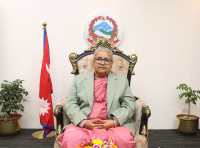
President Bidya Devi Bhandari’s state visit to China to participate in the Second Belt and Road Forum for International Cooperation also grabbed national attention. During the visit, China pledged Rs16.8 billion (1 billion yuan) as economic and technical assistance to Nepal and signed half a dozen agreements including the much-hyped Protocol to Transit Agreement between Nepal and China. The protocol had been pending since Nepal and China signed the Transit and Transportation Agreement in March 2016 during Prime Minister KP Sharma Oli’s visit to the northern neighbour. However, both sides had announced that protocol to Transit and Transportation Agreement would come into effect immediately but that is pending ten months after the agreement.
6- Parliamentarians’ visit to Tibetan function
Nepal’s official One-China policy came under serious scrutiny after two Members of Parliament participated in an event organised by the Latvian Parliamentary Support Group for Tibet and the International Network of Parliamentarians on Tibet while on a personal trip to the European country. This came just as three government journalists were under investigation by the state news agency for disseminating a report about the Tibetan spiritual leader Dalai Lama, in what the communication minister described as a violation of the official One-China policy. Pradip Yadav of the Samajbadi Party, Nepal, which was formed after the merger of the Sanghiya Samajbadi Forum-Nepal and the Naya Shakti Party Nepal, and Iqbal Miya of the Rastriya Janata Party-Nepal participated in the convention in Riga, the Latvian capital.
7-Oli’s Europe tour
One of the major tours that Prime Minister Oli embarked on in 2019 was to three European countries. Oli visited Geneva, Switzerland; Oxford, United Kingdom; and Paris, France in the second week of June. During his meeting with outgoing British Prime Minister Theresa May, Oli proposed a review of the 1947 tripartite agreement between Nepal, India, and Britain—concerning the recruitment of Nepali youths in their armies. Since May had announced her plan to resign, several critics back home criticised Oli for what they said making a fruitless visit to the UK. In France, Oli failed to meet with the French president and no major pacts were signed. Some even termed his visit as a “waste of time and resources”.
8-Indian letter on pesticide residue test
Discord between Nepal and India surfaced after New Delhi’s diplomatic note on pesticide residue test by Nepal on the international border. After Nepal stopped vehicles carrying Indian vegetables and fruits for mandatory pesticide tests, the Indian Embassy in Kathmandu wrote to the government of Nepal, protesting that the move violated several bilateral pacts. But Prime Minister KP Sharma Oli expressed ignorance over the incident. Later, the government revoked the decision but Oli and Matrika Yadav, then minister for industry, commerce, and supplies, both denied allegations of Indian pressure on the reversal of the government’s decision to test imported fruits and vegetables. Oli also denied that the Indians had anything to do with the decision.
9- Visits of Indian and Chinese foreign ministers to Nepal
After the formation of the new government, External Affairs Minister of India S Jaishankar visited Nepal in the third week of August where he co-chaired the long-awaited fifth meeting of the Nepal-India Joint Commission. During the meeting, Nepal and India agreed to enter into “a new era of partnership and cooperation” with Narendra Modi’s re-election in India and the formation of a stable government in Nepal. State Councilor and Foreign Minister of China Wang Yi also visited Nepal in connection with the visit of Chinese President Xi Jinping in the second week of October.
10- Kathmandu’s disapproval of the US-led Indo-Pacific Strategy
Hours after Chinese State Councillor and Foreign Minister Wang Yi wrapped up his three-day Nepal visit, a series of statements released by Beijing said Kathmandu disapproved of the Indo-Pacific strategy, potentially creating a new diplomatic debacle for the ruling Nepal Communist Party.
In five separate statements released by China’s Ministry of Foreign Affairs, the Chinese government said Nepal termed the agitation in Hong Kong as China’s internal affairs and all five key Nepali leaders—President Bidya Devi Bhandari, Prime Minister KP Sharma Oli, Foreign Minister Pradeep Gyawali, Nepali Congress President Sher Bahadur Deuba, and NCP Co-chair Pushpa Kamal Dahal—assured Wang that Nepal strictly adheres to one-China policy and will not allow external forces to promote anti-China activities in the country. But a single phrase in China’s statement about Wang’s meeting with Dahal raised eyebrows in Kathmandu and Washington. The US Embassy in Kathmandu sought clarification from the Ministry of Foreign Affairs Beijing’s statement said Nepal “disapproves” of the Indo-Pacific Strategy.
11- Controversy over training on Xi-thought
Ahead of Chinese President Xi Jinping’s visit to Nepal, the School Department of the Nepal Communist Party (NCP) organised a two-day training programme on Xi-thought, which courted controversy. Concerns were raised in Nepal over the training but ruling party leaders rushed to defend it and the opposition Nepali Congress and others criticised it citing the fundamental differences between Nepali and Chinese societies, and their constitutions, political orientations, and governing systems. Chinese Ambassador to Nepal Hou Yanqi clarified that China does not export political ideology. “We are consistent in our policy not to interfere in other countries’ domestic affairs,” she stated.
12- Visit of Chinese president to Nepal
After a hiatus of 26 years, Chinese President Xi Jinping paid a state visit to Nepal on October 12 in what the Oli administration described as a “big diplomatic success”. During the visit, both sides decided to extol the elevation of bilateral relations and signing over two dozen agreements and memorandums of understanding, primarily concerning infrastructure projects. Beijing offered financial support for a number of projects, either as grants or loans. The decision to elevate the Comprehensive Partnership of Cooperation Featuring Ever-lasting Friendship to Strategic Partnership of Cooperation Featuring Ever-lasting Friendship forDevelopment and Prosperity was viewed with suspicion in Kathmandu. After the agreement, Defence Minister Ishwar Pokharel left for China to sign a military deal. This created suspicions whether the ties had indeed been elevated to a strategic partnership. Several pacts worth billions of rupees were signed and Nepal agreed to expedite projects under the Belt and Road Initiative of China.
13- India’s new political map
A major diplomatic friction surfaced after India issued a new political map on November 2 in line with New Delhi’s division of Jammu and Kashmir into two federal territories based on the August move of the Narendra Modi government to rescind Kashmir’s autonomy. The Survey Department took issue with the new political map that places Kalapani, which is claimed by Nepal, within India’s territory.
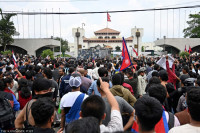
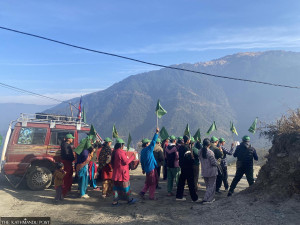
Despite the prime minister and several sitting ministers issuing strongly-worded statements on Kalapani, there has been little headway on the political and diplomatic fronts on securing Nepal’s areas bordering India. Prime Minister Oli organised an all-party meet on November 10 and sent a diplomatic note to India on November 20 and offered a talk at the foreign secretary level on November 23. However, India did not respond for long. There were protests and demonstrations against the Indian move across Nepal. One month after the diplomatic note, India finally responded positively to Nepal’s demand for talks but there has been no development on when and where the meeting will happen.
Anil Giri is a Chief Sub Editor covering diplomacy, international relations and national politics for The Kathmandu Post. Giri has been working as a journalist for more than two decades, contributing to numerous national and international media outlets.




 9.89°C Kathmandu