Repeated diplomatic failures reveal shortcomings in the Oli administration’s foreign affairs department
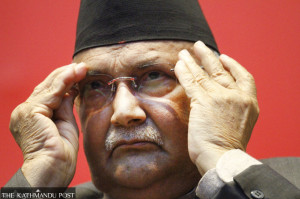
Foreign Ministry officials have not responded to at least three requests for clarifications from American and Indian embassies. Prime Minister KP Sharma Oli. Post File Photo
In February, when Prime Minister KP Sharma Oli was travelling to Davos to attend the World Economic Forum meeting, Pushpa Kamal Dahal, co-chair of the ruling Nepal Communist Party, issued a statement that not only sided with the embattled regime of Venezuelan President Nicolas Maduro but also denounced the United States for its “interference” in the Latin American nation. The statement prompted the US Embassy in Kathmandu to send a diplomatic note to the Ministry of Foreign Affairs, asking whether Dahal’s statement reflected Nepal’s official position regarding Venezuela.
The Ministry of Foreign Affairs did not respond to the US Embassy on the matter. The incident, which dragged for nearly a month, was one of the first incidents that exposed fault lines in the functioning of the country’s diplomatic apparatus under the Oli administration.
Another major diplomatic fallout came just weeks later when the Indian Embassy in Kathmandu asked for clarification over Indians requiring mandatory labour permits in Nepal. The Indian ambassador had dispatched a diplomatic note to the foreign minister seeking clarification. According to the Indian Embassy, the Ministry of Foreign Affairs, again, did not reply to the note.
“If we look at the pattern in which the state is functioning, the government appears to have lost control over various state mechanisms,” Ramesh Nath Pandey, former foreign minister, told the Post, pointing out that despite having a highly centralised Prime Minister’s Office, the government is continuing to make mistakes.
“We have even followed the American system of having advisers, but advisers should be those who have better knowledge and understanding than the prime minister,” said Pandey. “This is not the case here. The prime minister has weak and unqualified advisers.”
Last month, in another diplomatic incident, the Foreign Ministry did not reply to the US Embassy after an American citizen was refused entry into Nepal because he was suspected of being an agent of the Dalai Lama. But Nepali immigration officials, coming under pressure from the Chinese Embassy in Kathmandu, had deported the wrong man with the same name. The US Embassy asked for clarification from the Ministry of Foreign Affairs. Once again, there was no reply.
“International practise is to not respond when mistakes happen,” Pandey said. “And how can they reply? They can neither admit that they were misled nor can they say they acted under Chinese pressure.”
The most recent and most telling instance of a diplomatic failure came with the Indian Embassy’s letter asking that pesticide tests be recalled. A day after Prime Minister KP Sharma Oli openly questioned the existence of the letter, the copy of the letter was widely circulated in the media. The prime minister was forced to apologise, during which he said he had been “misled” by his own ministers and bureaucrats.
The incidents indicate a broken, and increasingly lacklustre, approach to handling diplomatic affairs by the Foreign Ministry, and much of the officials in the Oli administration. A series of statements by Oli himself, claiming to have not been informed about certain issues, has given way to concern among foreign policy analysts about the prime minister’s aloofness, his lack of communication, and his leadership to take control.
“If the prime minister repeatedly says he is being kept in the dark, it is a serious matter,” said Devi Ram Sharma, former chief of the country’s intelligence agency. “It is embarrassing for the nation and the prime minister.”
As the blame game continues within the Oli administration, the Foreign Ministry said that for it to respond to the Indian Embassy regarding the pesticide tests, it had to receive responses from the line ministries—commerce and agriculture.
In the case of refusal of entry to the American citizen, the Foreign Ministry had said it was awaiting a response from the Home Ministry.
Foreign Ministry officials could not say why there was a delay in response from the ministries concerned. Those from the prime minister’s circle, however, tried to downplay the incidents and instead blamed the media.
“Whether it was intentional or a mistake, that will be established later,” said Rajan Bhattarai, foreign relations adviser to the prime minister. He said that an internal probe is underway as to why the prime minister did not receive the letter dispatched by the Indian Embassy.
“A section of the media is hell-bent on criticising the government’s performance, which is not right,” said Bhattarai. “The government had several priorities at the time so the prime minister was focused on other tasks. We are very much on track and the government will take momentum soon.”
But former and current officials said that a prime minister receives information from numerous sources, including the heads of security agencies, senior bureaucrats, diplomats, intelligence officers, the media, and party leaders. All pressing issues and important diplomatic communications are communicated to the prime minister.
“So either someone is hatching a conspiracy against the government,” said Sharma, the former intelligence chief, “or the prime minister is just not aware of what is happening.”
Sharma then made comparisons to the political upheaval in Sri Lanka earlier this year following the deadly terror attack. “Those security chiefs who failed to share sensitive information on the attack with the heads of state and government were either sacked or arrested,” he said. “The prime minister should do the same here as well.”
Anil Giri is a Chief Sub Editor covering diplomacy, international relations and national politics for The Kathmandu Post. Giri has been working as a journalist for more than two decades, contributing to numerous national and international media outlets.




 9.89°C Kathmandu