Nepal’s ambassador has been waiting over a month for formal meeting with Indian external affairs minister, officials say
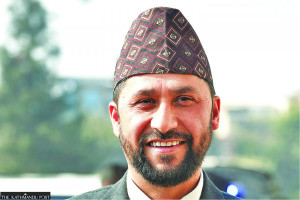
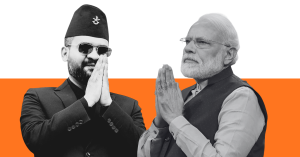
The delay, according to senior diplomats, is the result of Indian displeasure over the Nepali ambassador’s meetings with Chinese and Pakistani envoys Nepali Ambassador to India Nilamber Acharya (Left) and Indian External Affairs Minister S Jaishankar. Post Photo-Reuters
Despite waiting for over a month, Nilamber Acharya, Nepal’s ambassador to India, has failed to meet with S Jaishankar, India’s new external affairs minister.
This failure, though, is not for a lack of trying.
As soon as the new Indian Cabinet took office on May 30, the Nepali Embassy in New Delhi had written to India’s Ministry of External Affairs, seeking a courtesy call on Jaishankar by the ambassador. Over a month later, the embassy has been patiently waiting for a response, according to officials. But as of Thursday, no phone calls had been forthcoming.
Officials at the Nepali Embassy in New Delhi told the Post that they had made a number of separate requests with other line ministries, including the External Affairs Ministry, as soon as the new government was formed, but Acharya has not had facetime with any of them.
“We had requested courtesy calls with several ministries—Home, Energy, Trade, Infrastructure and External Affairs, all of which are of importance to us,” Hari Odari, spokesperson for the Nepali Embassy, told the Post.
It is especially important that Acharya meets with Jaishankar to advance bilateral ties, as a number of significant meetings and visits between Nepal and India are to take place in the coming months.
Foreign Minister Pradeep Gyawali has spoken to Jaishankar twice about holding the fifth meeting of the Nepal-India Joint Commission at the foreign minister level. Jaishankar will have to travel to Kathmandu to attend that meeting. There are also plans for Nepal to host Indian President Ramnath Kovind and Prime Minister Narendra Modi within the year. Foreign policy analysts say it is therefore important for Acharya to meet with Jaishankar to iron out the wrinkles and ensure that the high-level exchanges take place without obstacles.
Former diplomats said this is probably the first time that any Nepali ambassador has had to wait for so long to get time with the Indian foreign minister.
At least three previous Nepali Ambassadors to India—Deep Kumar Upadhaya, Durgesh Man Singh and Bhekh Bahadur Thapa—told the Post they had had to wait between seven and 10 days for a courtesy call on the foreign minister.
Though a formal meeting between the two might have yet to happen, Acharya, however, told the Post that he has been meeting Jaishankar at informal programmes in Delhi.
“There is no need to speculate, as I have met him [Jaishankar] several times unofficially,” said Acharya. “As the new government has just been formed and the Indian parliament is currently underway, he must be busy.”
On March 13, Acharya presented his letter of credence and started meeting with ambassadors from the region and representatives of the United Nations Security Council.
On April 9, he met French Ambassador to India Alexandre Ziegler, and US Ambassador to India Ken Juster on April 11. The next day, April 12, he met with outgoing External Affairs Minister Sushma Swaraj.
However, senior officials within the foreign ministry and the mission in New Delhi told the Post that Acharya’s meetings with these ambassadors, especially those from China and Pakistan, might have displeased some in the Indian establishment. Though Acharya did meet with outgoing Chinese Ambassador to India Lou Zhang Hui on April 14, the Post could not independently verify that he met with the Pakistani Ambassador in New Delhi.
“All those meetings were conducted with the confidence of the Indian Ministry of External Affairs,” said Bharat Kumar Regmi, deputy chief of mission at the Nepali Embassy in New Delhi. “It is set practice for our new ambassador to meet with other ambassadors from the SAARC region and the five ambassadors from the UN Security Council.”
An official at the Indian Embassy in Kathmandu, who requested anonymity because he was not allowed to speak to the media, said Jaishanker has been occupied with India’s engagement in G20 and other multilateral forums.
Some of Acharya’s recent public statements, especially those regarding SAARC and the report of the Eminent Persons’ Group on Nepal, might also have displeased India, according to some analysts.
In the June 7 interview with the Times of India, Acharya had stated that BIMSTEC cannot take SAARC’s place. In recent months, India has been pursuing BIMSTEC while sidelining SAARC.
“We should not hide whatever we have to say. There is no need to create unnecessary noise out of it,” Acharya told the Post. “To build trust, both India and Pakistan should have open and frank discussions. Our interest is that there should be good relations between the two nations.”
Many analysts in India and Nepal had expected that New Delhi would resume its “neighbourhood first” policy during Modi’s second term. Under this doctrine, Modi had visited Nepal four times between 2014 and 2019. More recently, Modi visited the Maldives and Sri Lanka, while External Affairs Minister Jaishankar visited Bhutan.
“We have already forwarded our request for a meeting with Jaishankar,” said Acharya. “I am sure that Jaishankar is also interested in meeting me.”
Anil Giri is a Chief Sub Editor covering diplomacy, international relations and national politics for The Kathmandu Post. Giri has been working as a journalist for more than two decades, contributing to numerous national and international media outlets.




 19.45°C Kathmandu

.jpg&w=900&height=601)