Beijing’s security concerns cloud Nepal’s push to reopen Tatopani
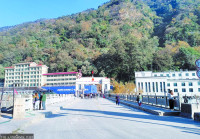
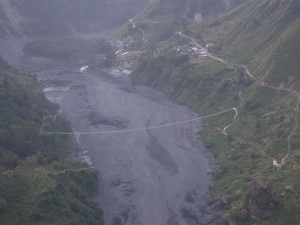
Flood damage to Rasuwagadhi and the high cost of Korala leave the Sindhupalchok crossing vital to Nepal’s trade with China, but Beijing remains reluctant to reopen it over concerns about Tibet.The Tatopani border crossing between Nepal and China in Sindhupalchok district. Post File Photo
Nepal has intensified diplomatic efforts to reopen the Tatopani border crossing with China after floods and landslides disrupted alternative trade routes, but Beijing has yet to commit to restoring regular operations, citing security concerns, logistical difficulties and recurring landslides.
The reluctance appears to extend beyond physical infrastructure. Nepali officials familiar with border security say Chinese concerns about Tibetan refugees entering Nepal and possible anti-China activities along the frontier have also complicated efforts to resume trade through the Tatopani crossing in Sindhupalchok.
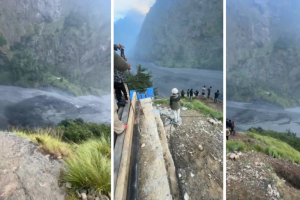
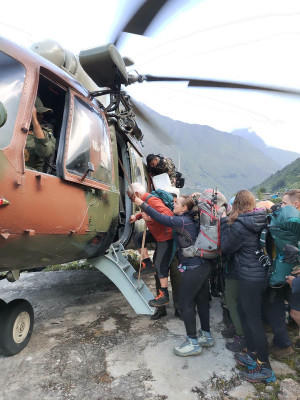
The issue has become more urgent since the August 26 Bhotekoshi flood closed the Rasuwagadhi border point, Nepal’s major trade route with China. Kathmandu urged Beijing to reopen Tatopani as an alternative, but China instead offered assistance to restore Rasuwagadhi as the main trading point.
Korala border crossing in Mustang, another alternative, was also disrupted by floods and landslides, leaving goods ordered by traders stranded ahead of Dashain, Nepal’s most widely celebrated festival and the biggest shopping season of the year.
The Nepal Trans-Himalayan Border Commerce Association wrote to Chinese Ambassador Zhang Maoming urging him to reopen the Tatopani border. A delegation led by Anjan Shrestha, president of the Federation of Nepalese Chambers of Commerce and Industry, also met the ambassador. The foreign affairs and infrastructure development ministries have pursued diplomatic channels, but reopening before Dashain appeared unlikely.
“Discussions with the Chinese side are being coordinated mainly through the Ministry of Foreign Affairs, but there is no certainty about when the border will reopen,” said Shashidhar Ghimire, chief district officer of Sindhupalchok. “The latest communication, however, suggests that they are positive about reopening it.”
At a meeting on Wednesday with Industry, Commerce and Supplies Minister Deepak Kumar Sah, Zhang indicated that Tatopani could be reopened for a short period to meet festival demand, but that its long-term operation would require a detailed assessment.
“The Chinese ambassador told the minister that Tatopani border could be opened for the main festivals, but that further study would be needed for long-term operations,” an official who attended the meeting said. According to him, the ambassador cited security challenges, logistical problems and frequent landslides as additional complications.
The official said Zhang also stressed reopening Korala and Rasuwagadhi. China has previously promised to help rebuild the Rasuwagadhi crossing and connect the road network to Syaphrubesi after the floods, although Nepali experts say the work will be difficult.
A home ministry source said a team including Chinese embassy officials in Kathmandu had already inspected the road from the capital to the Tatopani border area after Nepal pressed for the crossing to be reopened.
“Previously, they had argued that the road on the Nepal side was in poor condition, so teams from both sides agreed to inspect it,” a ministry official familiar with the discussions said. “The inspection team also concluded that there was no major problem with the road and that the crossing could operate. We don’t understand why a decision has still not been made.”
Nepal now awaits Beijing’s final decision.
The commercial case for reopening Tatopani is crucial. The crossing is closer to Kathmandu than Korala and substantially cheaper for freight, making it particularly important when other northern routes are blocked or become impassable during winter.
Ram Hari Karki, president of the Nepal Trans-Himalayan Border Commerce Association, said goods could reach Kathmandu within 10 to 12 days through Tatopani, compared with 14 to 15 days through Korala.
“After Tihar, the onset of winter makes it virtually impossible to operate the Korala crossing. Diplomatic efforts to reopen Tatopani are therefore essential,” said Karki.
Transporting a container to Kathmandu through Tatopani costs around Rs50,000, while the cost through Korala can reach Rs500,000, he said. Although some containers, new vehicles and other goods have begun moving through Korala after the highway linking Mustang with Myagdi partially reopened, snowfall and icy roads are expected to disrupt customs and immigration operations as winter sets in.
Tibet security concerns complicate border diplomacy
The reluctance to reopen Tatopani has also raised questions about Beijing’s wider concerns along the Nepal-Tibet border, particularly the movement of Tibetan refugees.
A senior official at the National Investigation Department, who monitors activities along Nepal’s northern frontier, said Chinese authorities remained suspicious of cross-border movement involving Tibetans.
“Those who came to Nepal and were verified by the Office of the United Nations High Commissioner for Refugees (UNHCR) were facilitated in returning to places in India, including Dharamshala,” the official said.
“However, the Chinese side alleged that, for a long period after the [2015] earthquake, refugees were issued identity cards at border crossings themselves and then sent to India. We deployed a team to monitor the matter and did find some irregularities.”
During the government led by the Nepal Communist Party, formed through the merger of the CPN-UML and the Maoists, the home ministry decided to stop deporting Tibetan refugees to India. A former senior administrator who served as chief district officer in Sindhupalchok said Chinese officials continued to provide information about people crossing from Tibet, and Nepali authorities acted on some of those reports.
Human Rights Watch, in its report Under China’s Shadow: Mistreatment of Tibetans in Nepal, documented cases in which Tibetans detained near the border were forcibly returned to Chinese territory without formal procedures. The report, citing a senior home ministry official, alleged that they had been sent back without following formal procedures.
A former chief district officer in Sindhupalchok recalled Chinese officials expressing concern over the alleged growing presence of followers of the Dalai Lama in border areas. However, investigations by Nepal Police and the National Investigation Department did not establish the scale of activity claimed by the Chinese side.
“There may be people using the area as a transit point, but we did not find the kind of followers they described,” the former official said, adding that subsequent administrative action had made such activity less likely.
According to another former additional chief research director of the National Investigation Department, the number of young Tibetans leaving their homes and coming to Nepal has declined as China has developed Tibet and sought to relocate settlements further inland, away from the border.
“Even a few years ago, the Chinese side proposed forming a joint monitoring team between Nepal and China, comprising officials from the administration in Tibet and their counterparts in Sindhupalchok. The proposal was also reported to the home ministry,” he said.
“The proposal was put forward as a way to coordinate responses to disasters and other issues, and it reached the home secretary through the relevant channel. The district security committee also endorsed it and forwarded it. But ultimately, the ministry didn’t approve it.”
Despite these concerns, officials and traders say the crossing’s economic importance warrants a fresh effort to reach an understanding with Beijing.
In December 2022, elected local officials from Sindhupalchok submitted memorandums to top politicians seeking help to reopen Tatopani. Pushpa Kamal Dahal, who later became prime minister for a second time, said he had discussed reopening the crossing with Chinese President Xi Jinping during a visit to China.
Kalyan Raj Sharma, nominated as Nepal’s ambassador to China, also pledged during his parliamentary hearing to pursue the issue.
Tatopani was closed following the 2015 earthquake and reopened for limited cargo movement in May 2019. It was again closed during the Covid pandemic in 2020. Imports remained restricted largely to selected goods, while exports have struggled to resume meaningfully despite China permitting outbound trade in 2023. Before the earthquake, Nepal exported copper utensils, handicrafts, flour, noodles, eggs, vegetable ghee and medicinal herbs through the crossing.
The Araniko Highway, built in the 1960s, was Nepal’s principal road link with China before the Rasuwagadhi-Kerung route opened in 2014. Repeated closures have since weakened Tatopani’s role.




 14.77°C Kathmandu