Sudurpaschim has seen huge investment in sports infrastructure but has little to show for it
Political favouritism and poor planning have rendered a multibillion-rupee investment in sports infrastructure virtually useless across Sudurpaschim.An under-construction covered hall left incomplete at Khalanga in Darchula, pictured recently. Basant Pratap Singh/TKP
On April 10, the Special Court handed down a landmark ruling convicting six individuals, including the acting chief administrative officer of Bitthadchir Rural Municipality in Bajhang, after finding them guilty of financial irregularities and deep-seated corruption during the execution of a local playground project.
The court found that Rs1.46 million had been misappropriated during the construction of a sports ground in Bitthad, which lies in ward 1 of the rural municipality. The full bench of judges Narayan Prasad Paudel, Dilliratna Shrestha and Bidur Koirala convicted former administrative officer Chakradev Bhatta, sub-engineer Ganesh Raj Upadhyaya and account officer Harkadev Joshi, along with officials of the users’ committee responsible for implementing the project.
The court sentenced each of them to three months in prison and imposed fines of Rs244,414.
The case stemmed from a sports ground project funded with Rs6.5 million in the fiscal year 2019-20. The money came from the federal Ministry of Youth and Sports and a parliamentary development fund. According to the charges, authorities signed separate agreements with the same users’ committee under different cost estimates, while some work was either not completed or carried out using substandard materials.
The Commission for the Investigation of Abuse of Authority (CIAA) found that duplicate payments amounting to nearly Rs1.30 million had been made for the same ground-cutting work through different vouchers. Investigators also found evidence of additional payments for work that had never been completed.
For many residents, the verdict merely confirmed what they had long suspected.
Harish Khadayat, ward chair of Bitthadchir-6, says the site itself was unsuitable for a sports facility.
“The project was not selected through the normal planning process,” Khadayat said. “It was brought through political connections reaching all the way to the then sports minister Jagat Bishwakarma.”
According to him, many such projects were designed less to develop sports than to reward political supporters and local power brokers. “If someone investigates properly, dozens of similar cases will be found in this district alone,” he said.
The same fiscal year, another Rs2.5 million was allocated to sports infrastructure in Bitthadchir. Grounds built in places such as Dungri consumed public funds but received little more than basic cleaning and levelling work.
The pattern is not unique to one local unit. Across Sudurpaschim Province, sports infrastructure projects worth hundreds of millions of rupees have struggled to deliver usable facilities despite repeated budget allocations.
Sports infrastructure drive over eight years fails to deliver functional facilities
In Bajhang alone, records from the federal Ministry of Youth and Sports and the provincial Ministry of Social Development show that 48 sports grounds built between the fiscal years 2018-19 and 2025-26 are either unusable or unsuitable for organised sporting activities.
Government records indicate that more than Rs120 million was spent on these facilities during the period. One of the most striking examples lies on the banks of the Bahuligad river opposite the open ground in Chainpur, the district headquarters of Bajhang.
More than a decade has passed since construction began on what was envisioned as a modern sports ground complete with parapets and supporting infrastructure. The then District Sports Development Committee purchased land and started work in 2013. Since then, federal, provincial and local governments have repeatedly allocated funds to the project.
More than Rs20 million has already been spent. Yet the facility remains unusable.
Each year, parts of the retaining wall are damaged by the river and reconstructed again. No significant sporting event has ever been organised there.
Naresh Singh, a former employee of the District Sports Development Committee, recalls how the project evolved. “We bought the land and began construction through the sports committee,” he said. “Later, local authorities implemented additional phases with funding amounting to around Rs15 million.” Embankments and partial parapets were built, but the ground never reached a condition suitable for sporting use.
Another stalled project lies in ward 6 of Jayaprithvi Municipality. Construction began in 2018 and more than Rs11.4 million from the federal government has already been spent. Yet the ground remains unfinished.
“Only around 60 percent of the work has been completed,” said former ward chair Narendra Bahadur Singh. “Retaining walls, levelling and several other tasks are still pending. More than Rs10 million additional investments will be needed to make it operational.”
A separate sports ground initiated in the municipality with Rs5 million from the provincial government also remains incomplete. The province allocated the money in 2020 to develop a playground at Satyabadi Secondary School. Shortly after construction, sections of the wall collapsed, leaving the project in limbo.
Baitadi’s sporting woes
In Gadhi of Dasharath Chand Municipality-4, a sports ground and the District Sports Committee office have remained under construction for nearly a decade despite repeated injections of public funds.
The project began with an allocation of Rs1 million from the then District Development Committee. In 2020, the provincial government added another Rs2 million and handed implementation responsibility to a users’ committee.
“Because the site was on a steep slope, retaining walls were built with the plan of developing two separate grounds,” said Santosh Kumar Kanaujiya, chairman of the users’ committee. “Later, we were instructed to construct only one ground. As a result, the wall that had already been built was simply buried within the new structure.”
In 2021, the provincial government allocated a further Rs5 million to the same project, after which construction was shifted to a contractor-led model.
“Then the system changed again,” Kanaujiya said. “During the monsoon, soil and stones began flowing into the nearby settlement. The contractor responded by constructing another retaining wall and carrying out additional filling work.”
Despite spending Rs8 million, the sports ground remains unusable. Tarkaraj Joshi, office chief of the District Sports Committee, said budgets are often allocated to satisfy political supporters rather than develop sports infrastructure. “There are no construction standards, nor is there any effective monitoring,” he said.
Between fiscal years 2018-19 and 2025-26, federal and provincial governments allocated more than Rs98 million for sports grounds and infrastructure in Baitadi. Including local government spending, the amount approaches Rs120 million. Yet this year’s district-level Running Shield competition was held in the courtyard of Ninglasaini Temple due to the lack of a suitable sports ground. District Sports Committee chair Bhupendra Chand said irregularities were largely to blame. “There must be a thorough investigation into who benefited from the sports infrastructure budget,” he said.
Similar story in Kailali
The Tikapur Sports Academy in Kailali remains unused despite the completion of its infrastructure more than a year ago. Envisioned as a provincial-level academy that would bring together players from all nine districts of Sudurpaschim and provide residential training facilities, the project has yet to be formally handed over for operation.
Built on 22 bighas (around 15 hectares) of land owned by the Tikapur Municipal Sports Development Committee, the academy includes a two-storey administrative building, a two-storey academic block, a canteen with a seminar hall, a guard block, toilets and other facilities. The structures were built at a reported cost of Rs99 million. However, records maintained by the provincial Ministry of Social Development show that Rs115 million had already been spent between fiscal years 2022-23 and 2024-25. A further Rs10 million has been allocated in the current fiscal year.
According to the municipal sports committee, the facility remains idle because an operational modality governing its use has yet to be finalised.
“We approached both the municipality and the provincial minister, urging them to bring such a large investment into operation rather than leaving it abandoned,” said Laxman Thapa, former chairman of the Tikapur Municipal Sports Committee. “But nobody paid any attention.”
The condition of Dhangadhi Stadium is equally concerning. Fourteen years after construction began, the venue that hosted events during the Sixth National Games in 2013 remains incomplete.
“Poor drainage means the entire ground becomes waterlogged during the monsoon,” said Trilok Pandey, president of the Sudurpaschim Karate Federation. “It becomes impossible not only to organise sporting activities but even to walk across the field.”
Only nine of the 16 planned parapet blocks have been completed, while a multipurpose indoor hall remains unfinished. According to stadium overseer Dhruv Saud, around Rs170 million has already been spent, yet another Rs250 million is required to complete repairs and remaining construction works.
Kanchanpur’s covered hall left in limbo
Kanchanpur does not have a different tale to tell. Construction of a multipurpose covered hall in Mahendranagar, the district headquarters of Kanchanpur, has been stalled for the past nine months.
The project, funded by the Sudurpaschim provincial government at a cost of Rs170 million, is intended to create a facility measuring 126 metres in length and 40 metres in width. Work stopped after disagreements emerged between the District Sports Committee and the contractor over the design of the parapets.
According to Gopal Dutta Bhatta, office head of the District Sports Committee, the committee insists that fixed parapets should be installed, while the construction company has argued in favour of folding structures.
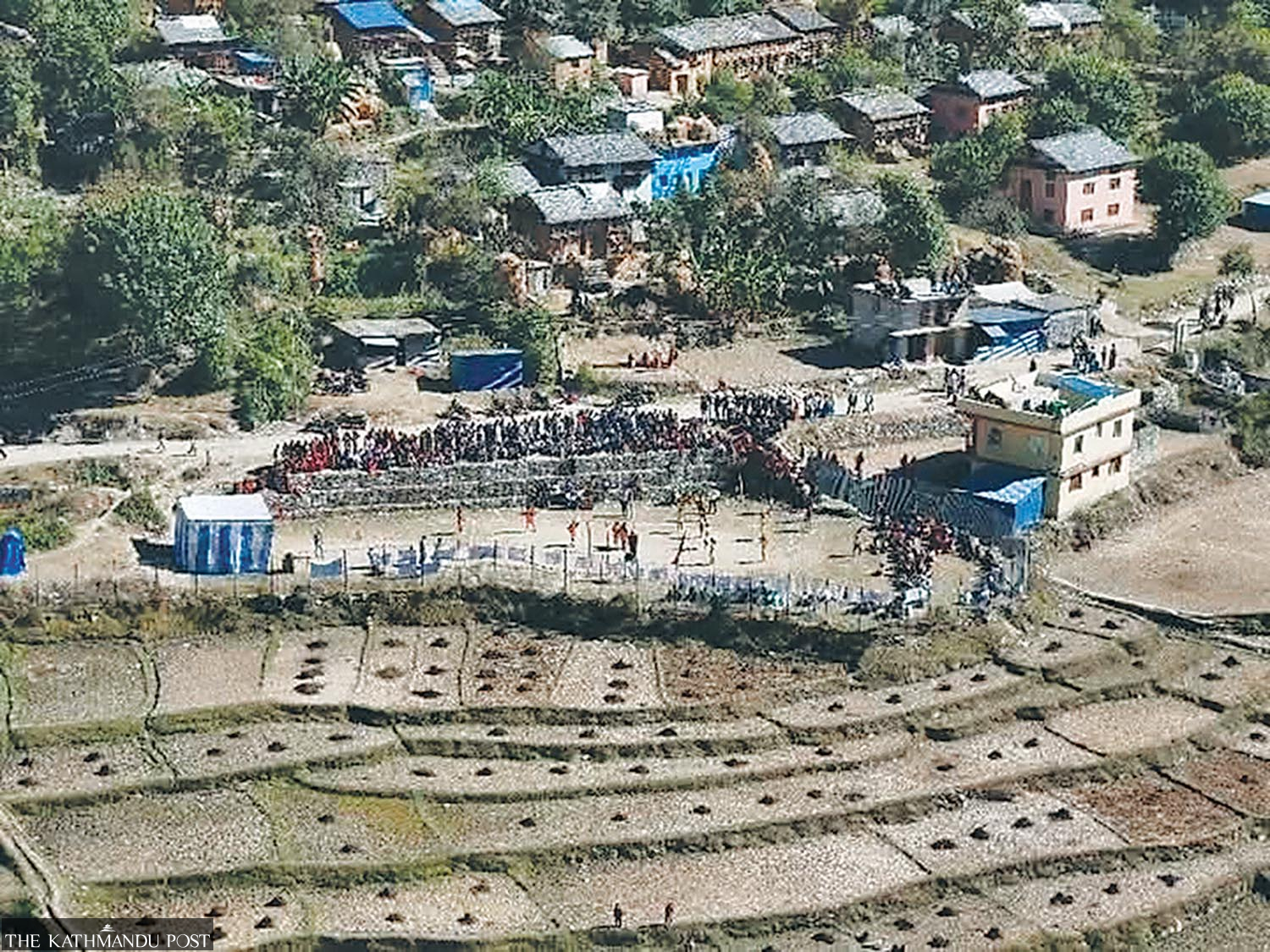
The lack of usable sports facilities has forced organisers to rent private land to hold district-level tournaments. Post photo
Bajura’s sports infrastructure debacle
In Bajura, authorities began constructing a sports ground near Juddi in Jagannath Rural Municipality-2 in 2019 using federal government funds. More than Rs9 million was spent through users’ committees and later contractors.
In October 2021, the Karnali river swept the ground away. “We could not find another suitable site and decided to build there. Later, geologists sent by the ministry concluded that the location should never have been selected for construction,” said rural municipality chair Kali Bahadur Shahi. Work was halted after the assessment.
A similar problem has emerged near Bahulikhola stream in Martadi, the district headquarters. Construction began through a users’ committee in fiscal year of 2023-24. Around Rs2.5 million has already been spent, and the provincial government allocated another Rs2.5 million in the current fiscal year. However, authorities are now considering relocating the project because the river threatens the site.
Kopila Singh, chair of the District Sports Committee, argues that many such projects were never designed to serve athletes. “Budgets are allocated in the name of sports grounds but are really meant to benefit political workers,” she said. “Millions have been spent in riverbeds and remote forests far from settlements, yet the district lacks a venue capable of hosting a major sporting event.”
Dadeldhura sports ground washed away by floods
A sports ground constructed on the banks of the Mahakali river in Parashuram Municipality-5 suffered a similar fate. Built in July 2021 with Rs2 million from the provincial government, the project faced opposition from local residents who warned that the site was vulnerable to flooding.
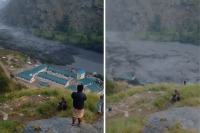
Their concerns were ignored. By October that year, floods in the Mahakali had swept away the ground entirely. “There were repeated objections because everyone knew the river could wash it away,” said ward chair Dil Bahadur Shahi. “But those responsible insisted on building there. Four months later, the flood destroyed everything.”
Over the past eight years, provincial and federal governments have spent more than Rs300 million on 88 sports-ground projects in Dadeldhura. When local government spending is included, the figure approaches Rs350 million.
Yet the district still lacks a single venue suitable for hosting major competitions.
Ganesh Magar of Amargadhi says the problem lies in how projects are conceived.
“There is a tendency to allocate plans worth Rs1 million or Rs1.5 million, appoint people with vested interests to users’ committees, run a bulldozer for a few hours and then collect the payment,” he said.
Dire state of sports infrastructure in Darchula
Sports infrastructure in Darchula has struggled to recover since devastating floods in the Mahakali river swept away a sports ground and covered hall in Khalanga in 2013.
More than a decade later, reconstruction remains incomplete. In fiscal year 2023-24, the Office of Integrated Urban Development in Doti spent Rs18.4 million on new structures at the site of the old open ground. However, the facilities remain unfinished.
“There is a temporary sports ground near the cremation area along the Mahakali,” said Shyam Raj Awasthi, office head of the District Sports Committee. The district continues to struggle with a severe shortage of sporting facilities despite repeated investments.
Similar plight in Achham, Doti
In Achham, a sports ground was constructed on a sandy stretch along the Karnali river in Panchdebal Binayak Municipality-5 using provincial funds. The province allocated money for three consecutive fiscal years beginning in 2020-21, spending around Rs6 million in total.
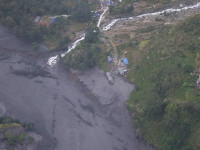
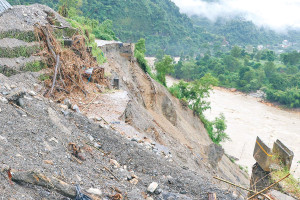
In 2024, floods washed the facility away. “The wall had been built on sand deposited by the Karnali,” said ward chair Hem Bahadur Shahi. “The river simply carried it away.”
Mayor Ambika Chalune believes resources could have been used more effectively.
“Instead of scattering money in the name of sports grounds, it would have been better to expand playgrounds at schools,” she said. “Children could have used them regularly and schools could host competitions.”
In neighbouring Doti, federal and provincial governments alone spent around Rs110 million on sports infrastructure over eight years. According to Harka Bogati, head of the District Sports Development Committee, total spending including local governments may have reached Rs140 million to Rs150 million.
“Yet there is not a single quality sports ground,” he said. “Small projects were distributed among political supporters. Only a fraction of the money was spent on actual work.”
Tournament organised on rented fields
Despite allocating Rs2.5 billion including the spending by the local governments for sports infrastructure in Sudurpashim, the expenditure has yielded little tangible benefit.
The lack of usable sports facilities has forced organisers to rent private land to hold district-level tournaments. A striking example was the Chamber of Commerce Volleyball Cup, the province’s highest-prize-money volleyball competition, held in Bajhang in 2024.
“We inspected several sites, but only a spacious farm field was suitable,” said Shankar Rasaili, vice-chairman of the Bajhang Chamber of Commerce and Industry. “The landowner initially refused, saying a large crowd would leave rubbish and compact the soil. He later demanded Rs100,000 in rent, and after repeated requests we settled on Rs25,000.”
The same field had been rented for Rs20,000 for a tournament in 2023. Rasaili said the competition was not organised in 2025 because no suitable ground was available.
Pushpalal Rokaya, former chairman of the Bajhang District Sports Committee, blamed corruption for the situation. “Corruption has crippled sports development. How long can athletes prepare on the edges of farmland and still be expected to compete nationally and internationally?” he asked.
Elsewhere, the shortage of sports grounds has led to increasingly unusual arrangements. In Darchula, a wheat crop was cleared from private farmland to host a municipal-level President Running Shield competition. In Duhu Rural Municipality, the same event was staged on the Darchula-Tinker road after work on a sports ground stalled following corruption allegations. Similar races held on roads in Baitadi have resulted in injuries to participating students.
‘Parliamentarians pick the projects’
Ram Charitra Meheta, member secretary of the National Sports Council, says many projects fail because political influence overrides technical planning.
“There is a culture of taking projects to one’s own constituency, appointing loyalists to users’ committees, pressuring technical staff and spending money without delivering results,” he said.
Deepak Singh, former member secretary of the Sudurpaschim Provincial Sports Council, agrees. “Basic standards for sports grounds are often ignored,” he said. “Budgets are channelled to places chosen by intermediaries and political activists rather than locations based on actual need. Hillsides are cut with bulldozers, money is spent and projects are declared complete.”
Hem Raj Regmi, secretary at the provincial Ministry of Social Development, says many large projects remain unfinished because allocated budgets are insufficient to meet their total costs.
“Some projects are selected by the ministry, but most are chosen by lawmakers,” he said. “We have little control over those decisions, yet implementation responsibility falls on us. If politicians led policy and also took responsibility for outcomes, such problems would be less common.”




 25.89°C Kathmandu