India, China invite PM Shah to visit as he opens up diplomatic engagement
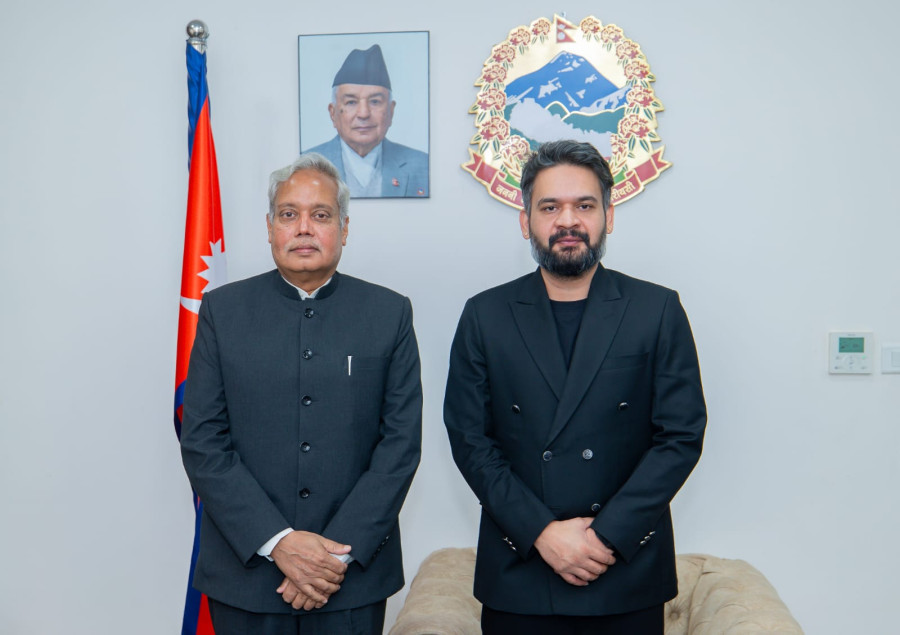
Shah acknowledged the invitations from the two neighbouring countries but made no commitment on when, or whether, he would visit either country. Prime Minister Balendra Shah with Indian Ambassador Naveen Srivastava at the Prime Minister’s Office in Singha Durbar. Photo: Courtesy of PM's Secretariat
The ambassadors of India and China on Monday invited Prime Minister Balendra Shah to visit their respective countries as they separately met with him in Kathmandu within a few hours of each other.
Indian Ambassador Naveen Srivastava reminded Shah of the invitation extended by Indian Prime Minister Narendra Modi to visit India, while Chinese Ambassador Zhang Maoming also invited the prime minister to China. Shah acknowledged both invitations but did not commit to any visit or indicate possible dates, according to officials familiar with the meetings.
“Since I am retiring at the end of September, it would be a great pleasure if you visit India by then,” Srivastava reportedly told Shah.
In response, the prime minister said that he would visit India at an appropriate time. Shah also stated that his government is ready to remove any obstacles on India-funded projects in Nepal and asked Ambassador Srivastava about any shortcomings. The prime minister and the Indian ambassador also briefly discussed some future projects, including Janakpur-Ayodhya rail to Buddhist circuit.
According to one official, the Indian ambassador briefed some obstacles that Indian companies have faced in Nepal.
The back-to-back meetings, held after four and a half months of Shah’s premiership, signal that his government is beginning to move away from his earlier policy of limiting individual diplomatic engagements and is seeking to maintain balanced relations with Nepal’s two immediate neighbours.
Shah met Srivastava and Zhang separately on Monday, with the meetings taking place only a few hours apart. Both ambassadors were accompanied by senior officials from their respective embassies.
The meetings were the first individual courtesy calls between Shah and the Kathmandu-based ambassadors of India and China since he became prime minister on March 27.
The decision to meet the ambassadors of Nepal’s two immediate neighbours on the same day appears intended to underscore their equal importance to Nepal, although the scheduling broadly retains the government’s stated foreign policy priority of engaging India first, followed by China.
The meetings also marked a break from Shah’s self-imposed moratorium on individual meetings with foreign diplomats immediately after taking office. Instead, he had held joint meetings with Kathmandu-based ambassadors on April 9 and May 26.
Monday’s meetings suggest that Shah has now opened up his engagement with both domestic stakeholders and foreign representatives.
Following his meeting with Shah, Indian Ambassador Srivastava said on X that he had conveyed Prime Minister Modi’s warm greetings and had an “engaging and productive exchange of views” on further deepening the “robust, multi-faceted Nepal-India partnership”.
A statement issued by the Prime Minister’s Office said Srivastava congratulated Shah and expressed his commitment to further strengthening mutual relations and cooperation between the two countries. Shah, in turn, emphasised the need to further deepen Nepal’s historic relations with India and work together in areas of common interest.
The Chinese Embassy, in a readout posted on its WeChat account, said Shah told Ambassador Zhang that Nepal attaches great importance to its traditional friendship with China and is willing to work with Beijing to deepen mutually beneficial cooperation in various fields and further advance bilateral relations.
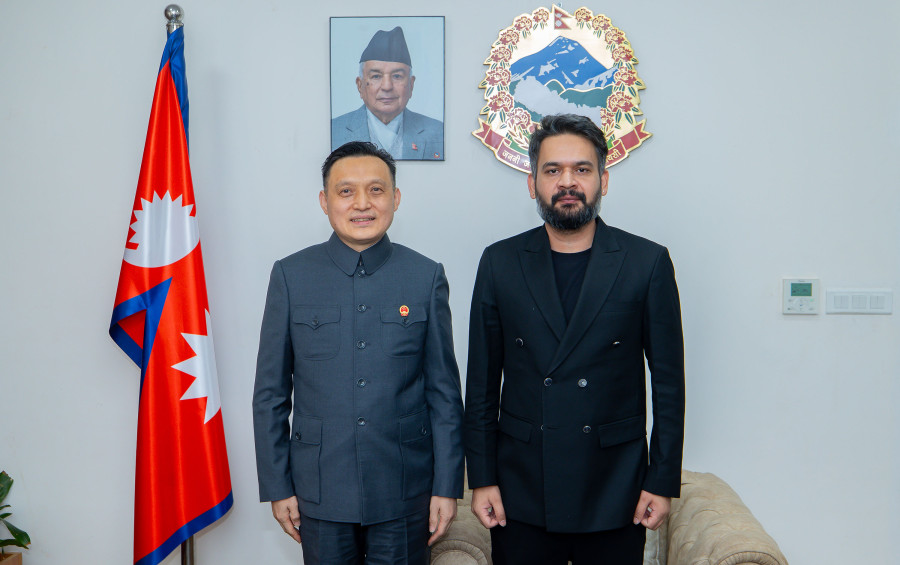
Prime Minister Balendra Shah with Chinese Ambassador to Nepal Zhang Maoming at the Prime Minister’s Office in Singha Durbar. Photo: Courtesy of Prime Minister’s Office
The two sides discussed issues related to Nepal-China bilateral friendship, mutual interests, development partnership and cooperation, according to the readout.
The Chinese ambassador also reiterated the invitation sent to Prime Minister Shah by his Chinese counterpart Li Qiang. The prime minister stated that he will visit China at an appropriate time.
While thanking Shah for continuously upholding the one-China policy, the Chinese ambassador also urged him to look after China’s sensitivities. The Chinese side raised the usual concerns that they used to raise on other occasions, the official added.
“Zhang congratulated Shah on the achievements made since he assumed office as Prime Minister of Nepal and reaffirmed China’s firm support for Nepal,” the Chinese Embassy said. Zhang also expressed China’s willingness to work with Nepal to implement important understandings reached by the leaders of the two countries and deepen the strategic cooperative partnership between Nepal and China.
The prime minister spoke for hardly five minutes to both ambassadors. Most of the time, the prime minister listened to them, the official added.
Former Major General Binoj Basnyat said Shah’s meetings with the Indian and Chinese ambassadors represented a timely shift from a position of avoidance to one of engagement.
“The recognition that immediate neighbours are a diplomatic priority is important,” Basnyat told the Post. “The test now is what those engagements deliver—investment, connectivity, energy, trade, technology, development and security cooperation.”
Diplomacy, he added, must ultimately convert engagement into the concrete advancement of Nepal’s national interests.
Anil Giri is a Chief Sub Editor covering diplomacy, international relations and national politics for The Kathmandu Post. Giri has been working as a journalist for more than two decades, contributing to numerous national and international media outlets.




 21.12°C Kathmandu