In Bhotekoshi’s wake, experts and activists question environmental cost of AI
As Nepal considers setting up data centres of its own, experts say the country must assess their energy, water and environmental costs before breaking ground. Rumours linking AI and data centres directly to the Bhotekoshi floods have also spread across the internet. However, experts state that claims suggesting China built an underground AI server farm beneath a glacier—the heat from which allegedly melted the ice and triggered the flood—are entirely unsubstantiated. Photo: Courtesy of IBM's website
The devastating August 26 Bhotekoshi flash floods have ignited an intense debate across social media and among environment experts about the ecological cost of modern technology and the growing footprint of artificial intelligence.
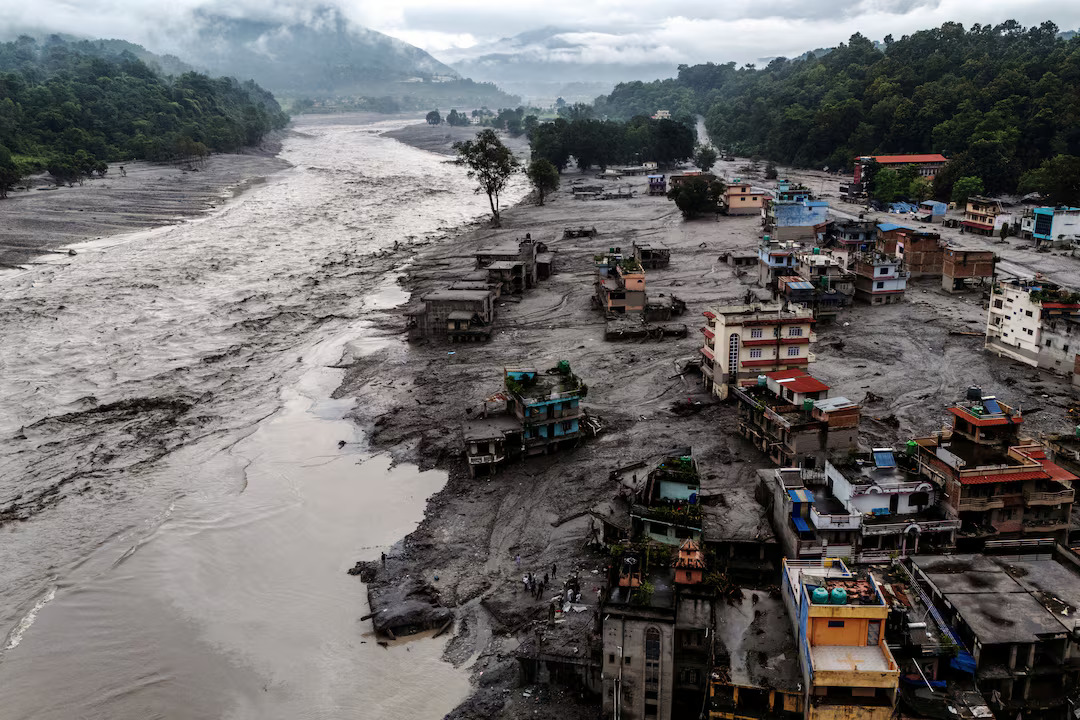
The floods, triggered by a massive glacial bedrock collapse dammed the Lhende river upstream before suddenly bursting, tore through settlements after settlements downstream, sweeping away homes, roads, power projects. In the wake of the unprecedented destruction, some experts and social media users in Nepal and abroad have increasingly sought to connect the vulnerability of the Himalayas to the climate crisis, and indirectly, to the environmental footprint of artificial intelligence. They point to the vast amounts of electricity and fresh water needed to run data centres.
Mahesh Kushwaha, an expert in diplomacy and international relations, shared an AI-generated infographic on Facebook to sarcastically illustrate how technology feeds back into environmental degradation. His visual mapped a grim chain of events: soaring global demand for AI drives up water and electricity consumption in massive data centres and generates substantial carbon emissions. These emissions accelerate warming in high-altitude zones, hasten glacial melt and destabilise fragile mountain terrain—and ultimately trigger catastrophic flash floods like the Bhotekoshi.
Meanwhile, development expert Ashutosh Tiwari questioned why AI remains absent on the front lines when disaster strikes. “Whether it is agentic AI [one that can act autonomously] or any other form, if technology is truly useful, now is the appropriate time to deploy it on the ground for real-time data analysis and rescue operations,” said Tiwari. He criticised the current local approach to technology, saying that Nepali AI discourse often remains confined to holding conventional seminars on topics such as ‘AI and Agriculture’, ‘AI and Transportation’ or ‘AI and Child Care’ rather than building actionable crisis tools.
Rumours linking AI and data centres directly to the Bhotekoshi floods have also spread across the internet. However, experts state that claims suggesting China built an underground AI server farm beneath a glacier—the heat from which allegedly melted the ice and triggered the flood—are entirely unsubstantiated.Writing in Green Prophet, journalist Karin Kloosterman said that while the energy consumption and greenhouse gas emissions of data centres do contribute to global warming, the specific claims regarding Chinese data centres causing the flood are “purely rumours.”
On X, user Nigerian Oyogbolahan Raphael questioned the global obsession with technological progress at the expense of environmental stability. “With what is happening in Nepal, I think it is time we rethink our priorities,” Raphael wrote. “We are investing enormous attention, resources and intelligence into robots, artificial intelligence and technological advancement, while the environment that sustains human life continues to deteriorate.”
A drone view shows damaged buildings and houses covered in mud next to the Likhu River following deadly flash floods and mudslides, in Devighat, Nuwakot district, Nepal, August 30, 2026. Reuters
At the heart of these criticisms lies the hidden infrastructure required to keep modern software running. Developing and deploying AI systems requires vast data centres that operate continuously, consuming tremendous amounts of energy and fresh water. Richan Shrestha, chief executive of QuickFox Technologies, a software and AI development firm, pointed to the heavy burden these facilities place on local ecosystems.
“A single data centre can consume as much electricity as an entire city. It requires huge volumes of water and energy just to keep its systems cool,” said Shrestha. “The heat exhausted by these facilities and their cooling systems can raise ambient temperatures within a ten-kilometre radius by 2 to 8 degrees Celsius. This has a direct negative impact on the local environment.” Shrestha added that as discussions around building data centres in Nepal gain traction, thorough environmental impact assessments must be conducted before breaking ground.
The ecological toll of data infrastructure is backed by international research. A report released by the United Nations University (UNU) on June 3 revealed that global energy consumption by AI and data centres could reach 945 terawatt-hours by 2030. The report also estimated that water consumption tied to AI infrastructure could equal the basic domestic needs of 1.3 billion people by the end of the decade, while the physical footprint of these data centres will expand to 14,500 square kilometres.
“This is roughly double the area of Jakarta, Indonesia, a city home to over 32 million people,” said the report.
Similarly, a study led by Associate Professor Andrea Marinoni at the University of Cambridge demonstrated that data centres create severe ‘heat islands.’ The study found that operating these centres increases surrounding land surface temperatures by an average of 3.6 degrees Fahrenheit, with peak localised increases reaching up to 16.4 degrees Fahrenheit, affecting more than 340 million people globally.
The International Centre for Integrated Mountain Development (ICIMOD) also warned of compounding threats in the region. In a media advisory issued on August 26, senior glaciology specialist Mohd Farooq Azam emphasised that cryosphere-related risks in the Himalayas are rising sharply. He said the pace of change is far outstripping our mitigation efforts. Addressing these risks requires urgent regional cooperation and joint action, he added.
Although scientists maintain that proving a direct causal link between climate change and the Bhotekoshi floods requires further study, the incident has drawn renewed attention to changing conditions in the Himalayas.
On Monday, speaking on Kantipur Television’s ‘Fireside’, Foreign Minister Shisir Khanal said Nepal must frame disasters like the Bhotekoshi floods as matters of global climate justice. “Nepal’s contribution to global greenhouse gas emissions is virtually zero, yet our mountains and our citizens are paying a devastating price,” said Khanal. “This is not about seeking aid or grants for Nepal; it is a question of accountability for the world’s biggest polluters. We will raise this on the international stage.”
Experts say although the use of AI technology in disaster management and forecasting is commendable and necessary, they maintain that its environmental cost and the energy consumption of data centres require serious review. “GPS and drone-level technology can be utilised to strengthen alerting and monitoring systems during disasters,” said Kapil Raj Pandey, head of Cedar Gate Services Pvt Ltd.




 15.33°C Kathmandu