New bypass track to be built above collapsed Krishnabhir stretch
Authorities race to restore Kathmandu’s main supply route as a 70-metre stretch plunged into the Trishuli river on Sunday. Engineers are also exploring long-term alternatives. Authorities have begun cutting a new alignment above the collapsed section, with work expected to take 10 to 15 days. Nepal Photo Library
Authorities have begun constructing a new track above the collapsed road at Krishnabhir along the Prithvi Highway to restore traffic along the key road link to Kathmandu within two weeks.
Workers started clearing trees on Thursday to prepare the hillside for the new alignment. Sajana Adhikari, chief of the Malekhu-Mugling Road Project, said the track would be cut into the slope right above the section that fell into the Trishuli river.
“We have started work. It may take 10 to 15 days,” said Adhikari after inspecting the site. “We are currently clearing trees. We will excavate the hillside above the collapsed section and connect the new track to the Prithvi Highway.”
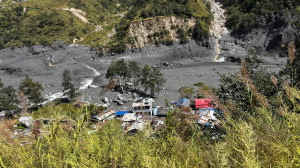
The move follows the collapse of about 70 metres of road into the river after devastating flooding on Sunday. Another 120 metres has developed severe cracks. The highway has been closed for five days, disrupting supplies and travel to the national capital.
The Department of Roads says around 12,000 vehicles normally use the highway section on a daily basis. With the road severed at Krishnabhir, traffic has been diverted to routes linking Hetauda-Naubise and Fisling-Benighat. Officials are examining roads on both sides of the Trishuli river as alternative routes.
Bijaya Jaisi, director general of the Department of Roads, said several options were being considered. “We are working to find a way to operate the road by making arrangements on both sides of Krishnabhir,” he told Kantipur. “A study is also under way on using alternative routes.”
The road collapse has made reopening the original alignment difficult because the Krishnabhir slope is highly prone to landslides. Engineers say repairs from the riverbank would be difficult during the monsoon.
The Infrastructure Development Ministry has approved immediate and long-term measures. Infrastructure Development Minister Sunil Lamsal said structures would be built above the gabion breast wall on the hillside so vehicles could use the new route as soon as possible.
“The work will also include installing sacrificial gabion boxes and dropping boulders down the hillside,” Lamsal wrote on social media.
For a lasting solution, the ministry has asked the Department of Roads to study a tunnel, soil nailing, sheet piling or a bypass road. An alternative road arrangement is targeted by the end of the current fiscal year. The Nepal Geotechnical Society will provide expert services.
Experts caution that the scale and cause of the damage need to be established before a permanent design is chosen. Naresh Man Shakya, a former joint secretary at the infrastructure ministry, said a technical team was still assessing the site.
“We have sent a team and a study is under way,” said Shakya. “It is not yet clear how serious the damage is or how it can be repaired. It appears that the road collapsed after powerful floodwaters laden with water and gravel slammed the Krishnabhir base.”
The location has a long record of instability. A major slide in 2000 blocked the highway for 11 days. Authorities later carried out bioengineering and support-wall works in 2007.
The problem kept coming back. The Department of Roads reported last year that water had caused the road to sag and sink. The collapsed section sat on a fragile hillside whose base was steadily eaten away by the Trishuli river. Engineers were working to stabilise it with micro-piling, horizontal anchors and improved drainage.
Police officials said the damage is not confined to Krishnabhir. Senior Superintendent of Police Ramesh Thapa, who has been deployed to the Prithvi Highway area from Police Headquarters, said three locations along the Naubise-Mugling section had suffered major damage. About 700 metres towards Naubise from Nagdhunga, another section of the highway has also subsided.
“The road at Krishnabhir is completely closed,” said Thapa. “The road has also been washed away around Parewatar and Shital Bazar in the Malekhu area. Landslides and erosion continue to cause damage at several other places.”
The disruption is raising concern about Kathmandu’s supply chain. Food, vegetables, milk, medicines, cooking gas and fuel normally enter the capital through the Prithvi Highway.
The closure has also pushed more traffic onto the Hetauda-Kathmandu routes. Authorities have divided traffic between the Tribhuvan Highway and Kanti Lokpath to reduce congestion and manage the limits of alternative roads.
Vehicles with fewer than 14 seats capacity from Hetauda towards Kathmandu are being sent through the Bhimphedi-Kulekhani-Sisneri-Dakshinkali route. Vehicles travelling from Kathmandu to Hetauda are using the Pharping-Phakhel-Kulekhani-Bhimphhedi route.
Large passenger buses and freight vehicles heading to Kathmandu are being directed through the Tribhuvan Highway, while smaller passenger buses and empty vehicles returning to Hetauda use Kanti Lokpath. The Tribhuvan Highway is narrow and winding, so vehicles with more than 10 wheels are barred from using it.




 21.66°C Kathmandu