The priest leading his people from grief to acceptance
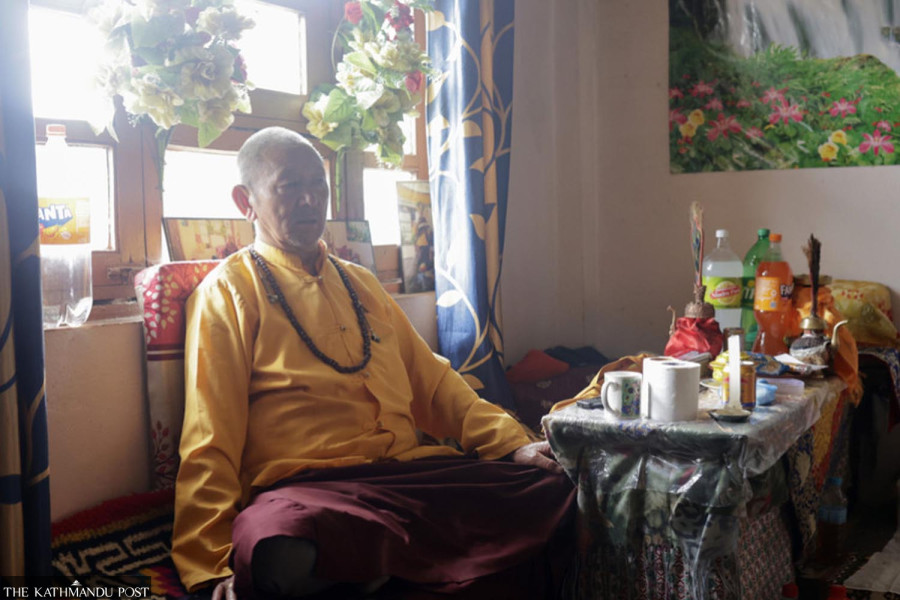
In a Rasuwa village, grieving families have begun performing Buddhist funeral rites without waiting for bodies, following the lead of chief priest Singi Lama, who lost his son and daughters-in-law in the disaster. Singi Nurpu Lama in the hall of his house at the edge of Thulo Bharkhu, in Dhuche, Rasuwa. Hemanta Shrestha/TKP
In the entirety of Rasuwa’s Thulo Bharkhu and Sano Bharkhu settlements, one man appears the calmest. But don’t let his composure fool you. Singi Nurpu Lama, an 83-year-old chief priest, quietly carries the realisation that his son and two daughters-in-law may never come back after they went missing in last week’s floods.
On Wednesday afternoon, Singi was seated in the hall of his house situated at the edge of Thulo Bharkhu. In front of him stood three photo frames of his family members who have gone missing since last week’s devastating floods. The photo frames were draped in white shawls, the colour of grief. Butter lamps and incense burned in front, with food offerings to the missing.
It has been over a week since he last contacted his second-eldest son Thile Wangdi Tamang and daughters-in-law Chungu Tamang and Pratima Lama.
“It was not an easy job to accept that our missing family members are no more,” Singi told Kantipur. “But how long could we wait?”
Rasuwa is among the hardest-hit districts in last week’s floods. While Thulo Bharkhu and Sano Bharkhu lie hundreds of metres above the riverbed, the settlements lost 33 residents—22 in Thulo Bharkhu and 11 in Sano Bharkhu—to the disaster. The residents had travelled to riverside settlements such as Syaphrubesi and Timure to earn a livelihood. Those riverside settlements were wiped out by the cascading disaster.
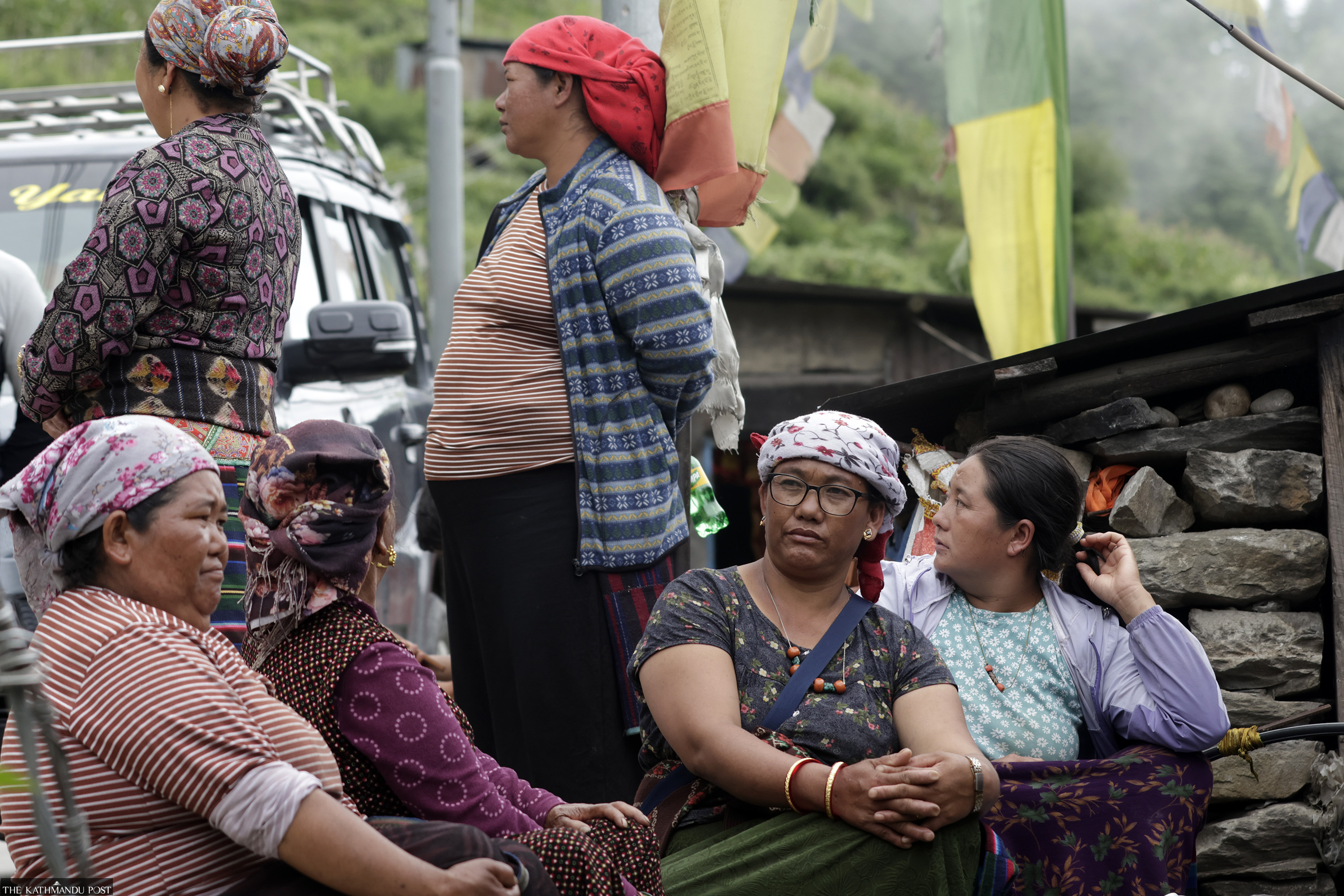
Singi is the chief Buddhist priest of the two settlements. And while he performed the funeral rites of his three family members, he could neither grieve properly nor rest at home. He has had to reach multiple houses in the Bharkhu settlements and offer his services to those who lost their kin to the flood. Buddhist tradition dictates that the funeral rites be held on the seventh day after death.
Mourners attend a death ritual in Thulo Bharkhu, Rasuwa on Wednesday. Hemanta Shrestha/TKP
Singi is performing a duty that his father handed over to him. KD Lama, Singi’s son, says that at least 19 generations of their family have lived in Thulo Bharkhu. Singi’s father was the chief priest of the area and so were his ancestors. Singi’s brother was a member of the parliament during the Panchayat regime, and Singi has received honours from former King Gyanendra Shah during his rule.
Singi took the path of a Lama, the Buddhist priest, from an early age, following in the footsteps of his ancestors. He got into politics for a while, but prioritised his Lama profession and continued to serve the two settlements.
He is beloved in his community as a social worker—helping locals in need and mediating with authorities to bring essential services like drinking water and electricity to the village. Now Singi has found himself in an unlikely role—to lead the whole of the two villages from grief to acceptance. It is Singi who oversees the funeral rites in both the villages.
But it is not easy for Singi to reach every affected house in a day and convince people to accept the bitter truth. So, he has allocated different times for each affected family.
“As per our tradition, we can perform the funeral rites in a week,” KD said. “If it could not be performed this week, it can be performed next week.” In the seventh week, a combined ceremony is organised for all the deceased, “so that their souls can rest in eternal peace,” KD added.
The death toll in the country’s deadliest disaster in a decade keeps on rising. As many as 1,259 have been confirmed dead and 5,083 remain missing as of Thursday evening. But a majority of the recovered bodies are unidentifiable, with families unsure whether to conduct the funeral rites for their missing members.
At such a time, the Bharkhu settlements have taken a difficult path.
As our conversation with Singi approached end, a local man came to the chief priest with a request to oversee the funeral rites at his home. Singi promptly accepted the request.
“It is what it is,” he said as he sprang from his seat, and walked away.
Nayak Paudel covers sports for The Kathmandu Post. He previously worked at the Post (2018–19) and spent over five years at The Rising Nepal. His reporting spans crime, health, education, and social issues.




 15.31°C Kathmandu