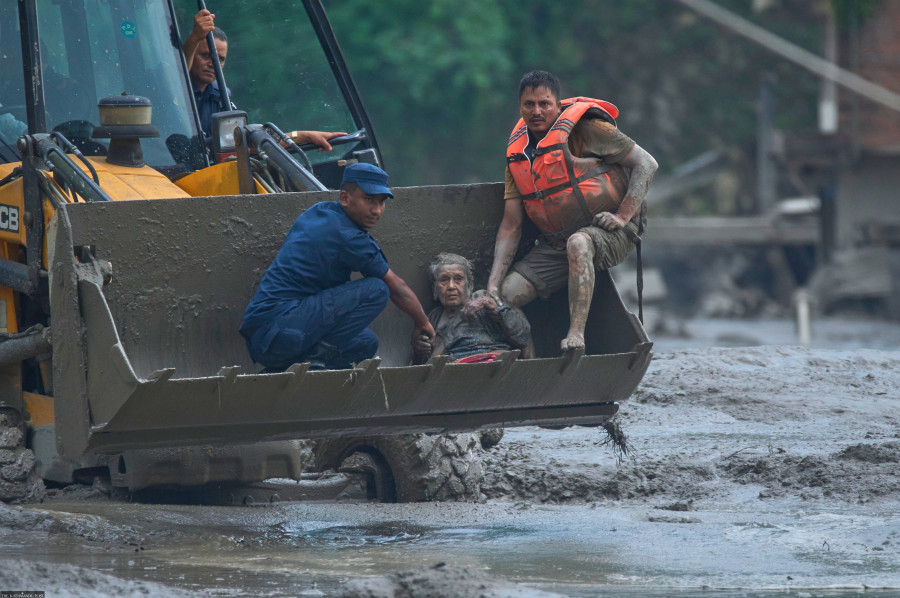
Guna Maya Bohara was rescued from an elderly care home where she had lived for more than a decade. But her survival was only the latest chapter in a life marked by loss, resilience and a family she built around herself. Security personnel rescuing 97-year-old Guna Maya Bohara (centre) from an elderly care home in Devighat, Nuwakot. Post Photo
Guna Maya Bohara sometimes sings at night. It is the same bhajan—Hare Ram, Hare Krishna—that she used to sing during her stay at the elderly care home and during temple visits. Sometimes after singing, she asks a question: “Why did the water hit me?” The 97-year-old has asked the question more than once.
Apart from that, however, Bohara has mostly stopped speaking. Bohara is currently receiving treatment at Bir Hospital in Kathmandu. Her arms and legs have turned black and blue. She sometimes moves suddenly, almost involuntarily. She lies still for a while. Then another movement breaks the stillness. Doctors have diagnosed her with acute stress disorder.
On the morning of August 26, Bohara was in her room on the ground floor of the elderly care home at Devighat, a riverside town in Nuwakot. She was unaware that a glacier had collapsed high in the Himalayas. The collapse triggered a landslide, sending water and debris thundering down into the Trishuli River. The furious waters reached the ground floor, where Bohara was. It pushed her to the edge of the ground floor and left her there. The current was less intense on this side of the floor, witnesses say. Some of those caught in the current did not survive.
Nepal Police and Nepali Army personnel worked for about four hours to reach her, clearing rubble carefully so as not to injure anyone still buried beneath it. Bohara’s relatives also rushed to the site. They brought a JCB excavator. With it, they worked together to move the debris away, inch by inch — moving, moving, moving, Dipak, Bohara’s great nephew, remembers, until there was space to lift her clear in its bucket.
Last Wednesday’s floods, however, were only the latest of Bohara’s ordeals in her long life.
At 97, Bohara has outlived her husband by 81 years. She was eight when she married him in Nuwakot’s Suryagadhi, at a time when child marriage was common practice. At 83, she chose on her own to move into a nursing home—Senior Citizens Welfare Foundation—in Devighat, close enough that her nieces could visit daily. She liked it there, among people her own age and looked forward to birthdays—her own and other residents—celebrated together.
By her twenties, she had already outlived nearly everyone who shared her blood: her husband, eight years into their marriage; both her parents, four years after that; her only brother, sometime later.
She never had children of her own.
What she had instead was her husband’s family, his three brothers, their wives, and in time their children. She raised thirteen nephews, twelve nieces as her own, sending every one of them to school, packing roasted maize for their lunch. Dipak says her family regards women of her generation as having quietly carried entire households through decades few now remember.
Bohara is the last of her generation left in the family.
Physically, she has proved more resilient than her age might lead one to expect. She has a pre-existing disability in her legs and an injury to her hand, caused by the torrents of water, is still being assessed, a CT scan and an X-ray pending. She survived on fruit juice for the first two days and has since moved to milk and full meals, Dipak said.
Of the people who share Guna Maya Bohara’s blood, none remain. Of the people who call her family, the nephews and nieces she once packed lunches for, there are twenty-five now, and they take turns at her bedside, waiting.
Dipak said that Bohara has not stopped asking, “Why did the water hit me?” He has tried to explain to her—more simply than what actually happened—that a lake, Gosaikunda, had burst far above them. She seems to understand, for a while. But hours later, she asks again: “Why did the water hit me?”
Aarya Chand is a reporter at The Kathmandu Post covering social issues. Before moving to the social beat, Chand was an intern covering culture and lifestyle for the Post.




 13.68°C Kathmandu