PM warns of growing climate risks as scientists flag more glacial disasters
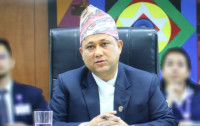
As Nepal reels from the August 26 flood, Chinese scientists warn that warming glaciers could trigger more frequent cascading disasters. Prime Minister Balendra Shah addressing the meeting of the House of Representatives on Wednesday. Photo: Nepal Photo Library
Prime Minister Balendra Shah has urged the international community to recognise the August 26 Bhotekoshi flood as a warning of the growing climate risks confronting the Himalayan region.
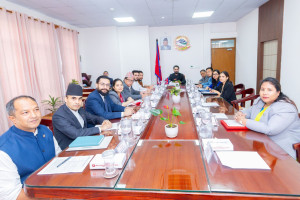
Briefing the House of Representatives on the losses caused by the disaster and the government’s response on Wednesday, he said the moment has come to bring these growing risks more urgently to the attention of the international community.
“Experts have said that the flood in the Bhotekoshi River in Rasuwa was triggered by a massive rockslide in the Himalayan region,” Shah said. “The incident is a serious indication that the risks we face in the Himalayan region are increasing.”
The prime minister said Nepal must tell the international community more forcefully that climate change is driving the disasters and risks it faces.
“Climate change is a global problem,” Shah said. “Mitigating and managing its impacts is a shared responsibility of the international community.”
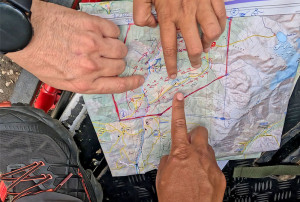
His remarks come amid a massive search-and-rescue operation in the aftermath of the disaster, with scientists and climate experts on both sides of the Nepal-China border still working to determine the disaster’s trigger and whether such events could become more frequent.
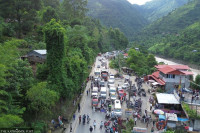
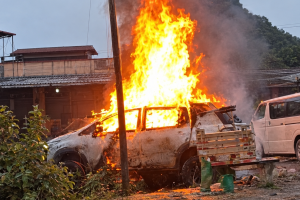
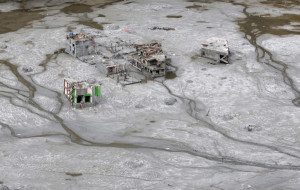
According to the National Disaster Risk Reduction and Management Authority, the flood’s death toll rose to 1,204 as of Wednesday evening, while 4,216 remained out of contact. Around 1.6 million people in Rasuwa and Nuwakot were directly affected by the disaster.
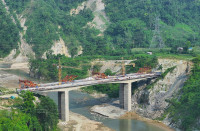
The floods completely swept away 41 concrete bridges and damaged four others. In Nuwakot alone, 1,267 houses were completely damaged and another 1,253 partially damaged.
But beyond the immediate devastation, the disaster has raised a larger question about the increasing instability of the Himalayan cryosphere and the possibility of similar events occurring more frequently as temperatures rise.
According to the National Climate Centre (NCC) of China, glacier-related disasters could indeed become more frequent as global warming weakens glacier stability on the Qinghai-Xizang Plateau.
Gao Rong, deputy director of the Centre, said at a press conference on Wednesday that global warming was accelerating the melting of mountain glaciers worldwide.
“Mountain glaciers in China are concentrated mainly on the Qinghai-Xizang Plateau and surrounding areas. Against a backdrop of a warmer and wetter climate, glaciers across the region are generally undergoing accelerated melting,” Gao said.
He added that the internal structural stability of glaciers on the plateau is expected to decline further. “Glacier-related disasters could become more frequent and trigger cascading effects that amplify the scale of destruction and expand their impact,” he warned.
The warning comes as the global scientific community is increasingly linking the rise in extreme weather events to a warming planet.
The United Nations Environment Programme said on Wednesday that global temperatures are set to cross the 1.5°C threshold, likely within the next few years, pushing climate risks and impacts to increasingly dangerous levels.
Foreign Minister Shisir Khanal has also blamed climate change for the increasing risks faced by Nepal and said the international community must recognise its responsibility towards countries such as Nepal that contribute little to global emissions but face disproportionate consequences.
The government has already approached the Fund for Responding to Loss and Damage for immediate support and compensation for the devastation caused by the August 26 floods.
Manjit Dhakal, an adviser to the Least Developed Countries Group in UN climate negotiations, said the Loss and Damage Fund was established precisely to respond to catastrophic events affecting vulnerable countries.
“As someone involved in the Transitional Committee that helped establish the Fund, I clearly remember our discussions about making it more responsive to the realities and urgency of loss and damage,” Dhakal said.
“The FRLD now has an opportunity to demonstrate what it was created to deliver: timely, accessible and grant-based support when vulnerable countries face catastrophic loss and damage. We sincerely hope no country has to face such a tragedy. But today, Nepal needs solidarity translated into action,” he added.
Anil Giri is a Chief Sub Editor covering diplomacy, international relations and national politics for The Kathmandu Post. Giri has been working as a journalist for more than two decades, contributing to numerous national and international media outlets.




 16.98°C Kathmandu