Flood death toll continues to rise as Nepal reels from one of its worst disasters in years
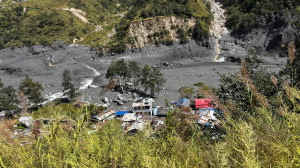
An avalanche on the Chinese side of the border triggered a wall of water with no warning, sweeping through trekking routes and towns along the Bhotekoshi river. Based on the scale of those unaccounted for, security officials and disaster experts say Wednesday’s flood may rank among the deadliest in Nepal’s modern history. Angad Dhakal/TKP
A mid-morning flash flood on the Bhotekoshi river wreaked havoc across three districts on Wednesday, killing scores of people, leaving hundreds, including security personnel and foreign tourists, missing, and sweeping away private and public property in one of the country’s worst disasters in recent years.
The flood was caused after an avalanche blocked the flow of the Lhende tributary of the Bhotekoshi and first hit Timure, near Nepal’s border with China at Rasuwagadhi. Much of the settlement, home to hundreds of people, was swept away before the flood surged downstream. With no rainfall reported in the area, residents had no warning of the disaster and were going about their daily routines when the flood struck.
Rajendra Dhungana, chief customs officer in Rasuwa, said he first thought an earthquake had occurred when he felt the ground shake on Wednesday morning. When he ran outside, he saw a wall of water, trailing what looked like a plume of smoke, crashing down from upstream, bearing down on the Timure bazaar.
“It was the flood, rising like a wave nearly 100 metres high and sweeping through the market,” Dhungana told the Post. “Within moments, the market was gone.”
As the scale of the disaster became apparent, Dhungana and dozens of others fled into the nearby forest. More than 300 vehicles and trucks waiting at the customs checkpoint were washed away.
As the flood moved towards Syaphrubesi and downstream, it devoured almost everything in its path along the river, including people, animals, buildings and public infrastructure. A statement from the Prime Minister’s Office shows hundreds of individuals, including 391 foreigners and 44 security personnel, have gone missing.
The automatic flood-monitoring stations installed in the upper reaches of the Bhotekoshi river were also swept away by the flood. Post Photo
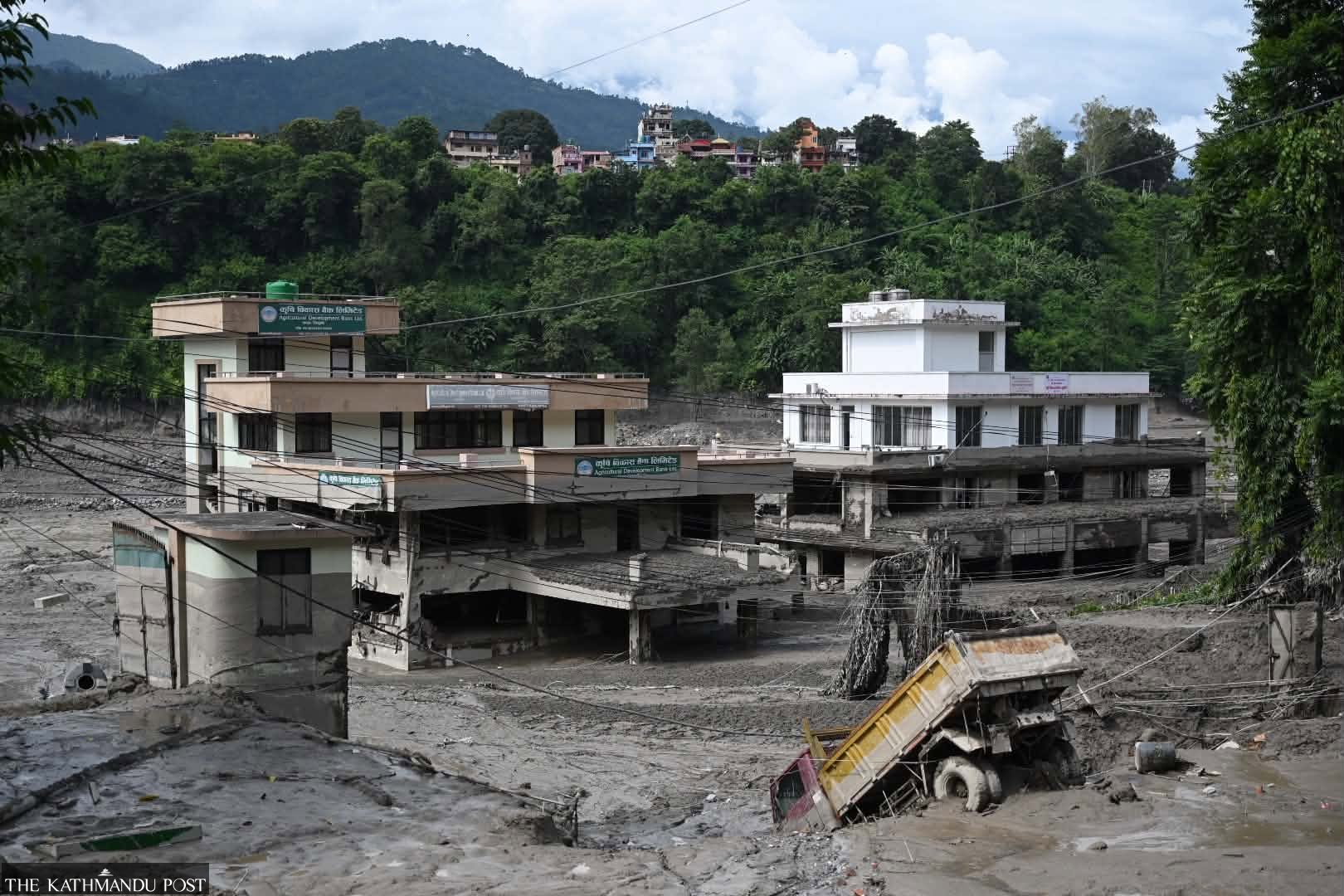
Wednesday’s floods have destroyed nine hydropower projects and an equal number of branches of commercial banks. A preliminary report shows 19 motorable bridges and 40 kilometres of highway have been swept away in the flood, with no accounts of the private and public properties so far.
Based on the scale of those unaccounted for, security officials and disaster experts say Wednesday’s flood may rank among the deadliest in Nepal’s modern history—potentially surpassing every disaster since the 1993 floods in Sarlahi, Rautahat and Makawanpur, which killed 1,400 people and have long stood as the country’s benchmark disaster.
Ravindra Nepal, ward 7 chair of Bidur Municipality in Nuwakot, said the flood wiped out hundreds of houses from Sole to Akkare Bazaar. He said some people managed to escape to safety, but many elderly people and children remain unaccounted for.
“I have been stranded at the municipal building since early morning,” he said. “There is no road or bridge left to get home.”
Gokarna Adhikari, a resident of Dandathok Tupche in Bidur Municipality-7, said nothing was left in his village. Most of the people he knew were still unaccounted for. Only a few houses in Karmetar, between Sole and Akkare Bazaar, remain standing, he added. “Even the houses that look intact from a distance are completely covered in mud and debris.”
A flood struck the same river last year and the destroyed areas had yet to return to normal. Last year’s flood in the Lhende river on July 8 had killed at least 11 people while washing away sections of the road at several places along this stretch. It had swept away the Miteri Bridge connecting Nepal and China.
Authorities say a lack of proper information about the flash flood caused the huge loss of life and property. Officials at the Rasuwa District Administration Office say they had no clue about the flood that originated in Tibet.
The incident has raised a fundamental question: Should downstream communities be warned only after a major flood has entered Nepal’s rivers, or should there be a mechanism to receive information as soon as an incident occurs in the vulnerable Himalayan region? The problem is not limited to information sharing between Nepal and China. Even equipment installed by Nepal on its own territory appears to have failed to send warnings before the flood struck.
Anil Pokhrel, former executive chief of the National Disaster Risk Reduction and Management Authority, said similar problems had occurred in the past when floods originated on the Chinese side but the issue was not taken seriously enough. “We still don’t know how much risk remains,” he told Kantipur. “Unless the Foreign Ministry of Nepal coordinates with the relevant Chinese authorities and creates a system through which early warnings reach our disaster management authority, this problem will continue.”
Pokhrel added: “The government needs to think about whether it will remain limited to relief and rescue after a disaster occurs, or work to prevent such disasters from causing loss of life in the first place.”
Experts have said the sudden, massive flood was triggered after an avalanche blocked the Lhende river. The National Disaster Risk Reduction and Management Authority has also said a preliminary assessment points to an avalanche in the Nepal-China border area.
After analysing satellite images from Planet Labs, the authority said a debris-laden flood in the Lhende river appears to have been triggered by an avalanche about 20 kilometres northeast of the Rasuwagadhi border crossing, in Tibet. Satellite images from August 25 and 26 show the avalanche and the resulting flooding in the Lhende river.
Following the damage caused by the flood, officials from Nepal’s Department of Hydrology and Meteorology and the China Meteorological Administration held a virtual meeting on Wednesday afternoon. China subsequently agreed to inform Nepal as soon as water flows begin to rise on its side of the border.
Nepal and China do have an agreement on cooperation in disaster risk reduction and emergency response. During then-foreign minister Pradeep Gyawali’s visit to China in 2019, the two countries signed a memorandum of understanding on cooperation in disaster risk reduction and emergency response. The agreement, signed between Nepal’s Ministry of Home Affairs and China’s Ministry of Emergency Management, was intended to provide a basis for cooperation on natural-disaster risks.
At a 2022 discussion on transboundary disaster risk reduction organised by the International Centre for Integrated Mountain Development (ICIMOD), Pokhrel, who was then chief executive of Nepal’s disaster management authority, described the agreement as an important foundation for Nepal-China cooperation. According to him, the 2019 agreement provided for cooperation in nine areas, including establishing an information-sharing platform, setting up training centres, monitoring natural hazards, implementing disaster-risk-reduction projects and exchanging experience among government agencies.
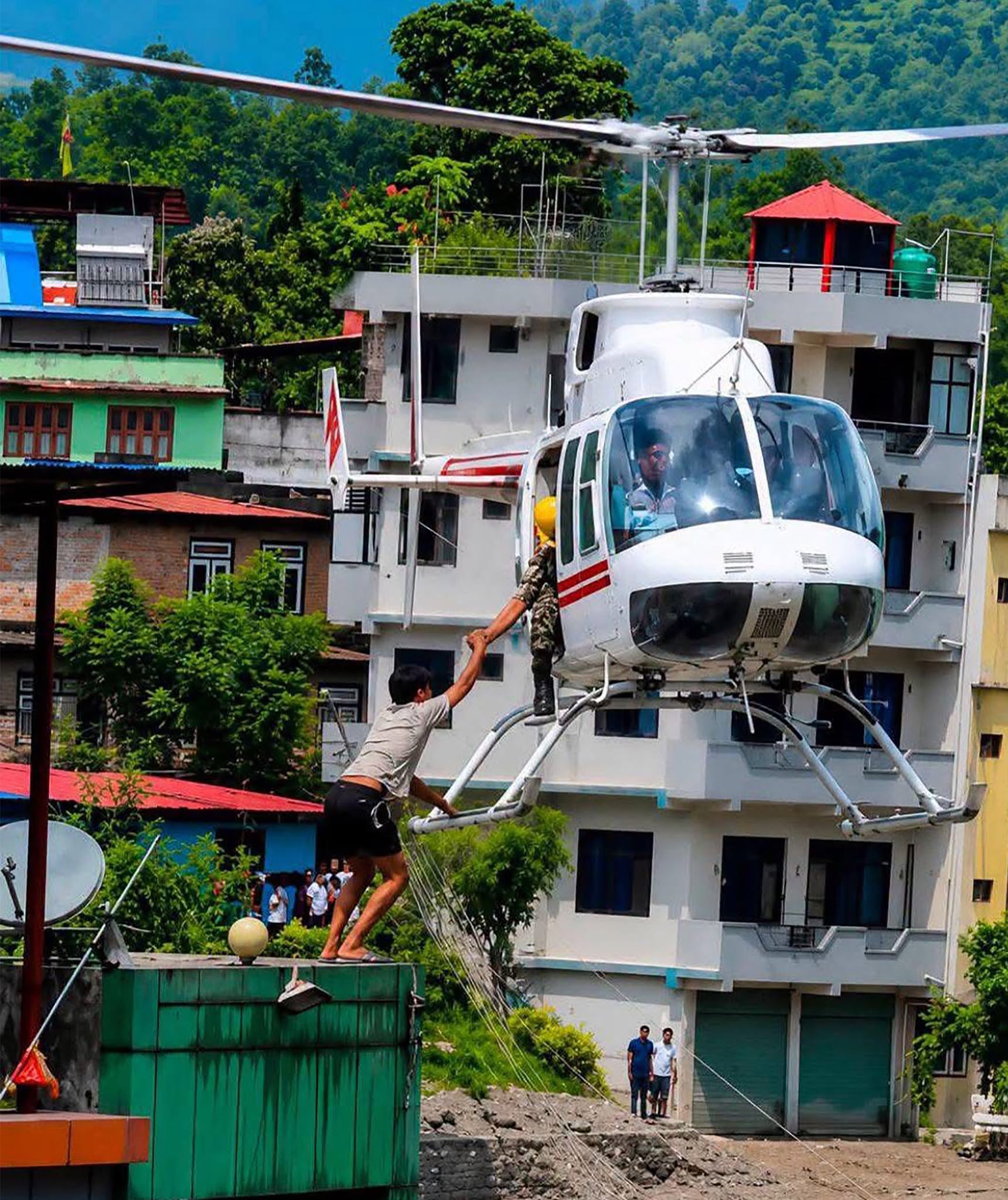
The Flood Forecasting Division says the warning sent to downstream areas helped many people reach safety. Photo: Courtesy of Nepali Army
Wednesday’s disaster, however, exposed the gap between having an agreement on paper and having an effective mechanism to implement it.
According to Binod Parajuli, a senior divisional hydrologist at the Flood Forecasting Division, information about the flood reached the division at 8:56 am on Wednesday. He said the information was relayed through the Rasuwa District Administration Office and the National Disaster Risk Reduction and Management Authority.
The division sent a warning to downstream areas within four minutes of receiving the information. But by then, the flood had already reached large parts of Rasuwa.
The automatic flood-monitoring stations installed in the upper reaches of the Bhotekoshi river were also swept away by the flood, he said. Normally, the stations automatically send alerts when river levels begin to rise. But the flood came so suddenly and with such force that the stations themselves were swept away before they could transmit a warning.
“None of the stations was able to send us an alert,” he said.
In other words, even equipment installed by Nepal on its own territory failed to provide a warning before the flood struck. The equipment and administrative mechanisms in Nepal could only become active after the flood had already entered the country.
The Flood Forecasting Division says the warning sent to downstream areas helped many people reach safety. Although the warning did not reach people in Rasuwa in time, Parajuli said alerts sent to Nuwakot and other downstream areas may have saved hundreds of lives.
“We failed in Rasuwa,” he said. “But we sent warnings to Nuwakot and downstream areas, and possibly several hundred people were able to save their lives.”
Parajuli said vulnerable Himalayan areas need real-time sensors, cameras and monitoring systems capable of detecting such events. But when the source of the risk lies across the border, a warning system built by Nepal alone is unlikely to be sufficient.
“The first thing is to detect an event through sensors and share that information across borders,” he said. “If we can install sensors extensively in the mountains and receive information as soon as an event occurs, we can give people downstream enough time to move to safety.”
Even as officials claimed messages had been sent to the downstream areas, it didn’t seem to work properly, leaving people in Uttargaya Rural Municipality vulnerable to the disaster. Somlal Dangol, a teacher at Uttargaya Public School, said even a school bus that had gone to pick up students after the flood struck has gone missing. Dangol added that the markets at Betrawati and Sole were completely swept away.
“The destruction is immense,” he said. “We cannot even begin to comprehend what has happened.”




 25.75°C Kathmandu