Lawmakers seek national plan to tackle rising crop losses from wildlife
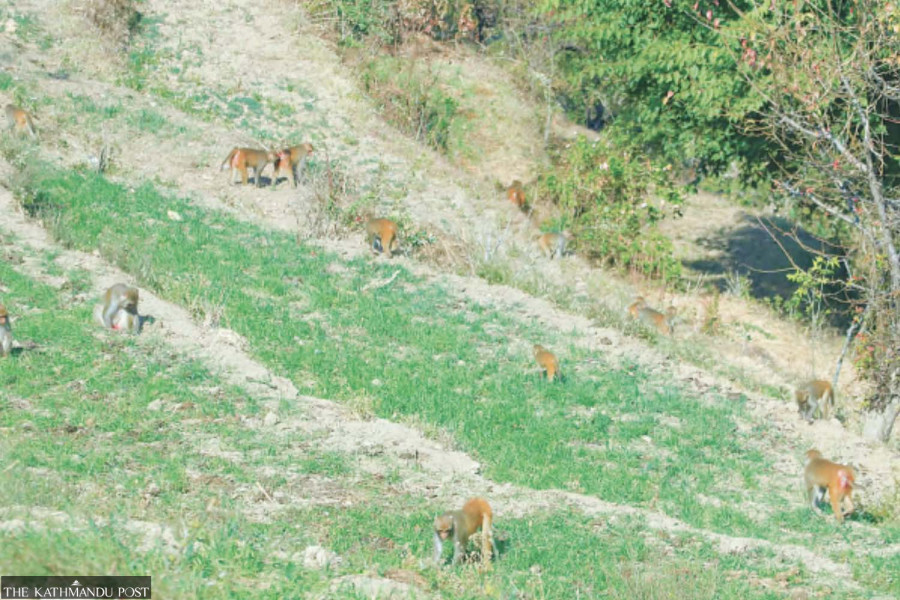
Motion calls for clear responsibilities, funding and deadlines as monkeys, wild boars and other animals increasingly threaten farm production and rural livelihoods. Monkeys nibble and pick at plants on a terraced field in Dasharathchand Municipality in far-western Baitadi district in this undated file photo. Post file photo
As crop losses caused by monkeys and wild boars continue to rise, lawmakers have filed a motion of urgent public importance in the House of Representatives, calling for a comprehensive national action plan to tackle the problem in the long term.
The motion was registered on Monday with Nepali Congress lawmaker Narendra Kumar Kerung as the proposer. It is backed by CPN-UML whip Nita Ghatani, Nepali Communist Party lawmaker Parbati BK and Shram Sanskriti Party lawmaker Aren Rai.
The motion says damage caused by monkeys and wild boars is hurting farmers’ production, incomes, food security and rural livelihoods. The problem, it argues, can no longer be treated simply as a case of human-wildlife conflict.
Kerung said the government should draw up a national action plan with clear deadlines, adequate funding and clearly defined responsibilities for the federal, provincial and local governments to manage monkey and wild boar populations.
The motion cites a study conducted with technical support from the National Trust for Nature Conservation and the Central Department of Zoology at Tribhuvan University, which found that damage caused by monkeys had reached serious levels.
According to the study, researchers directly counted 20,395 rhesus macaques in 44 local unit areas identified as the worst affected. The study estimated that at least 104,137 monkeys live across Nepal’s mid-hill region. Some troops were found to contain as many as 198 monkeys.
The motion says crop damage caused by monkeys, wild boars and porcupines is particularly severe in Bagmati, Gandaki and Sudurpaschim provinces. Farmers in Koshi have been affected mainly by monkeys and elephants, while communities in several districts of Lumbini and Madhesh have struggled with damage caused by monkeys and nilgai, or blue bulls.
The scale of losses varies across provinces but is alarming, according to Kerung. In Gandaki, monkeys and other wildlife are estimated to destroy up to 90 percent of maize crops.
The motion also calls on the government to present the House with a consolidated account of decisions taken, studies conducted, money spent, programmes implemented and results achieved following a parliamentary discussion on the issue in February 2025.
It further proposes that progress on the national action plan be submitted to the relevant parliamentary committee every three months.
Human-wildlife conflict, the motion says, should not be treated as a problem affecting only a particular village or local units, or as an issue to be addressed by either the ruling or opposition parties. It should instead be recognised and tackled as a national social, economic and political problem.
The motion identifies the Ministry of Agriculture, Forestry and Environment; Ministry of Finance; Ministry of Home Affairs; Ministry of Land Management, Co-operatives, Federal Affairs and General Administration; Department of National Parks and Wildlife Conservation; and Department of Forests and Soil Conservation as the agencies responsible for addressing the problem.




 21.27°C Kathmandu