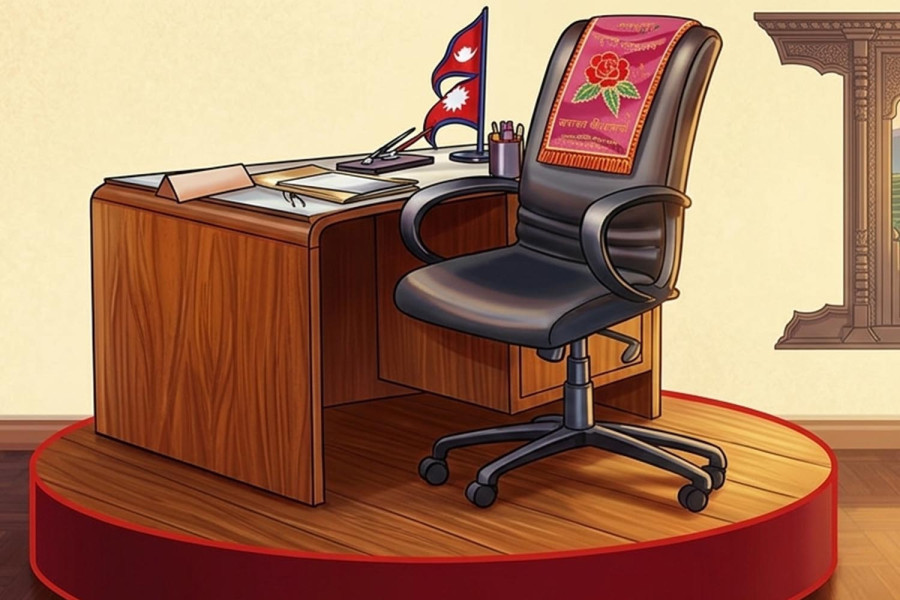
Proposal to streamline federal structure by reducing ministries from 21 to 17 aims to cut administrative costs, improve efficiency, and reshape governance.
Nepal’s federal government is preparing to reduce the number of ministries from 21 to 17, following a recommendation by a committee formed by the prime minister.
Officials at the Prime Minister’s Office said the government is moving ahead with the proposal, which involves scrapping four ministries as part of a broader administrative restructuring. Economists estimate the move could save the state between Rs160 billion and Rs200 billion annually.
The expansion of Cabinets in past governments—often driven by coalition politics and the need to accommodate multiple parties—has long drawn criticism for inflating administrative costs and weakening efficiency.
According to the committee, some ministries will be merged, others restructured, and a few renamed. The proposal aligns with commitments made by the Rastriya Swatantra Party ahead of the March 5 elections, which pledged to streamline the federal structure.
The five-member panel, formed on March 31, was led by Govinda Bahadur Karki, secretary at the Office of the Prime Minister and Council of Ministers. Members included joint secretaries from the Ministry of Finance and the Ministry of Federal Affairs and General Administration, along with legal and administrative officials from the Prime Minister’s Office.
The committee said reducing the number of ministries would enhance transparency, improve efficiency, and lower the financial burden on the state. The report will be endorsed by the Cabinet before implementation.
Nepal’s constitution allows for a maximum of 25 ministers, including the prime minister, under Article 76(9). However, successive governments have frequently formed oversized Cabinets.
In November 2015, a government led by KP Sharma Oli formed a 27-member Cabinet, including six deputy prime ministers. In August 2017, Sher Bahadur Deuba set a record with a 50-member Cabinet. Earlier, Baburam Bhattarai had formed a 49-member Cabinet after the country became a republic.
Economist Dilli Raj Khanal said cutting ministries could significantly reduce state expenditure. “If we estimate Rs40 billion per ministry, removing four could save around Rs160 billion annually,” he said, noting that costs tied to departments, staff, vehicles, and operations would also decline.
Khanal, who previously led the Public Expenditure Review Commission, said the panel had recommended limiting ministries to 16. “Fewer ministries would improve service delivery, reduce corruption, and free up billions for development spending,” he said, adding that unnecessary departments should also be scrapped to avoid duplication across federal, provincial, and local levels.
He suggested excess staff could be reassigned to provincial or local governments or offered voluntary retirement if required.
“Improving efficiency and reducing expenditure should go hand in hand,” Khanal said. “In the current budget alone, over Rs111 billion has been allocated to various funds and agencies under ministries. At least Rs150 billion could be saved even within recurrent spending.”
A separate high-level administrative reform committee led by Kashi Raj Dahal in 2019 had recommended limiting federal ministries to 15. Dahal said the current move was a positive step.
“Our recommendation was to keep no more than 15 ministries at the federal level and up to seven at the provincial level,” he said. “As Nepal transitions to federalism, the structure should reflect decentralisation rather than a centralised model.”
Dahal said reducing ministries would cut administrative costs and speed up decision-making. “There is no need to maintain redundant structures. Fewer ministries can function more effectively and transparently,” he said.
He added that in an increasingly digital era, the traditional bureaucratic chain—from departments to divisions and subdivisions—has become less relevant. “With many processes now handled digitally, eliminating unnecessary layers and ministries is a logical step,” he said.




 23.25°C Kathmandu