Vacant stares of children search for missing friends after settlement demolitions
Children scattered after eviction struggle with loss, uncertainty, and an abrupt break from school and friends. A child standing at the debris of her demolished house.
In Gairigaon’s displaced settlement on Wednesday afternoon, the sound of children’s singing cut through the light rain.
“Jhyappai aye Balen Dai dozer liyera…” (Balen Dai stormed in with his bulldozer… )
This folk-parody depicting then Kathmandu mayor Balendra Shah’s determination to free the riverbanks of squatter settlements by hook or by crook was sung to portray the prime ministerial candidate Balendra Shah as being against the squatters.
A small group of boys stood near the debris of their homes, rendering the song that quickly spread among children in the area after the demolitions.
They stopped when they noticed reporters standing nearby. The sudden silence seemed to quiet the rain itself.
When asked to continue, the boys hesitated. They looked at each other, unsure of who should speak. “We don’t know the rest. He knows it,” one of them said, pointing towards another boy standing slightly apart. Before he could respond, he quietly stepped away. Within moments, the group dispersed, amidst the piles of broken brick, twisted tin sheets, and scattered belongings.
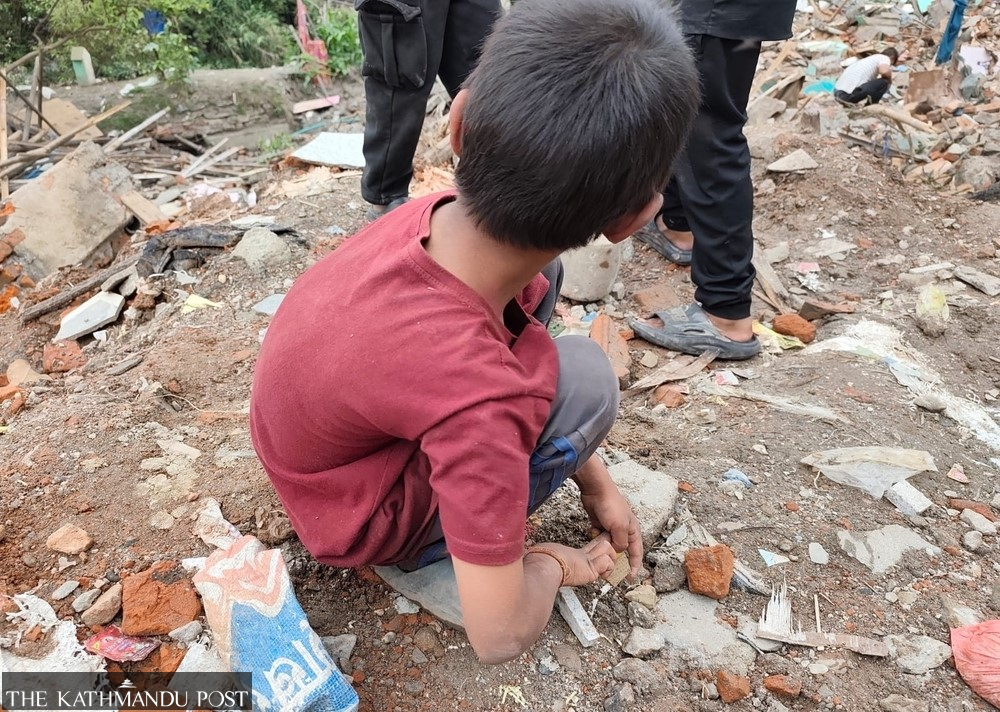
On Thursday, one of those boys, Dev Gurung, was found again in the same spot. Not playing this time. Instead, he was sitting on a broken slab of concrete, carefully cutting iron rods from the ruins of what used to be his home. His friend Bishal Darnal was beside him, doing the same.
To the question, “Why are you cutting that iron?”, they replied without looking up. “If we sell it, we make some money.”
Their tone bore no shock.
Around them, the remnants of homes lay exposed to the rain. Walls had collapsed into uneven piles, and personal belongings were mixed with debris. Adults in the background were doing similar work, pulling out metal sheets and reusable items, trying to salvage whatever they could.
Dev and Bishal soaked in the rain as they carried on with their business. Their focus was on a metal piece in front of them.
When asked about the song from the previous day, Dev paused before saying gently, “Ritesh taught us that. But he is not here anymore. I don’t know where he went.”
In the background, other children moved, calling out names and searching through the debris.
Last Saturday, bulldozers escorted by police entered the settlement. What followed was a rapid demolition that left little time for families to gather their belongings. Homes that had stood there for years were brought down in a matter of hours. Schoolbooks, notebooks, clothes, and household items were buried under concrete and dust.
The children said they heard adults repeatedly mention one name during the chaos. “Balen did all this,” they recalled hearing, referring to the prime minister, who has been in office for slightly over a month following the March 5 parliamentary election.
During the campaign, Dev and Bishal had found their parents highly supportive of the rapper-turned-politician. “Balen will build this country,” they would say. Now their hope feels shaken.
Unable to fathom the goings-on, the children wonder aloud: “If he is building the country, why did he destroy our house?”
For Dev, the demolition meant more than the loss of shelter. It meant the disappearance of friends he had grown up with in the same narrow lanes and shared courtyards.
“I want to see them, but they have just disappeared,” he said in a tone beaten down.
He should have already started Grade 3, having completed Grade 2 last month. This academic year, there is no classroom, no routine, and no certainty of where he will study.
“We are staying over there,” he said, pointing towards a small structure made of corrugated zinc sheets and tarpaulin. “We cannot sleep properly there. We do not get enough food.”
The makeshift shelter sways in the wind. Inside, space is tight, with little protection from rain or cold. Families now share a small patch of land never meant for long-term living.
Twelve-year-old Bishal Darnal, who studies in Grade 5, is also unsure of his next school. He previously attended Navadurga Secondary Boarding School. After the demolition, everything changed.
“I don’t know where it is now,” he said while continuing to saw iron rods. “I looked for my stationery after our home was struck. I could not find anything.”
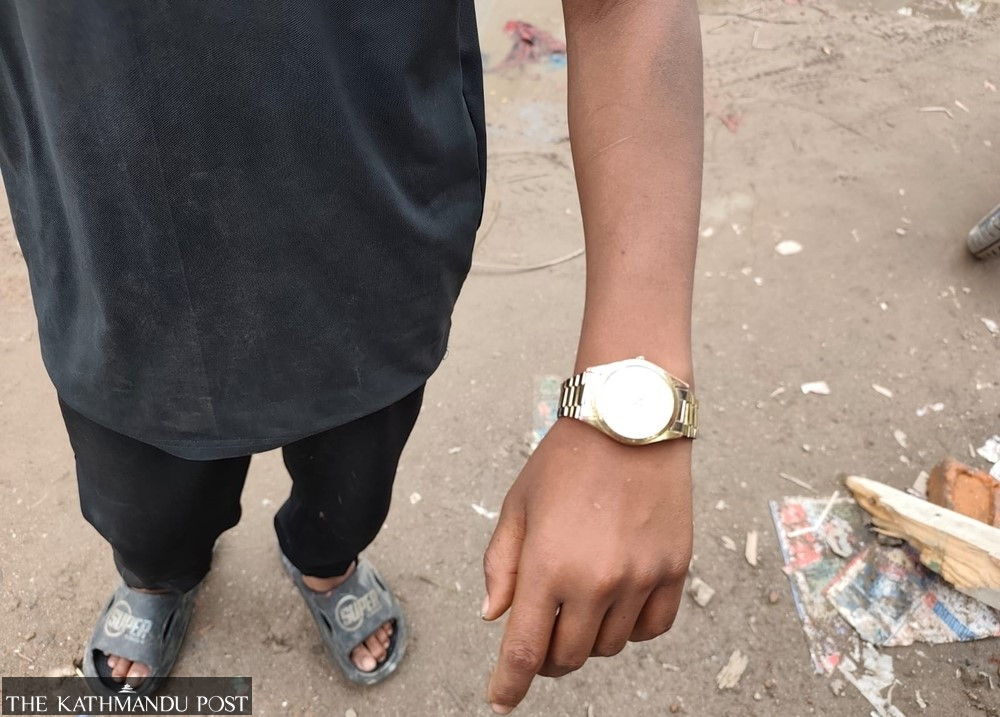
In another part of the settlement, 12-year-old Saurabh Pariyar walked slowly through damp ground wearing a vest. On his wrist was a yellow watch, a parting gift he got from his friend, Sijan, on the day of destruction.
They were playing when a loudspeaker echoed through the settlement. At first, many did not believe what they heard as a warning to clear up belongings. Soon, uncertainty lapsed into fear. Parents began gathering children, looking towards their homes with deepening concern.
“They are going to demolish it after all. There is nothing we can do,” Saurabh recalled his parents saying that day.
Before the bulldozers arrived, the children gathered one last time. Sijan fastened the yellow watch onto Saurabh’s wrist.
“We won’t be together anymore. If you miss me, just look at this,” Sijan told him.
Saurabh, overwhelmed, removed his cap and placed it on Sijan’s head. “You, too, keep this,” he said.
Others joined in exchanging small belongings. One friend handed over Pokémon cards. Another gave marbles. Someone else passed a volleyball, which Saurabh later left for his nephew. Pratik, standing nearby, said in a suppressed voice: “A friend gave me a gold medal.”
Saurabh does not know about any of those neighbouring children’s whereabouts. The settlement that once bound them together has been reduced to rubble, and their paths no longer cross.
“When I look at this watch, I remember Sijan. I keep looking outside, hoping he will come back,” he said.
Now in Grade 4, Saurabh too is unsure of when or where he will return to school. The idea of rejoining classmates feels distant.
The demolition remains unforgettable. “I saw my mother and sisters crying while the house was torn down. That hurt me more than anything,” he said.
Two days after the demolition, the family found a single room to rent nearby. But it was too small to hold everything so they sold many belongings, keeping only the bare essentials.
One of the most painful losses was his bicycle.
“My father promised to buy me a bicycle if I passed my exams. He bought me one last year when I indeed passed them,” he said.
Saurabh’s father works on thanka in Bouddha, Kathmandu. While accompanying his father, Saurabh has also developed an interest in the traditional art of elaborate Buddha paintings.
“I like operating the machine and sewing the thanka canvas,” he said.
Nine-year-old Bishwanath sits across Guheshwari School, watching children play inside the compound. He was once among them.
“I reached Grade 5, but I have not been enrolled again,” he said. “We cannot find a room [to live] and there is tension in the family.”
Nearby, his father gathers bricks from the rubble. “There is no money and no work,” Bishwanath added.
The family lost almost everything to the demolition, including toys bought by his grandmother.
They now live under tarpaulin sheets that fail to keep out rain. “Yesterday, a chair was blown away by the wind,” he said.
On Thursday, he ate leftover rice with pickles. “If my father sells bricks, I might get 50 rupees. I will buy something to eat,” he said.
The family briefly stayed in a guest house after registering at Dasharath Stadium, but returned to the ruins fearing theft of their remaining belongings. “I don’t know where we go from here,” Bishwanath said.
Twelve-year-old Dipisha spends her days moving through broken structures, collecting whatever may be reused. She now stays with relatives in Duwakot, Bhaktapur.
“I studied at Bhimsengola. I don’t know where I will go next,” she said.
Her mother died of cancer a year ago. Since then, Dipisha has become fearful of illness, worrying that even a simple cold might be something serious.
“I like helping my father with iron work,” she said.
Her friends are scattered. “One friend came yesterday. She said she will visit again,” Dipisha said.
On demolition day, she slept elsewhere. The next day, she returned briefly. “I will leave tomorrow, but I will miss this place,” she said mournfully.
Pratik Tamang’s mother says her son has changed since the demolition.
“He keeps talking about Balen. I don’t know how to explain it to him,” she said.
Pratik should be in Grade 4 at Loyola Secondary School, but his education is uncertain. Fees were unpaid, and results remain uncollected.
Teachers continue calling, but there is no fixed address. Pratik often searches for his friend Royal. “He keeps hoping he will return,” his mother said.
Life inside holding centres
Many displaced families from Thapathali, Sinamangal, and Manohara squatter settlements have been shifted to the Radha Swami Satsang Centre in Kirtipur, now functioning as a holding site for the squatters. Conditions there remain difficult for both children and adults.
Twelve-year-old Meshak Limbu sat alone near a tent before running away shyly when approached.
“It is his birthday today,” his mother said. “I could not even cut a cake.”
Meshak later returned holding a cricket bat. “It used to be fun at home. Now it is just sad,” he said.
He dreams of becoming a cricketer. “I made this bat myself,” he added.
Fourteen-year-old Anita Lama, staying in a hotel near Gongabu’s New Bus Park, described the moment her home collapsed in Thapathali.
“People were screaming. The house fell in front of us,” she said. “I only think about how I will go back to school.”
Other children from nearby settlements are now scattered across shelters and rented rooms. Many keep asking the same question: where will we go to school again?
Some families say they are still sleeping in garages or temporary rooms, moving frequently while searching for a stable place.
Despite the disruption, families say structured support for children has been limited.
Officials at the Ministry of Women, Children and Senior Citizens say local government agencies are responsible for education, while federal agencies provide support in special cases.
“We are providing psychosocial counselling through the National Child Rights Council and assessing needs,” Chakra Bahadur Budha, spokesperson for the ministry, said. “We are collecting information through government channels and media reports.”
But families on the ground say assistance has yet to reach many children.
Psychosocial counsellor Ram Pukar Sah warns that prolonged uncertainty can have lasting effects on children’s mental health.
He said basic needs such as food, shelter, schooling, and routine are critical. “Returning children to school should be the priority. If not, organised activities are necessary so they are not left isolated,” he said.
Without that, he warned, the impact could be greater than the present shock.




 15.76°C Kathmandu