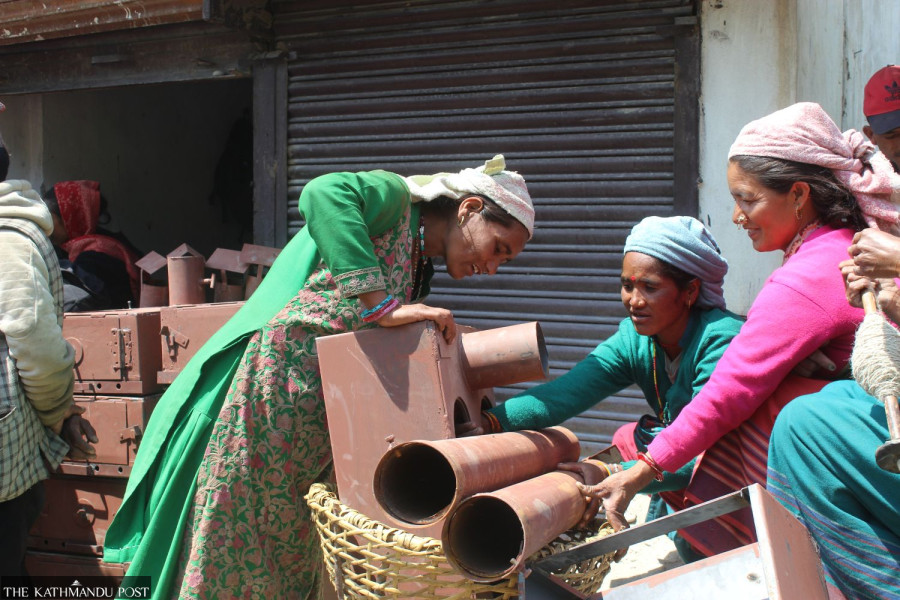
More than 4,000 households in Jumla and Kalikot districts are breathing cleaner air, saving firewood, and spending less time on daily chores. With the arrival of the improved stoves, firewood consumption has gone down, easing the workload of women in remote settlements. DB Budha/TKP
For years, Jayapura Sarki of ward 1 of Tila Rural Municipality in Jumla relied on traditional mud stoves and open fire pits for cooking. Thick smoke filled her kitchen daily, leaving walls blackened and utensils and clothes covered in soot.
That changed after she started using an ‘improved’ (smokeless) iron stove.
“Earlier, the house used to be completely black because of smoke,” she said. “Everything, from pots to clothes, would get dirty. Now the house is bright and clean. The change is clearly visible inside the home.”
She said washing utensils was also difficult earlier due to lack of proper soap, and regular exposure to smoke and dust often caused breathing problems and other illnesses.
“Now that we use the improved stove, the house stays clean and my health issues haven’t flared up,” she added.
In ward 2 of Tila Rural Municipality, Batulli Rawat said the stoves have improved both indoor living conditions and the surrounding environment. Before electricity reached the area, residents used resinous pine wood, locally known as jharo, for lighting. This left heavy soot deposits around the hearth, making cleaning difficult.
“The use of the ‘improved’ stove has removed smoke from the house. We are no longer troubled by dirt,” she said. “Eye infections, blackened faces and breathing problems have reduced.”
She added that firewood consumption has also gone down, easing the workload of women in remote settlements. “Forest pressure has reduced and health problems have also declined. Many things have improved after using this stove,” she said.
Jayapura and Batulli are among thousands of beneficiaries. More than 4,000 households in Jumla and Kalikot are now using smokeless metallic stoves under a climate protection initiative.
Under the programme, stoves are being distributed in Tila and Hima rural municipalities of Jumla, and Mahawai Rural Municipality and Tilagufa Municipality of Kalikot. So far, 2,021 households in Jumla and 2,179 in Kalikot have received the stoves.
According to project data, 2,200 stoves have already been installed and are in use at households, including 256 in Jumla and 1,944 in Kalikot.
The initiative is being implemented by Group of Helping Hands Nepal (SAHAS), a non-profit, in coordination with local governments under a Climate Protection Project funded by TDH (Terre des Hommes) Germany. The project aims to reduce indoor air pollution and improve health conditions of rural women.
The funding structure includes 90 percent contribution from the organisation and 10 percent from communities or local governments.
The project has also engaged 320 farmer groups, 34 youth groups and seven child clubs, involving more than 8,000 members in capacity-building activities linked to agriculture and climate resilience.
Officials said the programme focuses on climate-adaptive technologies, green enterprise development and fruit tree plantation to improve income opportunities. It also promotes women’s and youth empowerment through the use of improved cooking technologies.
Tila Rural Municipality chair Motilal Rokaya said the introduction of improved stoves aims to reduce dependence on forests and cut household greenhouse gas emissions.
He said the technology has brought visible changes in rural settlements. “The use of improved stoves has changed the condition of remote villages,” he said. “The municipality has prioritised the promotion of these stoves.”
In addition to the stoves, 2,500 clean water filters have been distributed so far, including 1,500 in Jumla and 1,000 in Kalikot. The programme aims to distribute 5,500 colloidal silver-based filters in total, covering 3,000 households in Jumla and 2,500 in Kalikot.




 24.91°C Kathmandu