Phewa demolitions, now halted, expose buffer dispute, selective enforcement
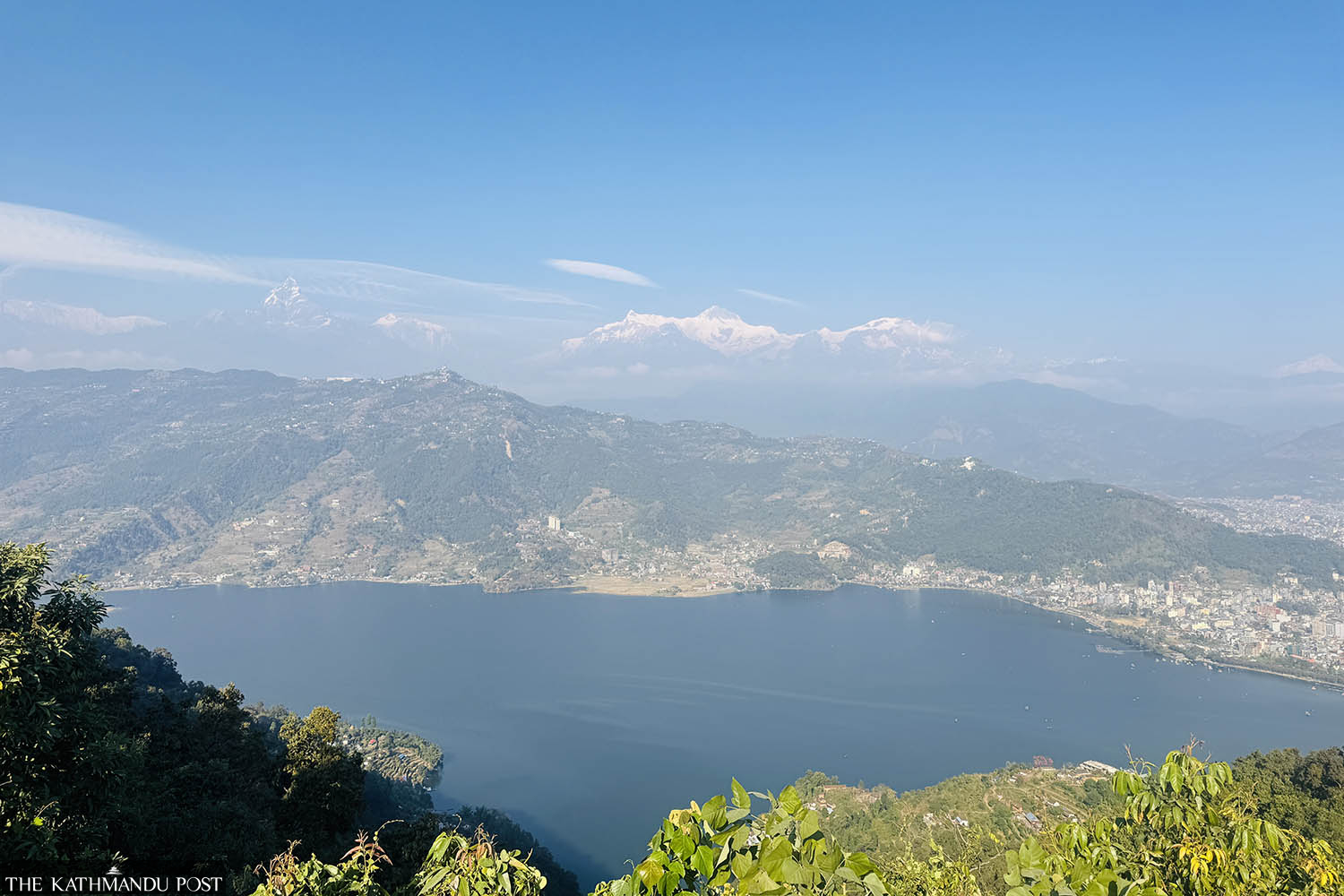
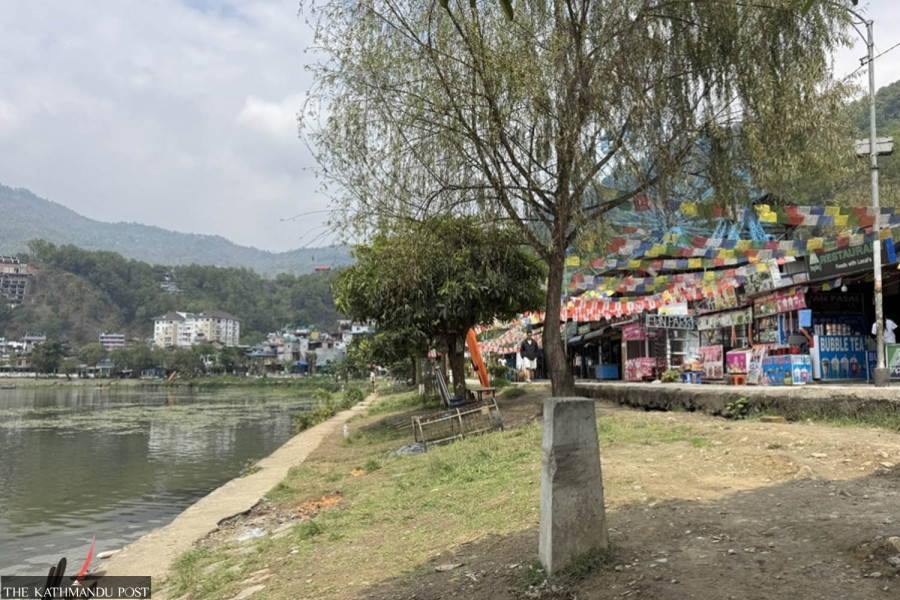
Residents and landowners allege that boundaries are unclear, enforcement is selective, and the 65-metre buffer rule does not have a scientific basis.A foreign tourist is seen walking along the lakeside promenade that runs along the shore of Phewa Lake in this recent photo. Post Photo
Manju Thapa, a resident of Khapaudi in ward 18 of Pokhara Metropolitan City, was jolted awake in the early hours on April 4 by a telephone call. While she was asleep with her two sons, her cell phone rang at 5:15 am, warning her that bulldozers were already descending upon the shores of Phewa Lake to demolish structures. By the time she rushed outside, an excavator was tearing Palm Beach Restaurant, located a stone’s throw from her home.
“When you wake up and see a working bulldozer right in front of you, it feels like a nightmare. The neighbours were still asleep. My husband, our two sons, and I ran out, crying for help, trying to wake up the community,” Thapa said, recalling that Saturday morning.
Until then, Thapa had understood that only structures built within the 65-metre boundary set by the Supreme Court along the lake would be removed—and that compensation would be settled before demolishing properties with legal ownership. Her family had built a house and run a small shop on ancestral land in Khapaudi, located on the north-western side of the lake. Yet even her house was symbolically damaged by a municipal bulldozer.
“There was chaos among workers in hotels and restaurants from Sedi to Khapaudi. Families living in temporary houses, children, the elderly, even the sick—everyone had to get up and run in panic,” said Thapa.
A day after Prime Minister Balendra Shah telephoned Pokhara Metropolitan City Mayor Dhana Raj Acharya to inquire about Phewa Lake conservation, Acharya said that the enforcement of the 65-metre rule would begin by demolishing the metropolis’ own education division building. However, in practice, bulldozers first rolled into private tourist establishments, beginning with the Waterfront Resort in Sedi on April 4.
Amrit BC, manager of the resort, said the sudden operation unsettled foreign guests. “The guests staying overnight were roused from their sleep. After hearing about the demolitions, past visitors from Nepal and abroad who had used our services called us with concern,” said BC.
The demolition drive, launched after concerns from the prime minister and instructions from Home Minister Sudan Gurung, is a part of the government’s 100-point governance reform agenda, which includes Phewa Lake conservation. Yet the manner of its execution has triggered widespread criticism.
Before deploying bulldozers, authorities neither finalised compensation mechanisms nor completed a comprehensive assessment of affected land and structures. Nor has a master plan been prepared for how the cleared land will be used.
If the Supreme Court’s verdict of April, 2018 and its mandamus order of June, 2023 are to be fully implemented, several government structures falling within the 65-metre boundary would also have to go. These include the metropolitan city’s education division building at the Damsite, nearby police barracks, buildings of the Nepal Tourism Board and the Immigration Office, Kedareshwar Temple, Ratna Mandir and Hima Griha. The last two were built by King Mahendra.
Post file photo
Yet while bulldozers targeted private structures, the campaign has since been halted without similar action on public buildings. Mayor Acharya said further demolitions will proceed only after a new notice is issued.
On April 29, 2018, Supreme Court justices Om Prakash Mishra and Sapana Pradhan Malla issued a landmark order based on this report. They directed the government to fix the lake’s boundaries within six months, remove structures within the 65-metre zone, and acquire necessary land by paying compensation. Yet, as years passed without action, cases of contempt of court were filed. In 2020, the KP Sharma Oli government formed another committee led by Punya Paudel.
This ‘selective enforcement’ has deepened concerns among local residents and tourism entrepreneurs. Stakeholders argue that the current demarcation, based on the high flood level of the lake, lacks scientific grounding. They also question the decision to begin demolitions without determining compensation or even documenting the extent of land and structures within the 65-metre zone.
The absence of a master plan has emerged as another major concern. Local residents say the government has begun demolitions without clarity on how the reclaimed land—likely costing billions in compensation—will be developed or managed. According to Punya Paudel, implementing the 65-metre standard would require the state to acquire an additional 3,300 ropani (167.88 ropani; 1 ropani equals 0.05087 hectares) of private land.
“This includes hotels and homes, where people have lived for generations. Applying the 65-metre rule would cost the state nearly Rs45 billion in compensation alone. Does the government have that budget?” He emphasised that the issue is not just financial but constitutional. Nepal’s Constitution recognises the right to property as a fundamental right. If private property is acquired for public interest, fair compensation must be provided.
“Land within the 65-metre boundary that has legal ownership certificates and structures built with state approval cannot be demolished without compensation. Doing so would be unlawful and against the dignity of the state,” asserted Paudel. He added that the Supreme Court’s ruling explicitly mentions both removal of structures and compensation. “If the state focuses only on demolition and ignores compensation, it will be injustice to citizens,” he said.
Paudel proposed a cost-sharing model where the federal government bears 50 percent, the provincial government 35 percent, and Pokhara Metropolitan City 15 percent of compensation costs. Payments could be made in installments over five to ten years. “Decisions taken in haste may win applause for a while but will not offer long-term solutions. Demolition alone is not bravery—construction and management are also part of conservation. What will be built after demolition? Where is the master plan?” said Paudel.
This is not the first time bulldozers have been used along Phewa Lake. In December 2020, during the tenure of the then mayor Man Bahadur GC, a similar campaign was launched to remove structures within the 65-metre boundary. However, locals filed a writ petition in the High Court, arguing that the case was still sub judice in the Supreme Court.
Post file photo
“The High Court ordered that existing structures should not be demolished and no new structures should be built. We stopped demolitions, but construction of new structures did not stop,” said Deputy Mayor Manju Devi Gurung.
The June 2023 order from the Supreme Court eventually cleared the way for implementing the 65-metre rule. Following this, a facilitation committee was formed under the leadership of Chief Minister Surendra Raj Pandey to implement the verdict. A technical subcommittee was later formed and assigned to determine how far the 65-metre boundary extends from boundary pillars, assess compensation requirements, and document affected land and structures. However, much of this work remains incomplete.
Further complicating matters, records maintained by the Pokhara Valley Town Development Committee were destroyed in a fire during the Gen Z movement. According to office chief Prakash Subedi, this forced authorities to restart the documentation process from the beginning.
The facilitation committee had instructed the technical subcommittee on March 17 to submit its report within two months. The report was expected to identify land parcels within the lake boundary, those requiring compensation, and the number of affected structures.
“Based on that, the committee planned to submit recommendations to the federal government, finalise compensation, and only then proceed with demolition. But instructions from the Home Ministry accelerated the process in fast track,” said Subedi.
Locals had also demanded that compensation be settled before any demolition.
However, after Shah became prime minister, the Cabinet’s inclusion of Phewa Lake encroachment removal in its first 100-point agenda increased pressure on local authorities. Mayor Acharya said the technical subcommittee has completed about half of its work and is currently transferring field data into maps.
“Once that is done, the exact area within the 65-metre boundary will be determined,” he said. He clarified that land plots will be finalised in trace maps, and pillars installed only after compensation is determined. “We cannot install pillars on private land without settling compensation,” he said.
When asked whether bulldozers were deployed under pressure of the federal government without completing necessary steps, Acharya was tight-lipped.He said the recent action was symbolic and has been suspended until further notice.
Nabin Baral, chairman of the Phewa lake victims committee, said the most painful aspect of the campaign is that affected residents who have been tilling the land for generations are being labelled as land encroachers.
“We are not enemies of the lake. We are a community that has lived alongside it for generations,” said Baral, pointing out that many properties registered after the 1975 land surveywere developed with state approval. Owners have taken bank loans using these properties as collateral.
“If this land was illegal, why did the state allow transactions? Why did land revenue offices accept ownership transfers? Why has the municipality been collecting taxes?” he asked. “Displacing people without compensation is a blatant violation of human rights.”
The basis of demarcation has also been challenged. Baral said earlier boundary markers installed decades ago clearly distinguished between the lake and private land. “Now, under the label of the high flood level, boundary pillars are being placed inside privately owned land. There has been no consultation with locals or use of scientific methods to justify this,” he said.
Mukti Timilsina of ward 18 of Pokhara Metropolitan City echoed these concerns. He said fertile farmland temporarily submerged during heavy rainfall has been included within the lake boundary. “This is a mockery of lake demarcation,” he said. Nearly 25 ropani of his land now falls within the lake boundary.
Timilsina argued that earlier demarcation conducted under the Paudel committee was more practical and evidence-based. “No one has asked for compensation for land that is permanently under water. But placing boundary markers far above the actual lake level will render hundreds landless,” he said.
Paudel also stressed that while those who registered land within the lake may be land mafias, many affected by the 65-metre rule are small farmers, long-time residents, and legitimate investors. “It is unjust to lump everyone together,” he said.
Records burnt to ashes during Gen Z protests
The federal government’s attempt to verify the land records has been hampered by the loss of physical documents. A five-member probe committee, headed by Shiva Prasad Regmi, director general of the Department of Land Management and Archives, was formed on April 6. Their task was to reconcile current land holdings with the official lake area of 5.726 square kilometres as published in the Nepal Gazette in 2021.
The 2021 report indicated that 1,479 ropani [75.24 hectares] within the lake’s boundary was registered under individual names. Of this, 916 ropani [46.6 hectares] was registered as early as 1975. Another 477 ropani [24.27 hectares] was registered later under the ‘missing land’ provisions of the Land Revenue Act, 1977.
Govinda Sunar, an officer at the Kaski Land Revenue Office and a member of the probe committee, admitted that the verification process is now nearly impossible. "All our physical archives were burnt during the Gen Z protests. We only have digital records from 2019 onwards. We cannot verify the authenticity of the older files that existed before the digitisation era. We have had to conclude our report by stating our inability to verify these missing files.”
Despite this data gap, the new survey conducted by the chief minister’s facilitation committee—using drone surveys and DGPS (Differential Global Positioning Systems) technology—claims the lake’s area has expanded to 6.343 square kilometres following the record rainfall of July 2024. This discrepancy of over 1,200 ropani [61.05 hectares] between the gazette and the new survey is the primary source of the current boundary dispute.
Entrepreneurs outraged, tourism sectors anxious
Bikash KC, who operates Hotel KC at Damsite, said longtime tourism entrepreneurs are now worried and in a dilemma. “We have built our homes and businesses with proper permits. The problem lies elsewhere. Sewage from the Seti canal and the Phirke stream flows directly into Phewa Lake. All urban waste ends up there. The government must focus on that.” He insisted that displacement should only take place after compensation is provided at prevailing market rates.
Dipendra Karki, who operates a hotel at Gairako Chautara, demanded even higher compensation. “The state should provide double the market value so we can relocate, educate our children and repay bank loans,” he said. “This must be done promptly.”
Hari Bhujel, vice-president of the Pokhara Tourism Council and operator of Hotel Raniban Arcade at Gaurighat, Lakeside, questioned the scientific basis of the demarcation. “Why exactly 65 metres? Why not 100 or 30? What evidence shows that this alone will save the lake? Where is the master plan?” he asked. He also criticised the government for failing to utilise previously acquired land such as Basundhara Park and Komagane Park.
Stakeholders have called for an independent and impartial commission to distinguish genuine encroachment from legally owned land, urging authorities to ensure fair compensation and proper planning before enforcing the boundary. “While the state has the authority to acquire private land with compensation, due process must be followed to win public trust. Lake degradation is driven more by pollution and sediment inflow than by local residents,” said Nabin Baral, chair of the Phewa Lake Standard Victims’ Concern Committee.
Various organisations including Pokhara Chamber of Commerce and Industry, Pokhara Tourism Council and Hotel Association Pokhara have also issued separate statements urging authorities to enforce the 65-metre boundary only after ensuring fair compensation to affected businesses and local residents, along with proper resettlement and management measures.




 15.26°C Kathmandu
.jpg)