These Karnali women once relied on family support. Now they own businesses
Through street vending, group farming and skill training programmes, women in remote districts are slowly moving towards self-reliance and financial independence. Tripti Shahi/TKP
Usha BK of ward 7 in Birendranagar Municipality grew up with an ambition to earn her own living. That plan, sadly, collapsed early as she was married young, and her studies did not go further than Grade 11. Years passed, her relationship deteriorated, and she began living alone eventually.
She said she never wanted to further strain her parents, who were already struggling financially. But she also had no clear path to stand on her own.
“I always felt I should do something to earn, but I didn’t know what or how,” she said. “Staying idle became mentally exhausting. I would overthink everything and feel restless. I wanted to be self-reliant, but I had no money to start anything.”
Her mother eventually linked her with a local organisation, a step that changed the course of her life.
After a three-day entrepreneurship training by the Feminist Dalit Organisation (Fedo), she found direction.
“I learned that you should not tolerate violence and that you must become self-reliant,” she said. “I also joined a group run by the organisation.”
Through that group, she received a loan of Rs35,000. She used it to start selling snacks from a pushcart.
The business slowly picked up. Today, she no longer depends on her parents for money. In fact, she contributes to household expenses and manages to save as well.
“This work has changed my life,” she said. “I had nothing before. Even this little progress feels huge. I have always wanted to do something since childhood. Now it feels like that dream is finally taking shape.”
She said she can now spend on basic needs without hesitation. “There are still many dreams left, but I believe I will achieve them step by step,” she said.
Before starting her current business, she had trained for a beauty parlour job and even considered opening one. But financial constraints forced her to drop the idea.
Now, she has been selected for a one-year free beautician training in Chitwan by Aafanta Nepal, an NGO. Her mother is currently running the cart business in her absence.
After the training, she plans to move from a street cart to a rented shop and eventually open a small beauty parlour.
Across Karnali, one of Nepal’s most economically challenged provinces, government agencies and NGOs have expanded skill-based and livelihood programmes. Officials say these initiatives are steadily pushing women like Usha towards financial independence.
Khagisara Oli, secretary of the Feminist Dalit Organisation in Surkhet, said coordinated efforts between government bodies and development partners have increased women’s access to opportunities.
She said women who once depended on family members for daily expenses are now running businesses and making financial decisions themselves.
“As women become economically stronger, they are also becoming more confident in speaking up for their rights,” she said.
However, Karnali Province still lacks consolidated data on women’s economic status. The most recent reference remains the 2021 National Census.
According to the census, 33 percent of women contribute to household income. About 32.4 percent are engaged in various occupations, while 8.6 percent are classified as employers.
It also shows 41 percent of women working in formal sectors such as government offices and organisations, while 58 percent are in informal work, including agriculture, tailoring, weaving, domestic labour, small shops and cart businesses.
Agriculture remains dominant, with 82 percent of women engaged in farming activities.
In ward 2 of Birendranagar Municipality, another group tells a similar story of change.
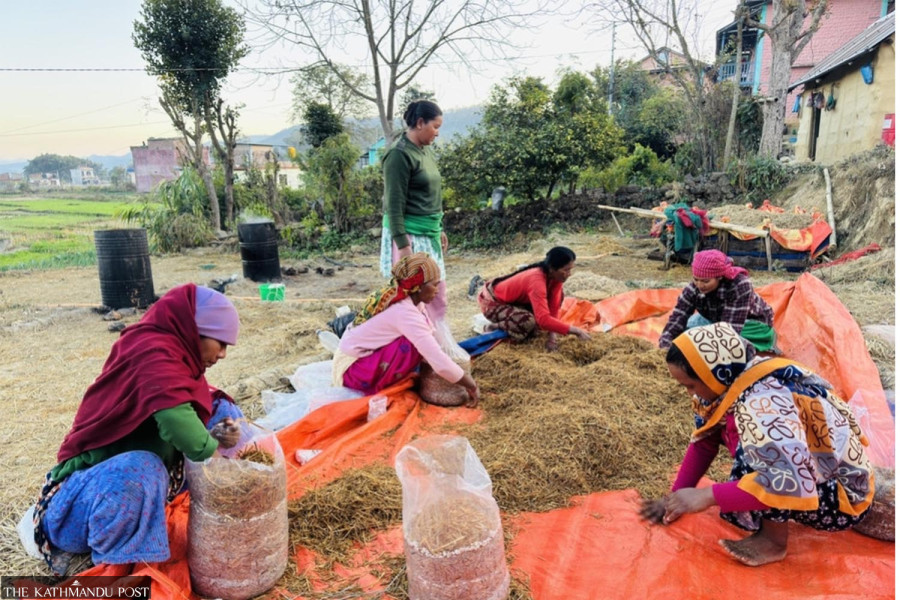
Radhika Chaudhary and 17 other women, once engaged in traditional farming, shifted to joint commercial farming last year. They now collectively cultivate mushrooms and produce incense sticks.
Initially supported by SOSEC Nepal, the group received seeds, tunnel infrastructure and fertilisers. They have since continued on their own.
They operate five tunnels, sharing work based on need. So far, they have completed four production cycles. Their first harvest alone produced more than 3.5 quintals of mushrooms, earning Rs120,000 in profit.
The income is pooled into a group fund. Members withdraw as needed and share profits periodically.
“It has made life much easier,” Radhika said. “We now have our own income and savings. When you earn yourself, you also gain confidence to speak and decide.”
Lila Chaudhary, 41, said she no longer has to ask her husband for money. Household expenses are now shared.
“After I started earning, things became much easier at home,” she said. Earlier, she struggled even with basic needs through traditional farming methods. Now, she said, she has both income and confidence.
“I couldn’t even introduce myself properly before,” she said. “I used to feel shy. Now I can speak without hesitation. That itself feels like a big change.”
Officials said women’s participation in income-generating activities is rising steadily across Karnali, particularly in agriculture.
The provincial government has been promoting women-led cooperatives and group-based farming models.
Tilak Pandey, spokesperson for the Ministry of Land Management, Agriculture and Cooperatives, said women and marginalised groups are the main beneficiaries of such programmes.
He said men’s migration for work has also increased women’s role in agriculture at home.
At the Agriculture Development Directorate in Surkhet, Director Chitra Bahadur Rokaya said women now account for around 70 percent of participation in agricultural programmes run by the government and NGOs.
He added that subsidies and payments are also increasingly registered in women’s names.
Bina Thapa, an official at the Women’s Development Section of the Ministry of Social Development, said nearly all ministries now run women-focused programmes, while NGO partnerships have further expanded participation.
Social Development Minister Ghanshyam Bhandari said the provincial government is prioritising women’s entrepreneurship through awards, skill training, technology support and youth talent programmes.
“These initiatives are helping women become self-reliant and building leadership capacity,” he said.
One key initiative, “Empowered Women, Prosperous Nepal”, is being implemented across 10 local units, including Birendranagar Municipality, Narayan Municipality, Dullu Municipality, Bhairavi Rural Municipality, Mahabu Rural Municipality, Shubha Kalika Rural Municipality, Khadachakra Municipality, Sanibheri Rural Municipality and Thuli Bheri Municipality.
Officials say more than Rs1 billion has been spent in Karnali on women’s economic and social empowerment programmes by various organisations.
Suvarna Kumar Khadka, chief of the Education Development and Social Development Section at the Ministry of Social Development, said there is no clear data on how many women have actually benefited from these programmes.
He said the absence of coordination between government and non-government agencies has made it difficult to maintain proper records.
Bina Thapa, an official at the Social Security and Women Development Section of the ministry, said the lack of coordination has also led to duplication of programmes.
“Because of poor coordination, some individuals receive opportunities multiple times while others are left out,” she said.




 13.8°C Kathmandu