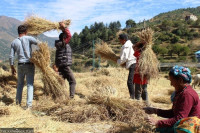
In Nekpa, ward 5 of Chankheli Rural Municipality of Humla, Purna Budha is forced to walk nearly six hours one way just to buy salt.
“There is no road access in the village, so we have to reach the municipal centre at Piplang to get salt,” he said. “We wake up at dawn, go there, bring salt back and return only by evening.”
The journey is not occasional. It is a seasonal necessity in one of Nepal’s most remote Himalayan districts, where basic supplies still depend on long foot routes and fragile supply chains.
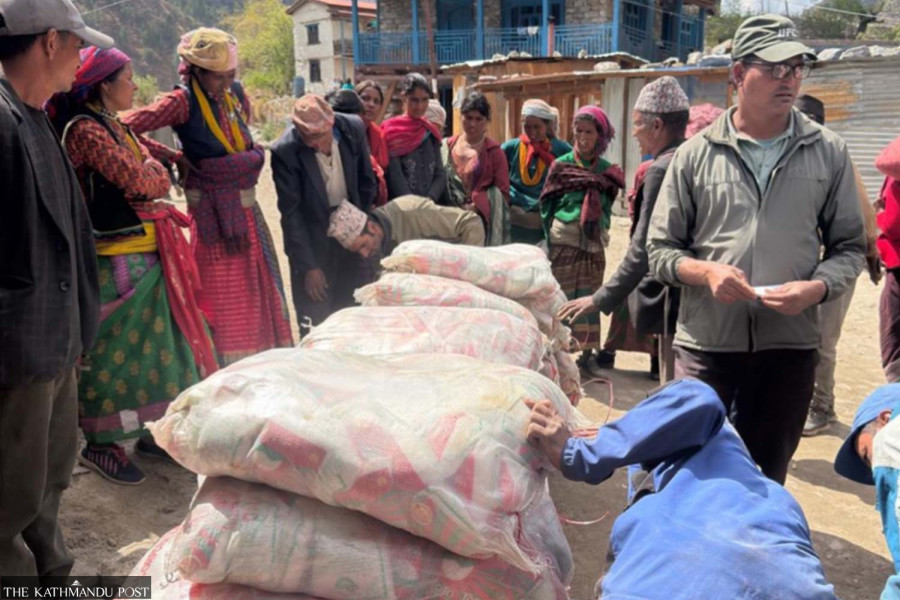
In Chankheli, subsidised salt for the year arrived in early March. The municipality arranged distribution at 50 kg per household, according to chair Pyarilal Shahi. Households were required to obtain recommendations from their respective wards before receiving their allocation.
Ward chairperson Harkadhan Tamang said around 70 households in the ward managed to collect their salt allocations. A depot of the Salt Trading Corporation was established in the area only last year. Before that, residents relied on Chinese salt sold through informal channels.
Today, salt in local markets costs Rs40 per kg. Subsidised salt, however, is sold at Rs9 per kg, Tamang said. He added that the ward received a total allocation of 50 quintals this year. Across the rural municipality, 470 quintals were initially supplied, but shortages prompted a request for an additional 200 quintals, according to chair Shahi.
The problem is not limited to Chankheli.
In Tanjakot Rural Municipality, salt arrived only on Monday, nearly a year after the last delivery. Even last year, supplies were delivered only in the third week of April, according to local officials.
Chair Lal Kesh Jaisi said 470 quintals were delivered this year, of which 430 quintals have already been distributed. “Salt arrives only once a year. This year, we allocated 25 kg per family. Once more stock arrives, we will distribute another 25 kg per household,” he said. “Other districts may face different challenges, but we always struggle with salt.”
Jaisi blamed contractor delays for the late arrival, saying supplies reached the rural municipality nearly nine months after the start of the fiscal year. He added that 40 quintals are still pending.
According to him, salt is divided among five wards, with allocations ranging from 70 to 110 quintals before being sold locally.
Distribution from the Salt Trading Corporation branch in Simkot, the district headquarters, takes place once a week on Mondays. Outside the headquarters, contractors transport salt to municipal centres, where local representatives divide it among wards, said Raj Bahadur Lama, chief of the Humla branch of the corporation.
“There is a shortage of staff at rural depots, which creates problems. At present, we distribute salt once a year in bulk,” he said. “If it is insufficient, locals come to Simkot to collect more.”
In Adanchuli Rural Municipality, 648 quintals of salt allocated for this year have not yet arrived. Lama said salt has already been distributed to Tanjakot, Adanchuli, Sarkegad, Chankheli and Namkha rural municipalities. Residents of Kharpunath, however, continue to purchase salt directly from Simkot.
In Simkot, salt is distributed every Monday based on copies of citizenship certificates, with a limit of 11 kg per person.
For many households, even this system is unreliable. Harish Chandra Rokaya from ward 2 of Adanchuli said salt allocated under government subsidy often arrives late and in insufficient quantities.
“Even when it comes, it is not enough for all family members or livestock,” he said. “That is why we are forced to buy salt at Rs40 per kg from the local market.”
A recent meeting of political parties and local authorities at the District Administration Office, Humla, decided to request an additional 1,500 quintals of salt for Chankheli and Sarkegad rural municipalities. Assistant Chief District Officer Rajendra Kumar Chand said the decision was taken ahead of the monsoon season, when transport routes are often cut off.
“Vehicles cannot operate once the rains begin. We need additional salt for emergency stock,” he said.
According to him, a total quota of 4,310 quintals has been allocated for Humla’s seven local units this year. For the next fiscal year 2026-27, the meeting proposed quotas of 2,500 quintals for Simkot and Kharpunath, 630 quintals for Namkha, 1,500 quintals for Sarkegad, and 1,500 quintals combined for Adanchuli and Tanjakot, totalling 6,130 quintals.
Local officials say chronic shortages continue to define life in the southern belt of Humla, including Tanjakot, Adanchuli, Sarkegad and Chankheli.
“In Simkot and Kharpunath, people somehow manage to get salt,” said Shivaraj Sharma, chief of the District Coordination Committee. “But in other municipalities, it arrives only once a year. If people cannot buy at that time, they are forced to use expensive salt.”
He also highlighted livestock needs in the region, where animal husbandry is widespread.
“Fifty kg of salt is not enough for a year. People are left deciding whether to use it for themselves or for livestock,” he said.
According to the District Livestock Service Office, nearly 950,000 livestock animals are raised in the district. Veterinary expert Kamal Sharma said animals in Himalayan and hilly regions require at least 20 grams of salt daily.
While humans require around five grams of salt per day for health, data from Karnali Province Hospital shows average consumption in the region is about 9.1 grams daily, according to hospital director Dr Ganesh Thapa.
For residents across Humla’s remote villages, however, the issue is not dietary balance but access.
As one resident put it, salt remains both a necessity and a burden, arriving late, costing time, and often forcing households into long journeys through difficult terrain simply to secure a basic essential of daily life.




 13.74°C Kathmandu