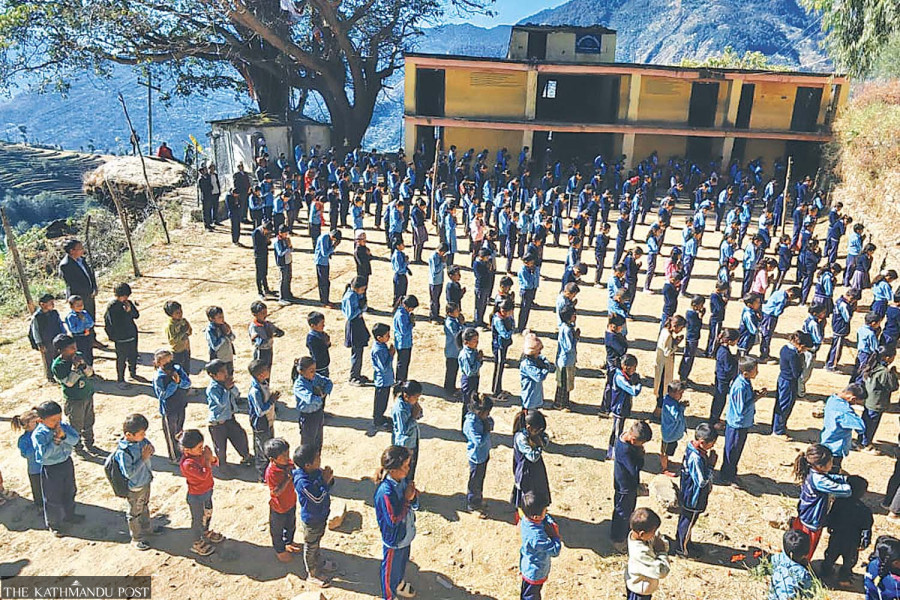
As a new academic year begins across Karnali Province, thousands of students are enrolling without certainty that they will receive textbooks on time. Delays in fund releases by several local units have stalled textbook procurement.
In Soru Rural Municipality of Mugu, which has 39 community schools and enrolled 5,535 students last year, a similar number is expected this session. But nearly Rs2 million allocated for textbooks has not been released, raising concerns that books will not reach students during the enrolment drive.
“Suppliers do not provide books on credit,” said Govinda Shahi, a teacher at a basic school in Sorukot. “The rural municipality has not released the budget, making it difficult to ensure students receive textbooks during the enrolment campaign.”
Administrative disruptions have stalled the process. Kushal Baral, the chief administrative officer, transferred to the rural municipality two weeks ago and has yet to assume office. Meanwhile, the accountant has been suspended after the Commission for the Investigation of Abuse of Authority filed a case, which has further delayed funds release.
“Schools had submitted their demand forms as early as mid-March,” said Birendra Malla, head of the municipality’s education section. “There is still no clarity on when the funds will be released.”
A similar situation has emerged in Thatikandh Rural Municipality of Dailekh, which has 40 community schools and around 5,200 students. About Rs1.8 million is required to procure textbooks, but funds have not been released, prompting suppliers to hold back distribution.
“The accountant was on leave, which caused some delay,” said Netra Bahadur Thapa, the municipality’s senior education officer. “We plan to transfer the funds to the schools’ accounts on Wednesday.”
Teachers said that even if the funds had been released earlier, it would still take at least a week for textbooks to reach students.
“It seems students may not receive books even by the end of the enrolment campaign,” said teacher Bibek Budha. “Ideally, students should have textbooks during enrolment.”
Out of Karnali’s 79 local units, 10 have yet to release funds for textbooks. As a result, not all students are likely to receive books during the enrolment drive, said Balbir Sunar, senior education officer at the Ministry of Social Development.
“All funds up to the secondary level are transferred to local governments,” he said. “But local units tend to delay releasing the budget every year.”
Karnali has 3,026 community schools, with 595,599 students enrolled last year. A similar number is expected this year, requiring around 120,000 sets of textbooks, according to the provincial office of Janak Education Materials Centre.
“Some books remain in stock in schools and stationery shops from the previous year,” said Jamuna Dhakal, the centre’s provincial chief. “Certain grades’ textbooks are printed by the private sector and distributed through them as well.”
According to the centre, 80,868 sets of textbooks have already reached various districts. The largest share—17,984—has been delivered to Dailekh, while the lowest—5,666—has gone to Jajarkot.
“Suppliers have completed the first phase of distribution in all districts,” Dhakal said. “They will deliver additional books based on demand.”
She said that, for the first time in a decade, the highest number of textbooks has been dispatched before the enrolment drive. Last year, only around 40 percent of books had reached hill and mountain districts during enrolment, while in 2024 it was about 50 percent.
“This year, there was a longer gap after the annual exams,” she said. “The curriculum has not changed, so printing was completed on time, allowing us to dispatch books earlier.” With shipments continuing, around 70 percent of textbooks have already been distributed, she added.
The centre said it has sold textbooks worth Rs76.9 million as of Monday. It distributes books for Grades 3 and 5 to 10, while private publishers handle Grades 1, 2 and 4. A total of 89 bookstores have been authorised to distribute textbooks across the province.
Despite improved supply, delays in fund release have disrupted distribution at the local level. Some booksellers say they have been forced to keep stock in their shops due to uncertainty over payments.
Chetan Kandel, proprietor of Nabin Books and Stationery in Surkhet, said they procure textbooks from Janak Education Materials Centre only after receiving funds through schools from local governments.
“Local units have not yet provided funds to schools,” he said. “We can supply books only after receiving payments based on student data. We cannot invest on our own due to the financial risk, yet the blame for shortages often falls on us.”
He added that it is not feasible to risk large investments for a commission of around nine percent. Amar Pandey, a bookseller in Kalikot, echoed the concern, saying they cannot supply books until schools make payments.
Teachers in remote areas say such delays have long forced students to rely on outdated materials. “Funds do not match student numbers, and even when they arrive, it takes one or two months,” said Kamal Nepali, a teacher at Bhairav Secondary School in Sinja Rural Municipality of Jumla. “Students have been forced to study from old books for years.”
Surendra Bahadur Shahi, headteacher of Balkalyan Primary School in Tajakot Rural Municipality of Humla, said that last year, out of around 500 students, nearly 100 had to use old textbooks due to shortages.
Deepa Hamal, acting director of the Education Development Directorate in Karnali, said efforts are underway to ensure textbooks reach students on time.
“This year, there is no shortage of textbooks at Janak Education Materials Centre,” she said. “Suppliers are actively distributing books across districts.”
Min Bahadur Pun, former headteacher of Tribhuvan Janata Secondary School in Musikot, Rukum West, said delays in previous years were also caused by late printing, curriculum changes and transportation bottlenecks.
“In some years, books did not arrive even after six months,” he said. “They were printed in Kathmandu and dispatched gradually to districts, forcing students to rely on old books.”
Sunar said weak transport access has also contributed to delays. “In many districts, reliable transport extends only to the headquarters, and books still have to be carried by mules in some areas,” he said.
Jaya Bahadur Bam, headteacher of Saraswati Secondary School in Sarkegad Rural Municipality of Humla, said textbooks are central to effective learning.
“Students learn faster when they have books,” he said. “It helps with homework and participation, and makes teaching easier.”
He said delays in textbook supply affect syllabus completion and exam results. This year, he added, students in his school received textbooks during the enrolment drive for the first time. Last year, books arrived in June, and in earlier years in July.
According to data from the Janak Education Materials Centre, around 70 percent of textbooks had been dispatched before the enrolment drive this year—the highest so far. In comparison, 40 percent were distributed in 2022, 45 percent in 2023, 48 percent in 2024 and around 50 percent in 2025.
Srijana Roka, a Grade 9 student at Shree Krishna Sanskrit and General Secondary School in Birendranagar, said textbooks make a clear difference to learning.
“Without books, it is hard to understand lessons,” she said. “Even completing homework becomes difficult.” She said she was unable to study at home for three months last year due to delays in receiving textbooks.
Parent Kamal Jung Shahi said delays in textbook distribution have a direct impact on student performance.
“When students do not receive textbooks on time, their learning suffers, and that ultimately affects results,” he said.




 13.74°C Kathmandu