Water scarcity deepens in Achham as springs dry up
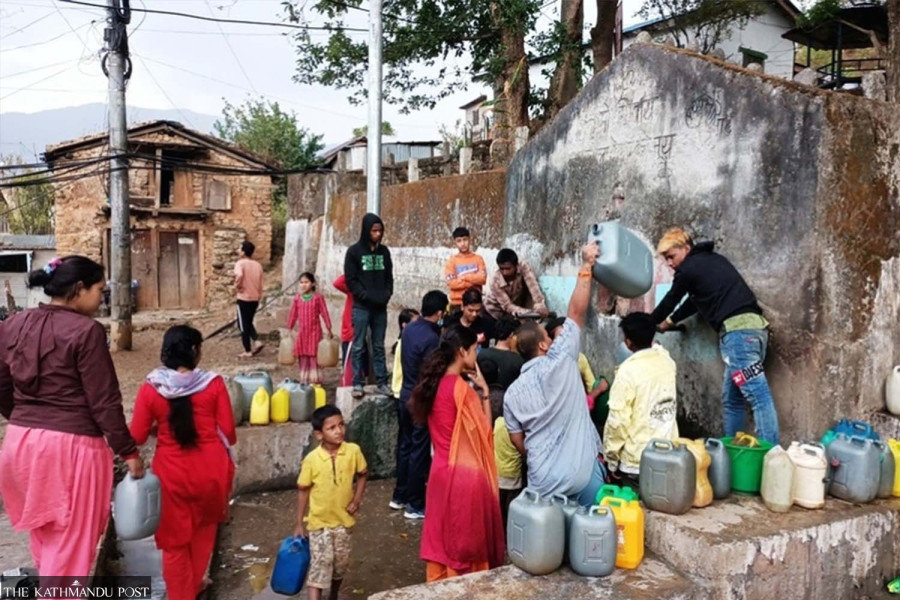
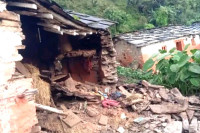
Unplanned road construction, shrinking sources and erratic rainfall are forcing long queues for drinking water and increasing pressure on rural households, especially women. Menuka Dhungana/TKP
For 65-year-old Maina BK from ward 5 of Mangalasen Municipality, fetching water has been a lifelong routine. But the spring she once depended on no longer flows reliably.
“Earlier, we did not have to wait. There was enough water,” she said. “Now it takes four to five hours just to fill a container.”
In the same ward, 80-year-old Udayaram Jaisi said water sources have steadily declined over time. “Rainfall has become irregular, and most springs have dried up,” he said.
Nepal Demographic and Health Survey 2022 shows the time needed to collect drinking water in rural areas of the district has risen sharply, from about 45 minutes to as much as three hours.
Shortage is now part of daily life in many settlements. In ward 6 of the municipality, resident Mansara Bhandari said the only local well is overcrowded from early morning.
“There is no tap water. The well becomes muddy because everyone depends on it,” she said. “We face shortages throughout the year.”
Locals said small streams and natural springs are drying up, forcing some households with better means to leave the village.
Many blame unplanned road construction for worsening the situation by disturbing natural water recharge systems.
Amarnath Shahi from ward 6 of Kamalbazaar Municipality said roads have been built without considering environmental impacts.
“Farmland, forests and water sources were not taken into account,” he said. “Development has also caused damage.”
A 2018 study by the District Soil Conservation Office found that rural roads built without environmental assessment had buried or diverted multiple natural water sources per kilometre. It also noted that debris from construction had blocked recharge zones of many traditional wells, reducing groundwater replenishment.
District data from 2024 shows dozens of drinking water taps, irrigation canals, water mills and micro-hydropower projects are now at risk due to landslides linked to unmanaged construction.
Former local officials said the problem stems from a lack of technical planning.
“In many cases, roads were opened without proper study and even in unsuitable locations,” said former District Coordination Committee chief Nar Bahadur Kunwar.
Local governments had earlier attempted small-scale restoration efforts. In 2019, Chaurpati Rural Municipality built more than a thousand recharge ponds through community labour to retain rainwater and revive springs.
But officials said those efforts were not sustained after changes in local leadership.
Municipal authorities now acknowledge that weak environmental enforcement has deepened the crisis.
“Roads have connected villages but also damaged water systems,” said Panchdewal Binayak Municipality Mayor Ambika Chalune. “With migration rising, only the elderly and children remain, and labour shortages are becoming severe.”
Women are bearing the heaviest burden. In ward 10 of Mangalasen, Indira Kami said most of her day is spent collecting water.
“We stand in line from early morning until afternoon just to fill a pot,” she said.
Teenager Isika Bhandari said the shortage is affecting her education, especially during menstruation, when access to water is essential for hygiene.
“We often miss classes because water sources are far and queues are long,” she said.
Agriculture has also been hit hard. A 2023 provincial report recorded a sharp decline in winter rainfall and a corresponding drop in wheat and barley production in Achham.
With irrigation systems drying up, large areas of farmland are being left uncultivated.
Studies suggest a significant share of traditional water sources in the hills have already dried up, pushing thousands to migrate in search of water and livelihoods.




 15.76°C Kathmandu