



 14.81°C Kathmandu
Sat, Oct 24, 2026
Money
“Let the ice wall melt”: No safe way up Everest yet
Experts rule out immediate alternatives through Khumbu Icefall; risky conditions force wait as anxiety grows at base camp.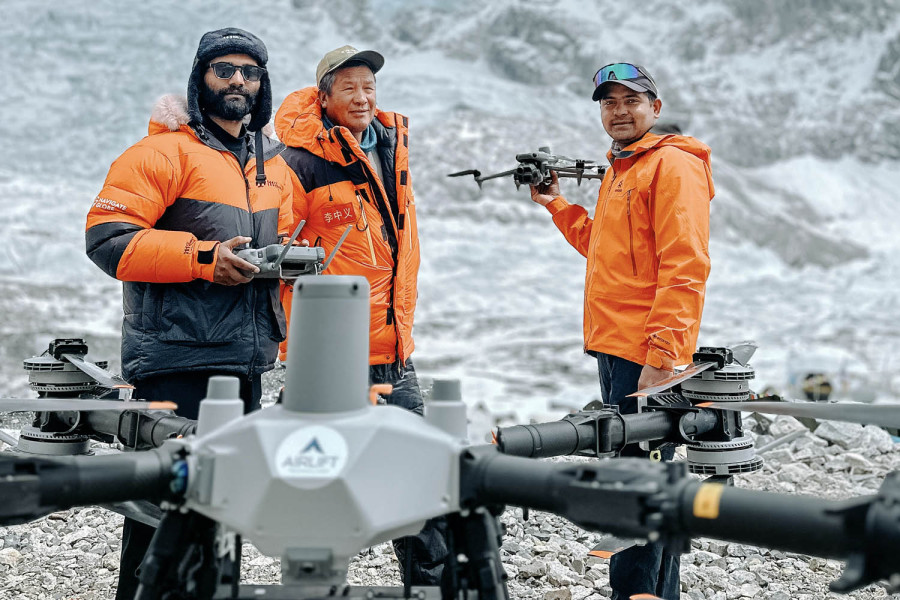
bookmark
Sangam Prasain
Published at : April 27, 2026
Updated at : April 27, 2026 06:44
Kathmandu
“It’s clear. It’s not possible.”
That blunt assessment from a joint inspection team has effectively stalled this year’s Everest climbing season, as a massive serac perched above in the Khumbu Icefall continues to threaten the only viable route to the summit of Mount Everest.
After multiple field inspections, including aerial surveys and drone-based mapping, experts say there is currently no safe alternative path around the unstable wall of ice. This has left hundreds of climbers stranded at base camp, waiting for a natural resolution that no one can predict.
One theoretical option—linking 15 to 20 aluminium ladders to scale the serac—has already been dismissed as too dangerous. Each ladder, typically about four metres long and commonly used to cross crevasses in the Khumbu Icefall, would have to be lashed together into a precarious vertical route. Even then, climbers would be exposed to the constant threat of collapse.
“The best alternative is to wait for the serac to collapse naturally,” said Pemba Sherpa, executive director of 8K Expeditions and a member of the inspection team. “It may take a few days or even weeks.”
The Khumbu Icefall, a shifting maze of crevasses and towering ice blocks, has served as the gateway to Everest for decades. First opened in the 1980s, the route has been adjusted repeatedly—sometimes veering left, sometimes right—to adapt to the glacier’s constant movement. But this season’s obstruction is unusually large and unstable.
The Khumbu Icefall also has a long and deadly history. On April 18, 2014, a collapsing serac triggered an avalanche that buried 16 Sherpa guides—in one of the deadliest single accidents in Everest’s history. The tragedy forced the cancellation of that year’s climbing season and led to a redesign of the route to reduce exposure to such hazards.
A second round of assessments by high-altitude climbers on Sunday confirmed that the threat remains acute. The towering serac looms directly over the route to Camp I, raising fears of a catastrophic avalanche if even a small section of ice breaks loose.
British mountaineer Kenton Cool, who has summited Everest 19 times, stated those concerns in a video message from the mountain. “The icefall is still shut. The serac is still there and it’s still threatening the route,” he said. “If there was another viable route around the serac, apparently there isn’t.”
Cool added that a crack has appeared in the ice formation—offering a glimmer of hope—but warned that its collapse could happen at any time. “Could be tonight, could be tomorrow, could be next week,” he said.
With each passing day, the delay is tightening the already narrow weather window for summit attempts.
The prime climbing season typically runs from early April to the end of May, when conditions are most stable. Any prolonged disruption could compress the number of viable summit days, creating logistical challenges and increasing risks as climbers crowd limited windows of good weather.
At Everest Base Camp, perched at 5,364 metres, frustration and uncertainty are mounting. The site is packed with climbers from around the world, their brightly coloured tents stretching across the glacier. This seasonal influx is a cornerstone of Nepal’s high-end tourism economy, supporting airlines, helicopter operators, hotels, guides and porters.
This year, 410 climbers have already been issued permits. Including guides, the total number of people moving through the icefall is expected to reach between 800 and 900, raising the stakes for any decision on route safety.
As concerns intensified, the government moved to intervene. On April 24, the Department of Tourism authorised the Expedition Operators Association Nepal to mobilise expert teams to assess the risk and recommend solutions. The effort is being coordinated with the Sagarmatha Pollution Control Committee, which oversees the specialised “Icefall Doctors” responsible for fixing ropes and ladders along the route.
An aerial inspection on Saturday was followed by a detailed ground survey on Sunday, involving two dozen experienced Sherpas. Drones were deployed to create 3D maps of the serac and surrounding terrain, providing a clearer understanding of the risk.
“Some parts of the ice wall have melted—that’s good news. But it’s still huge,” said Milan Pandey, co-founder of Airlift Technology, the tech company that is helping with the assessment.
According to Pandey, multiple seracs are hanging across different sections of the route—left, right and centre—making the threat even more complex. “It’s very, very risky as even a small movement can trigger an avalanche,” he said.
His company, which previously conducted the world’s first successful drone cargo deliveries on Everest, has deployed heavy-lift drones to support logistics and mapping. The technology is also being used to transport supplies and potentially help in route planning.
Despite the uncertainty, some experts believe the situation could soon resolve itself.
“The serac is falling piece by piece. It’s a matter of time,” said Dawa Steven Sherpa. “We are cautiously watching the development.”
Still, contingency plans are being quietly discussed. One option under consideration is extending the climbing season into mid-June, though that would coincide with the onset of the monsoon—a period typically avoided due to heavy snowfall, poor visibility and heightened risk.
Another, more drastic measure would involve allowing helicopters to ferry climbers and equipment directly to Camp II, bypassing the icefall altogether. While technically feasible, such a move would be unprecedented on this scale and is seen as a last resort.
“If it takes more time, the government has to intervene,” said Pemba Sherpa.
Officials insist that safety will remain the top priority.
“We cannot make decisions in haste,” said Ram Krishna Lamichhane, director general of the Department of Tourism. “Climbers have spent a huge amount of money to come here. We should not disappoint them, but safety comes first.”
Lamichhane said that while elite alpinists might be able to navigate the current conditions, the majority of climbers—many relying on guides—would face significant difficulty and danger.
For now, Everest remains effectively closed above the icefall.
Climbers wait, watching the massive ice formation for signs of movement, knowing that their fate this season depends not on planning or preparation, but on when—and how—the mountain decides to change.
Sangam Prasain
Sangam Prasain is Business Editor at The Kathmandu Post, covering tourism, agriculture, mountaineering, aviation, infrastructure and other economic affairs. He joined The Kathmandu Post in October 2009.

Most Read from Money

Why does an hour long flight to Dhangadhi cost more than a flight to New Delhi?
Nepal travel agents threaten to stop selling Thailand trips over visa rules
Malaysia rejects Nepal’s demand to open recruitment to all manpower agencies

No school, but a graduation cap for women dairy farmers
Nepal arrests four medical service providers as Malaysia recruitment row deepens
Editor's Picks




E-PAPER | October 24, 2026

×