Evicted squatters shifted to temporary lodgings, but resettlement remains uncertain
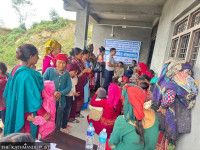
Government weighing interim cash aid and monthly rent for displaced squatters, says PMO official. Since her eviction from Thapathali, Kumari Tamang (43) has been lodged at a hotel. Daya Dudraj/TKP
Forty-three-year-old Kumari Tamang has again been left without a dwelling, nearly 25 years after she first settled in the Thapathali squatter settlement. On April 25, bulldozers arrived at the site where she had raised her children, reducing her hut to rubble. Sitting amid the debris, she wept as police urged her to remove her belongings while the clearance operation continued.
After her home was demolished, Tamang made her way to Dasharath Stadium at Tripureshwar where the government had set up a temporary desk to register those displaced. She was later taken to Hotel Tokyo Town in Balaju where she has been staying since. Although she has received immediate shelter, uncertainty over her future has begun to weigh heavily.
“People keep telling us we cannot stay in a hotel for long,” Tamang told the Post on Sunday. “No one has told us what will happen next. I don’t even know who will pay the hotel bill. We certainly cannot afford it.”
A total of 143 registered families had been living in the Thapathali squatter settlement. Among them, six families had lived there since 1978, two since 2003, and the remaining 135 since 2006.
A similar sense of uncertainty prevails for 40-year-old Sangita Singh, who was displaced from the Shantinagar squatter settlement along with her three children. Singh had been earning a living through daily wage labour after moving to the city following her rejection by her family due to an inter-caste marriage.
Since the demolition of her home, she has been unable to work, and her children have stopped attending school. She is currently staying at Hotel Mission Baglung, also in the Balaju area, but says lack of clarity about the future is deeply unsettling.
“How long will they keep us here, and what will happen afterwards? I have no idea,” she said.
Records show that 476 families were living in the Shantinagar settlement. Data from Kathmandu Metropolitan City indicate that one family had been residing in Thapathali since 1981, and 138 families since 1989.
A 2022 report by the High-Powered Committee for Integrated Development of the Bagmati Civilisation estimated 3,466 households of informal settlers along riverbanks across the Kathmandu Valley. Of these, 2,245 households are within Kathmandu Metropolitan City, 90 in Kageshwari Manohara Municipality, 156 in Budhanilakantha Municipality, 17 in Lalitpur Metropolitan City, and 773 in Bhaktapur Municipality.
Over the past week, the government has intensified eviction drives across the Valley, deploying bulldozers and police personnel to clear settlements along riverbanks and public land.
Following the evictions, authorities have arranged temporary accommodation for those displaced. According to Dilip Bhandari, joint secretary at the Ministry of Urban Development, 635 individuals who registered themselves as homeless after the demolitions have been placed in various facilities.
Among them, 327 individuals are staying in hotels and lodges in the Balaju area, while 146 have been housed at the Training Management Department of the Nepal Electricity Authority’s Engineering Services Directorate in Kharipati, Bhaktapur. Another 146 people are staying at the Radha Swami Ashram in Bhaktapur, and 16 individuals have been accommodated in Bode.
Officials said those in temporary shelters are being provided with food, health services and psychological counselling. However, the duration of their stay remains uncertain.
“We are encouraging those who have relatives or alternative places to stay to move there for convenience,” Bhandari said. “We have assured them that they will receive the benefits they are entitled to once their details are verified. The government will not abandon those in genuine need.”
Despite these assurances, questions remain over how long the government can sustain such arrangements and what long-term solutions are being considered.
Hotel operators assigned displaced families also say they have not been informed about payment arrangements. Suresh Baral, president of the Kathmandu District Hotel Professionals’ Association, said they were told the metropolitan city would cover the costs but have received no clarity on timelines.
“We were informed that the metropolis would pay the rent, but there is no information on how long the displaced will stay,” Baral said. “There is also no clarity on how and when the payments will be settled.”
Land rights activist Jagat Deuja said the government should have planned rehabilitation measures before starting evictions.
“By the time the government will start thinking about management, much will have already gone wrong,” he said. “There should have been a proper census and planning beforehand. Now we need to think in three stages—managing conditions in holding centres, relocation to alternative sites, and long-term settlement.”
Deuja stressed that the state must ensure safety, dignity and access to basic services for those currently in temporary accommodation. “Children's education has been disrupted, and many have lost their livelihoods,” he said. “Short-term options such as rented housing could be explored.”
For the long term, he said, the government must provide land and housing at designated locations. However, he cautioned that relocation far from existing settlements could create new problems.
“In other countries, when squatters were relocated far away, they struggled to sustain themselves due to lack of employment opportunities,” he said.
At present, the government has limited options for permanent resettlement. Apart from an apartment complex built in Ichangunarayan, there are no ready facilities for large-scale relocation. Officials said the complex can accommodate only 45 families and is currently being used by a ward office and the Manav Sewa Ashram.
The apartments were constructed during the tenure of then prime minister Baburam Bhattarai at a cost of Rs120 million, specifically with the purpose of squatter resettlement.
Officials at the Ministry of Urban Development said discussions are ongoing regarding long-term solutions. “Our immediate focus is to ensure that those displaced do not face further hardship,” Bhandari said. “We will soon announce plans for long-term management.”
Officials at the Office of the Prime Minister and Council of Ministers said preparations are under way to relocate verified squatters from holding centres to other arrangements.
“Discussions are ongoing on whether to provide a lump-sum relief amount initially, followed by monthly rent support for verified squatters,” an official said. “Further long-term measures will be decided afterwards.”
Since the eviction drive began, around 1,700 families claiming displacement have registered at Dasharath Stadium.
Prime Minister Balendra Shah had earlier sought to clear squatter settlements during his tenure as mayor of Kathmandu Metropolitan City, but did not receive support from the federal government at the time. He had requested assistance from successive home ministers, including Narayan Kaji Shrestha and Rabi Lamichhane.
Following his appointment as prime minister, Shah has prioritised the issue as part of the government’s 100-point governance reform agenda.
The agenda includes completing a nationwide digital census and verification of landless squatters and informal settlers within 60 days. It also proposes conducting household surveys in coordination with local levels and resolving the issue within 1,000 days.
The government plans to formulate clear criteria for identifying genuine beneficiaries and update records of public, unregistered and Guthi lands.
“The plan is to develop an integrated digital database and provide land in phases to bona fide squatters,” the agenda states. “In densely populated urban areas, relocation through integrated housing will be arranged as an alternative.”
For now, however, thousands of displaced families remain in temporary shelters, uncertain about how long they can stay and what lies ahead.




 16.49°C Kathmandu