What Nepal’s ministry rename means for the queer community—and what it doesn’t
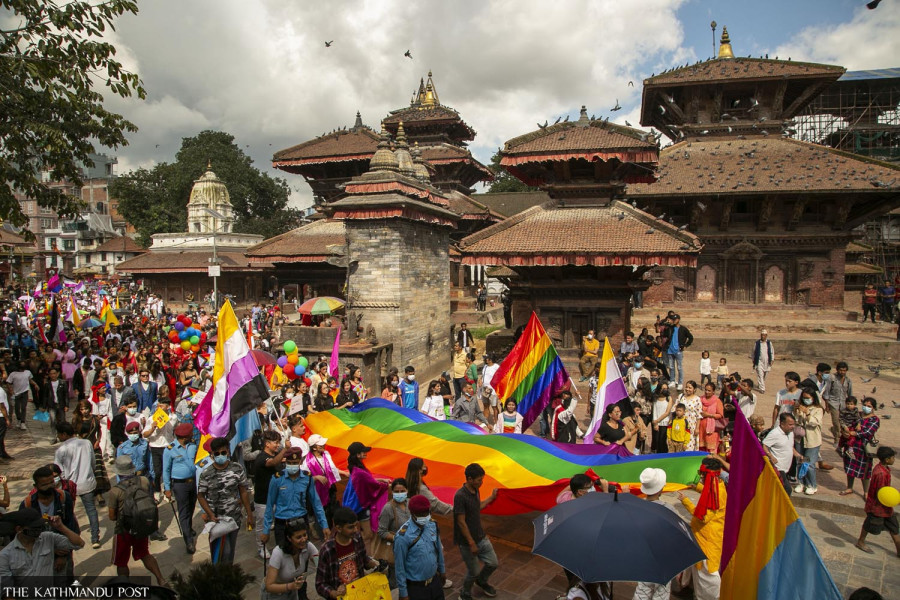
By renaming a federal ministry to include ‘gender and sexual minorities,’ Nepal has made a historic symbolic shift. But citizenship, marriage and discrimination hurdles persist. Post file photo
When Resham Neupane came across the news, they couldn’t believe it. A photo of the Ministry of Women, Children and Senior Citizen’s new name—explicitly including the words ‘Gender and Sexual Minorities’—had popped up when they were lazily scrolling their Facebook feed one day earlier this month.
In an era of generative artificial intelligence and fake news, an announcement this significant felt implausible. ‘‘It was so surprising,” Neupane told the Post recently. “I felt like, is this even real?’’
Resham, 30, is a rights worker. They have spent their entire adult life advocating for the queer community, whose rights, as they say, exist on paper but dissolve at the ward office door.
‘‘The ministry should ensure that these rights are implemented in real life, not just on paper,” Neupane said. “And not as an act of pity or mercy.’’
The Nepal government recently renamed the previous Ministry of Women, Children and Senior Citizens as the Ministry of Women, Children, Gender and Sexual Minorities and Social Security. For a community that has historically been marginalised, the inclusion of ‘gender and sexual minorities’ in the ministry’s name marks a watershed moment. But activists like Neupane are not ready to celebrate the decision—not yet.
For years, queer Nepalis watched constitutional promises broken, citizenship denied, marriages rejected, identities erased by bureaucratic indifference. The rename does not fix any of that. But for the first time, it means officials can no longer claim it is someone else’s problem.
Nepal’s constitutional provision for gender and sexual minorities is considered among the most progressive in Asia. The country banned discrimination based on gender or sexual orientation in 2007, officially acknowledged the ‘third gender’ in citizenship in 2013, and two years later, the same provision was applied to passports. The 2015 constitution recognised gender and sexual minorities.
Then in 2023, in a landmark ruling, the Supreme Court allowed same-sex and transgender marriage registrations.
For SammonChhetri, a trans man and queer activist, the recent decision reflects years of sustained struggle.
He traces the shift to a handful of turning points—Bhumika Shrestha’s entry into Parliament through the proportional system, two decades of sustained advocacy by the pioneer LGBTQIA+ organisation Blue Diamond Society and the growing force of social media in shifting public awareness.
Following the March 5 elections, Nepal got its first transgender lawmaker, Bhumika Shrestha, elected to Parliament through the proportional representation system under the Rastriya Swatantra Party.
‘‘When we weren’t in the House, our voices weren’t heard,’’ Sammonsaid. ‘‘Now that we have someone from the community, things are moving.’’
Previously, he says, officials could sidestep the community’s demands because the ministry’s title gave them cover. That cover is now gone. ‘‘The doors are open for our work,’’ Chhetri said.
However, he is aware that the name change alone cannot move the needle. ‘‘But I do wonder if the Ministry and the minister are truly ready to walk alongside us,’’ he said.
Chhetri is also wary of who gets left behind in the celebration. The LGBTQIA+ umbrella, he notes, covers identities that policy has yet to fully reckon with. ‘‘If the new policies address trans men but leave out asexual people, then those people are being left out,’’ he said. ‘‘The narratives must move beyond binary definitions of male and female.’’
The path unto here was not rosy. Sammon describes significant backlash from within the movement itself—a faction that insists the community should only accept the ‘third gender’’ label and rejects identities like trans man or non-binary.
‘‘This caused a lot of infighting and personal attacks, which weakened our collective voice,’’ Chhetri said.
The next fight, he adds, is less about visibility and more about power at the ground level—more queer community members in direct elections and better political literacy so that everyone from the community, even from a remote ward, can advocate for themselves. Also crucially, the move is expected to help gather more accurate census data.
The last census recorded the community’s population at around 3,000—a figure Sammon says is far from reality. ‘‘The census shows our population is very low, which isn’t a fact,’’ he said. ‘‘We need proper data collection to ensure reservation and rights.’’
For instance, even though the government of Nepal introduced the provision to count the ‘third-gender’ in its 2021 census, many queer folks couldn’t be open about their identity in front of their parents, and some census takers didn’t ask at all.
At an interaction programme with journalists on May 17, the International Day Against Homophobia, Transphobia and Biphobia, transgender activist Manisha Dhakal shed light on loopholes in census data.
“Some census takers didn’t even ask whether anyone in their family belonged to the non-binary category,” she said.
As a result, the population shown in government data, which is only around 3,000, doesn’t match the actual population of the LGBTQIA+ community. According to the Blue Diamond Society, Nepal has more than 9,00,000 sexual minorities.
Hundreds of kilometres away from the federal capital Kathmandu, the gap between policy and daily life is something Resham lives daily.
They live with their family in Bhairahawa, but spend little time at home. ‘‘I worry that because of my sexual orientation or identity, my family might face consequences or have to hear things from others,’’ they said. They find happiness with friends, in their work, and on the road between district offices, where they advocate for queer rights with local and provincial governments.
Three of their friends currently have citizenship documents stuck at the CDO office. Two others obtained theirs only after being subjected to a humiliating experience—being forced to strip naked in front of doctors at Bhim Hospital and Lumbini Provincial Hospital to have their genitals examined.
“If I have to strip at a government hospital to get an ‘Other’ category citizenship just to apply for a one percent civil service quota, then that quota is just for show,” they said.
The constitution, Resham notes, does not require medical documentation for citizenship. Articles 12, 18 and 42 recognise their community, but implementation is lacking.
‘‘A man gets citizenship because he wears a Dhaka Topi. A woman gets it because she has long hair,” they said. “Why does my community need medical documents? There is no machine in the world that can measure my mind or brain.’’
Implementation gaps remain visible elsewhere, too. The Supreme Court’s ruling that allowed same-sex and transgender marriage registrations is yet to materialise at the grassroots level.
The Post reported last year an incident where a lesbian couple at the Sunkoshi Rural Municipality in Sindhuli district tried to register their marriage, but faced hostility. The local unit rejected their proposal, and they were separated by the police as their family knew their secret decision to get married. They never accepted their relationship.
The situation remains the same despite the Supreme Court’s ruling. The Ministry of Home Affairs in 2024 directed all local units to register same-sex and other non-heterosexual marriages. But many ward officials haven’t complied.
Lawmaker Bhumika Shrestha says the rename traces back to a structural gap no previous government had bothered to close. Nepal’s 2015 constitution recognised gender and sexual minorities, but no ministry had ever been assigned to carry out that mandate.
Without a designated Terms of Reference, she says, officials had a ready excuse to do nothing. ‘‘Whenever we had to move our issues forward, our focal ministry would become the Ministry of Women,’’ she said.
‘‘We worked with the Ministry of Women for many years on policies and laws, but things did not move at the desired pace.’’
Shrestha put forth the gap directly to the prime minister at a meeting convened for proportional members, telling him plainly that under the Government of Nepal Work Division Regulation, 2017—the framework that defines each ministry’s responsibilities and jurisdiction—gender and sexual minorities had never been assigned to any ministry. Without that formal designation, officials could, and did, stall or dodge the community’s demands by claiming they lacked the mandate to act.
She argued the rules needed to be updated to assign a specific line ministry, so the community’s rights could finally be codified into policy.
Her expectation was modest—a specific Terms of Reference added to the existing Women’s Ministry. What happened instead surprised her. ‘‘I didn’t know the name itself would change,” she said. “I was also surprised.’’
On concrete policy, she is candid about what remains undetermined.
Budget allocations, staffing and departmental mandates have not been finalised. Her list of unfinished work is long: constitutional amendments on citizenship, marriage equality, discrimination-free education and healthcare policy. ‘‘It’s more about what to bring than what is coming,’’ she said.
To critics who call the rename election-season optics, she does not reach for budget lines. She reaches for history. ‘‘Years ago, it was the Ministry of Women, Children and Social Welfare. Then it changed to include social security and then senior citizens,” she said. “There were critics then, too.’’
Shrestha added, ‘‘The name has changed, and now the work must match it. That is what will prove this means something.’’
She is also clear-eyed about what the rename does not yet deliver.
‘‘A ministry name alone doesn’t end discrimination,’’ she said, pointing to the Dalit Commission as an example—an institution that exists while caste discrimination persists. ‘‘Where there is no equity, there can be no equality.’’
Rukshana Kapali, a legal team member at Singha Durbar who has been involved in policy advocacy for gender and sexual minority rights, says the name change carries more legal weight than it might appear. The key, she explains, lies in Nepal’s Government Business Allocation Rules—the document that functions as the government’s formal Terms of Reference, assigning responsibility for specific issues to specific ministries.
Gender and sexual minorities were not named in those rules before. Now they are. ‘‘It can no longer be said that this is not this or that ministry’s responsibility,’’ she said. ‘‘Legally, there is now clarity that this is the focal ministry for this issue.’’
But she is unsure about what comes next. The rename, she says, is a start, not an arrival. The immediate task is to specify within the ministry’s own organogram which department, section, or division will handle these issues. Without that internal structure, she warns, the legal clarity at the top will not translate into accountability at the desk level.
‘‘The staff at the ministry can no longer dodge us by saying it’s not within their jurisdiction,’’ she said. ‘‘But the next step is to build the organogram.’’
Aarya Chand is a reporter at The Kathmandu Post covering social issues. Before moving to the social beat, Chand was an intern covering culture and lifestyle for the Post.
Aarati Baral is an Op-Ed editor at The Kathmandu Post. She joined The Post as an Op-Ed intern in 2021 and later became a full-time Assistant Senior Sub-Editor in the newsroom. She holds a degree in English Literature.




 12.97°C Kathmandu