They built lives on land that was never theirs. Now they have nothing
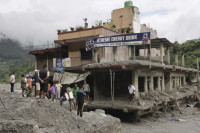
In the rain-soaked aftermath of eviction, hundreds of displaced families are scattered across hotels and shelters — separated, uncertain, and waiting for answers that haven’t come. Hemanta Shrestha/TKP
It was around 5pm on Sunday. A steady pre-monsoon downpour had flooded the ground at the Dasharath Stadium. Scattered belongings lay soaked in the rain. Faces in the crowd looked drained, uncertain, and defeated.
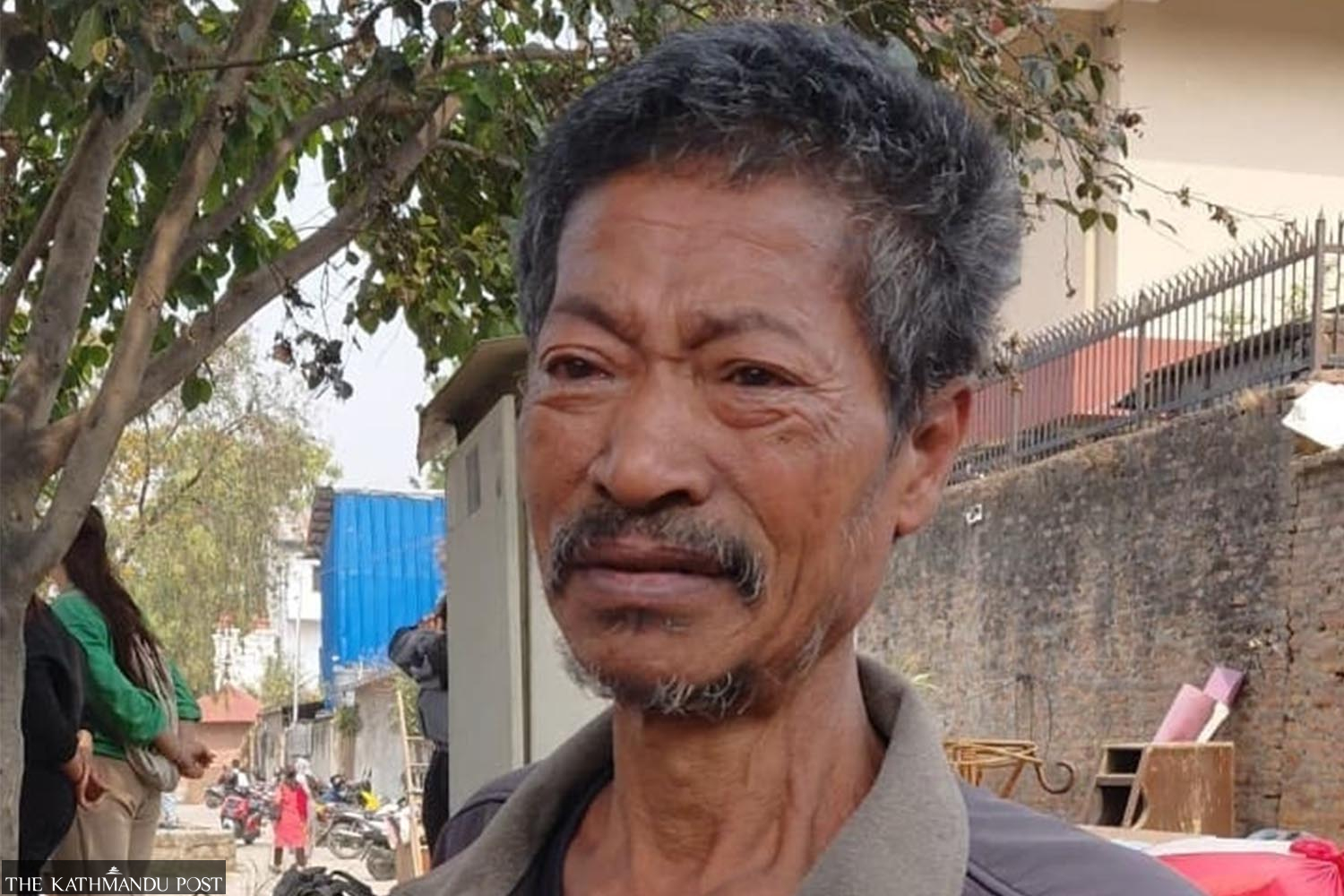
Among them sat 53-year-old Pakcha Tarim Kasai, drenched but unmoving. The rain did little to mask the exhaustion etched across his face. It was not just age. It was the hollow look of a man who had lost everything within hours.
When bulldozers moved into the riverside settlement in Thapathali on Saturday, Kasai did not just lose his shelter. In the chaos, he was separated from his wife.
He had reached the stadium that evening. Around 9pm, municipal officials began moving displaced families to temporary accommodation in Balaju. As he was being ushered into a vehicle, Kasai realised his wife, Pushpa, was nowhere to be seen.
He panicked. He searched, asking nearby police officers. They told him she would be located and sent to him. Standing at the vehicle door, he hesitated, asking repeatedly how he could leave without her. Eventually, he was persuaded to board.
Pakcha Tarim Kasai Post photo
At a hotel in Balaju, he waited through the night, staring at the door, hoping she would walk in. She did not. He pleaded with police and hotel staff for information. Hours later, someone informed him that she had been taken to a different hotel.
Only after officers connected them by phone did he regain some composure.
“How do you hold yourself together in a moment like that without hearing your wife’s voice?” he said, recalling the night.
The couple do not own a mobile phone. In a city increasingly shaped by digital connectivity, that absence left them more isolated.
Early Sunday morning, he returned to the stadium in search of her. He later learned she had been taken to Kirtipur. By late afternoon, he was still waiting for officials to arrange transport to reunite them.
Kasai’s story was repeated in different forms across the displaced population.
At a budget hotel in Machhapokhari, 32 displaced individuals had taken shelter. Among them was 48-year-old Kumari Tamang, who had spent decades building a life in the same Thapathali settlement.
When reporters met her on Saturday morning, before the demolition began, she had already sensed what was coming. She spoke quietly about raising her children there, about the effort it took to survive in the city, and about the uncertainty ahead.
By Sunday, she was recounting what followed.
She had removed the roof of her house the previous day, anticipating eviction. But she did not expect heavy rain that night. Without a roof, her family spent hours exposed to the weather.
“We stayed awake most of the night, soaked. I was worried about my grandchild and my elderly relative,” she said.
Before she could process the situation, security personnel arrived with bulldozers. The demolition began quickly. Journalists were pushed back from the site as structures were torn down.
On Sunday, the settlement stood empty. What had been rows of makeshift homes had turned into debris fields. Clothes, broken furniture and family photographs were scattered across the ground.
Kumari was later found at a hotel, resting after a sleepless night. She spoke slowly, recounting the previous day.
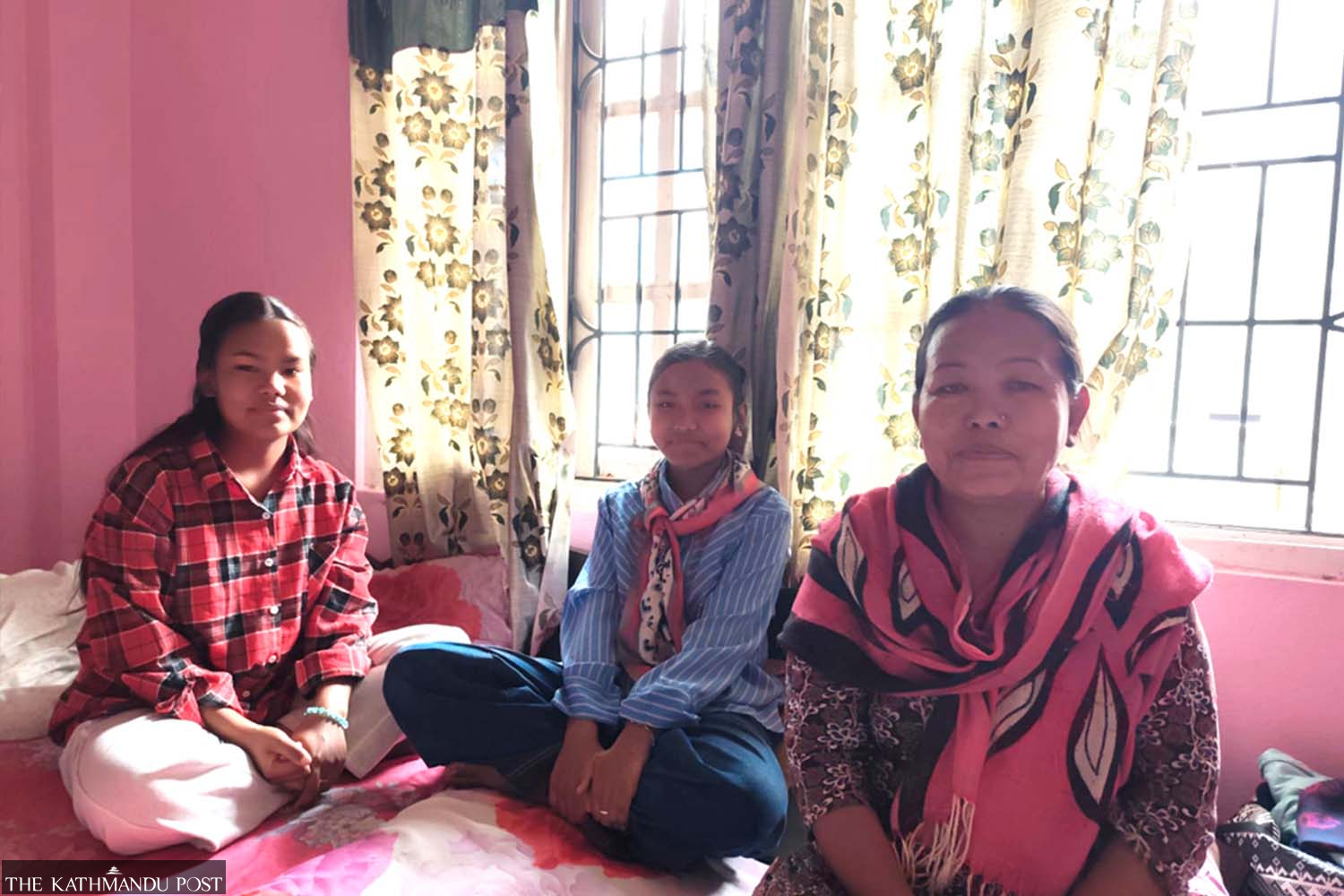
Kumari Tamang with her family. Post photo
Among the things she worried about were small details that reflected a larger loss. She had been raising chicks at home. As the eviction became imminent, she rushed to leave them with relatives, unsure when she would be able to return.
By evening, municipal vehicles transported her and others to the stadium. They queued for hours in the rain to register their names, without knowing where they would be sent.
“We stood there for nearly three hours in the rain. No one could tell us where we were going,” she said.
Around 10pm, they were moved again, this time to temporary accommodation in Machhapokhari.
Her concerns have since shifted to her children’s future. Her younger daughter is due to enrol in Grade 8. She had been studying at a school in Tripureshwar. Now, with no fixed residence, continuity in education is uncertain.
Her daughter has already expressed reluctance to move to a new school, saying she would rather stop studying than start over in an unfamiliar environment.
For Kumari, the loss extends beyond physical assets. The settlement had functioned as a community. Neighbours supported each other in times of need. That social network has now been dismantled.
“Everyone has been scattered. We don’t know where anyone is anymore,” she said.
Rumours have added to the anxiety. At the shelter, displaced families heard that anyone found to own land elsewhere might be required to pay for their accommodation. The claim, unverified, caused panic. Some families left the shelter early, unsure of the consequences of staying.
Kumari herself was unsure what to do. Leaving meant uncertainty. Staying meant fear of potential penalties.
Her ancestral home is in a remote part of Sindhupalchok. The land there is steep and agriculturally unproductive, and it is not formally registered in her husband’s name. Returning there is not a viable option.
She came to Kathmandu as a child to work in carpet factories. Over the years, she shifted from rented rooms to the riverside settlement after being repeatedly evicted by landlords who were unwilling to accommodate large families.
The Thapathali area, once covered in shrubs, was gradually cleared and settled by people like her. With informal assurances that land titles might eventually be granted, residents invested in building homes.
Kumari took a loan of around Rs300,000 to construct a small house. It was demolished within months. She rebuilt, faced flood damage, repaired again through borrowing, and continued living there.
She later ran a vegetable business in Baneshwar, but lost her livelihood after stricter municipal enforcement against street vendors. Savings she had deposited in a cooperative were lost when the institution shut down. She no longer has documentation to claim the funds.
Her husband works as a security guard, but has been unable to report to duty since the eviction. She fears he may lose his job.
For now, she is waiting for the government to provide clarity.
“Even a small plot with legal ownership would have made a difference,” she said. “If we had been informed in time, we could have prepared. Now everything is uncertain.”
Similar uncertainty was visible at another shelter, where 67-year-old Indra Bahadur, a daily wage labourer, was staying with his family.
He has spent decades working on construction sites across Kathmandu, building homes for others. Yet he now finds himself without a place to live.
“I must have helped build dozens of houses,” he said. “This time, I couldn’t save my own.”
His family fled their home without salvaging belongings. They had expected more time before eviction.
He now worries about his grandson’s education. The child was due to enrol in school, but with no stable housing, the plan has stalled.
Indra Bahadur migrated to Kathmandu in the early 1990s. His family had no registered land in Solukhumbu. Like many from rural backgrounds, he relied on informal work in the city, moving between jobs ranging from porterage to construction.
He says they are not seeking confrontation with the state, but want a secure place to live.
“We are not here to fight the government. We just need a place where we can live without fear of being removed again,” he said.
For younger families, the disruption has been equally severe.
Twenty-nine-year-old Sushila Rai was feeding her two-year-old son when she described her situation. She had previously worked abroad in Iraq, saving money with the intention of building a stable life in Kathmandu.
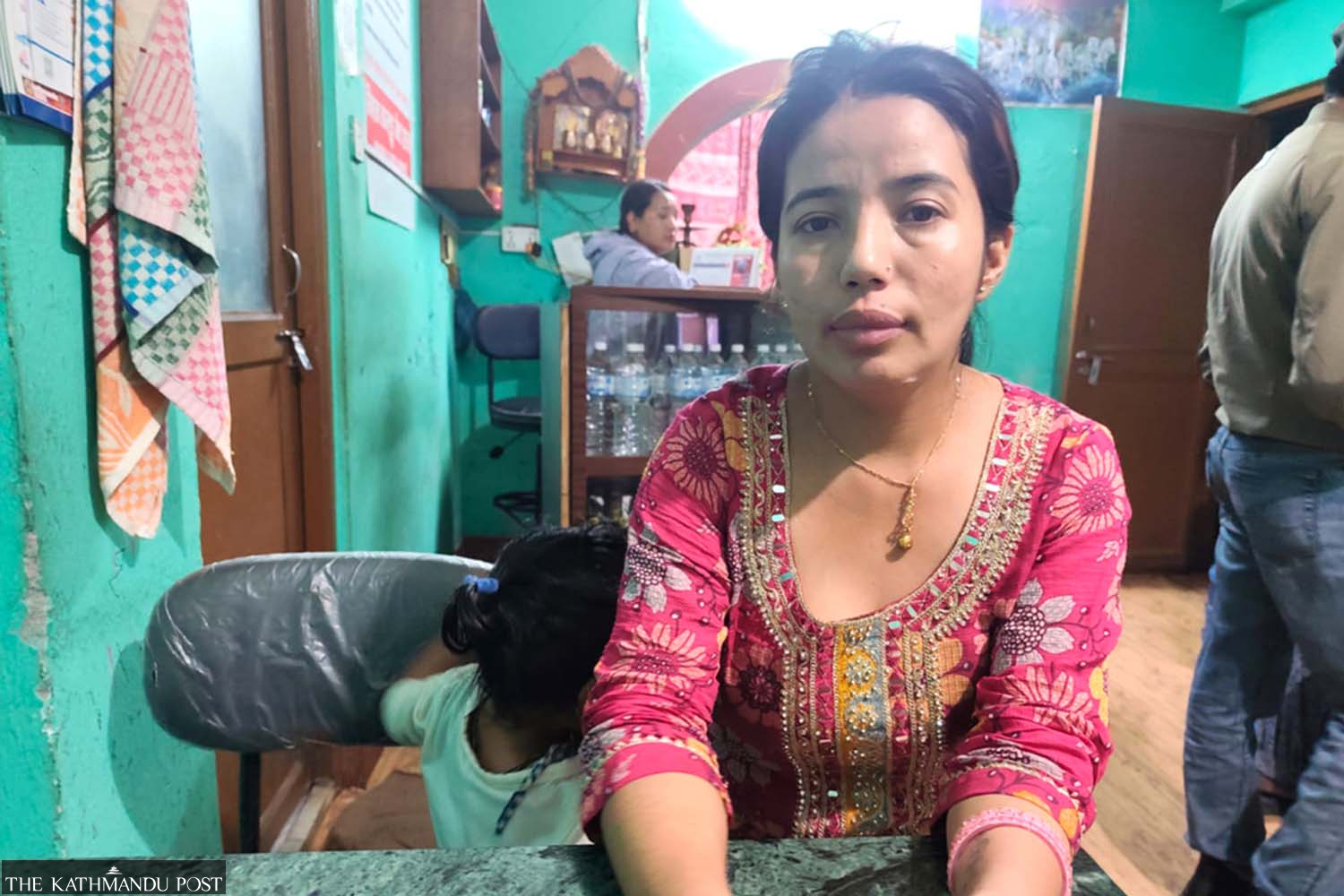
Sushila Rai
Health complications forced her to return early. With her savings, she purchased land informally in the settlement, believing it would eventually be regularised. The seller later disappeared, leaving her without legal proof of ownership.
Her house was demolished before she could retrieve her belongings.
“I couldn’t even take clothes or food. Everything was buried in front of me,” she said.
She now has no land in either her marital or parental home. Her immediate concern is shelter for her child.
“I can manage on my own, working in someone else’s house if needed. But with a child, how do I live on the streets?” she said.
Another displaced resident, Sangita Singh, is staying in a cramped hotel room in Balaju with her three children. Her husband left for Saudi Arabia five months ago in search of work, but has struggled to secure a stable income.
Singh had spent days searching for rental accommodation before the eviction. Landlords repeatedly refused to rent to her after seeing her children.
“Everywhere I went, they said no as soon as they saw the children,” she said.
Her two older children were enrolled in a local school supported by a non-governmental organisation, which covered educational supplies and meals. With schools reopening soon, she is unsure how to continue their education.
“I don’t even know where we will be living. How do I send them to school?” she said.
According to data from the Kathmandu Valley Development Authority, hundreds of families have been displaced across multiple locations, including Shantinagar, Gairigaun, Thapathali, Gothatar and Manohara.
Officials said some families have been relocated to temporary shelters in Kirtipur, while others have been placed in low-cost hotels across the city. As of Sunday evening, dozens of families had been moved, with more awaiting relocation.
Hotel operators in areas such as Balaju, Gongabu and Mitranagar are currently accommodating several hundred displaced individuals.
Authorities say arrangements are being made, but for many families, the process has been fragmented and unclear. Movement between locations, lack of information, and separation from family members have compounded the distress.
Back at the stadium, as rain continued to fall, individuals like Kasai were still waiting. Waiting for transport. Waiting for information. Waiting to reunite with family.
For them, the eviction was not just the loss of a structure. It was the collapse of a fragile system of survival built over years, now replaced by uncertainty that shows no clear end.




 16.49°C Kathmandu