Destruction of confiscated cell phones sparks legal and administrative scrutiny
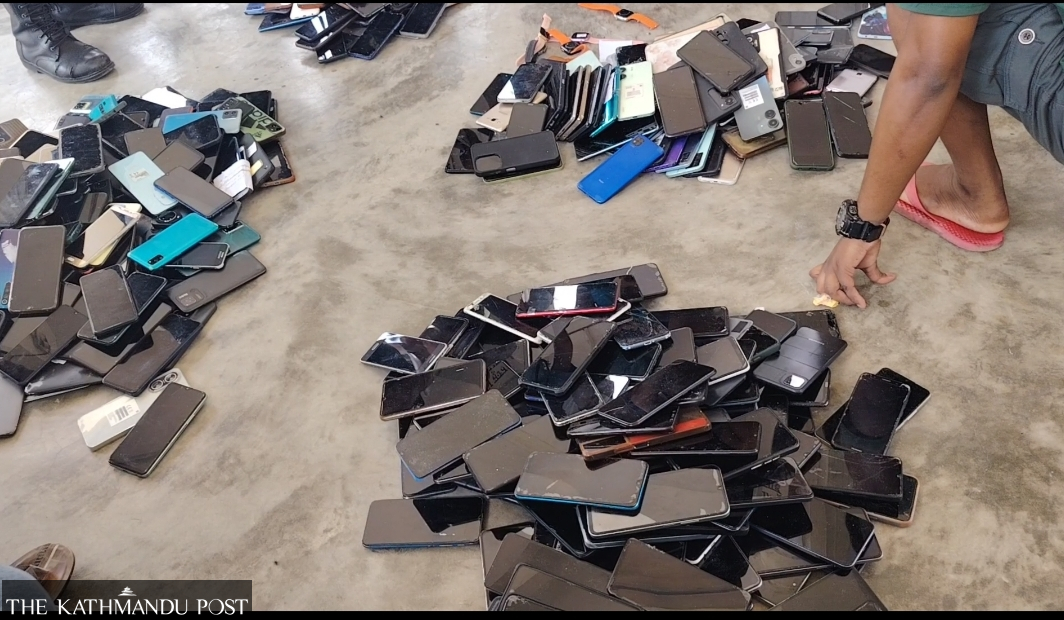
The destroyed devices included seven iPhones and 489 Android smartphones. Officials estimate their combined value at more than Rs10 million. The footage shows police personnel dumping a large number of mobile phones into a water tank before destroying them. Binay Aazad/TKP
A decision by the authorities in Siraha to destroy hundreds of mobile phones confiscated from students during examinations has drawn widespread criticism and raised questions about whether the move was legally justified.
At 1:48 pm on Wednesday, a video lasting four minutes and 25 seconds was posted on a Facebook page called ‘Siraha Today’. The footage shows police personnel dumping a large number of mobile phones into a water tank before destroying them.
The video was uploaded with the caption: “Mobile phones confiscated during Secondary Education Examination (SEE) in Siraha district destroyed by district police.” By the time this report was prepared, it had been viewed more than 560,000 times and had attracted hundreds of comments, many of them critical of the authorities' actions.
The incident shown in the video took place in Siraha. On Wednesday, 496 mobile phones and five smartwatches were destroyed on the premises of the District Police Office, Siraha. According to officials involved in the process, the devices were first submerged in water for 24 hours before being smashed and discarded.
The destroyed devices included seven iPhones and 489 Android smartphones. Officials estimate their combined value at more than Rs10 million.
The phones and smartwatches were not connected to any criminal investigation. They had been confiscated from students during the Secondary Education Examination and Grade 12 examinations conducted in the district this year.
According to officials, the devices were seized either while students were entering examination centres or while they were taking their examinations. The administration had enforced a strict ban on carrying mobile phones and other electronic devices into examination halls.
The decision to destroy the confiscated devices was linked to an earlier statement made by Rani Sharma Tiwari, the then minister for education of Madhesh Province, who had said that mobile phones found being used during examinations would be destroyed as part of efforts to discourage cheating and maintain the integrity of examinations.
Following that announcement, the district examination coordination committee, headed by the chief district officer, formed a separate mechanism to oversee the destruction process.
A five-member committee was constituted under the coordination of Rajdev Yadav, an official at the Education Development and Coordination Unit in Siraha. The committee included representatives from the District Administration Office, Nepal Police, Armed Police Force and the National Investigation Department.
The mobile phones had been confiscated from students during the Secondary Education Examination and Grade 12 examinations conducted in the district this year. Binay Aazad/TKP
The destruction of the devices has angered many students and guardians, who argue that the punishment was excessive and resulted in the loss of valuable personal data.
Several students whose phones were confiscated said the devices contained family photographs, academic documents, personal records and account credentials that could not be recovered.
“Bringing a mobile phone to the examination was a mistake,” said one student whose phone was among those destroyed. “But instead of destroying the phones, the authorities could have returned them after imposing a fine. Our phones contained family memories, important documents and credentials that we can never get back.”
Students said many of them had hoped the devices would eventually be returned after the examinations were over. Some claimed they were never informed that the phones would be permanently destroyed.
Guardians also expressed dissatisfaction with the administration’s decision. They said they had repeatedly requested that the authorities return the phones after imposing financial penalties on the students involved.
“In today’s world, a mobile phone has become an essential part of daily life,” said Nabin Yadav, a guardian from Siraha. “If the authorities had imposed a fine and returned the phones, the devices would have been saved and the government could have generated revenue. Instead, the administration chose to destroy them.”
Yadav said many families had spent significant amounts of money purchasing the devices and were shocked to learn that they had been destroyed.
“The phones belonged to the students or their families. Destroying them was unnecessary,” he said.
The incident has also sparked a strong reaction on social media.
After the video was posted online, many users criticised the administration and questioned the rationale behind the decision. The comment section quickly filled with posts describing the move as excessive and unreasonable.
One user, Kebal Singh, wrote that the authorities should have imposed a fine and returned the phones rather than destroy them.
“This was not right. They could have returned the phones after collecting a penalty. What kind of decision-makers are these?” he wrote.
Another user, Bipin Chamling Khwasangucha, posted a strongly worded comment criticising district officials and security agencies involved in the process.
Similarly, Rabin Kumar, another social media user, argued that a warning or financial penalty would have been a more appropriate response.
“If the phones have really been destroyed, then this was the wrong decision,” he wrote. “A warning or fine would have been a better option.”
Most comments on the video echoed similar concerns, with users questioning why alternative measures were not considered before the devices were destroyed.
While the incident has generated significant public attention, the National Examination Board said it was unaware of the matter.
Jung Bahadur Aryal, member secretary of the National Examination Board, said the board had not received any information regarding the destruction of the phones.
“We have no information regarding this issue,” Aryal said.
The controversy has also prompted legal questions about whether the administration had the authority to destroy confiscated personal property.
Chandan Kumar Karna, an advocate based in Siraha, said he had never encountered a case in which mobile phones confiscated during examinations were destroyed by state authorities.
“Mobile phones can certainly be confiscated during an examination,” Karna said. “However, the larger question is whether the authorities had the legal right to destroy private property belonging to citizens.”
Karna argued that the destruction of the devices appeared inconsistent with constitutional protections relating to property rights and privacy.
“The Constitution guarantees the right to property and the right to privacy,” he said. “The authorities need to explain how they justified destroying personal devices that contained private information and belonged to individual citizens.”
According to Karna, even in criminal cases, law enforcement agencies do not automatically destroy seized property.
“Only prohibited or contraband items are generally destroyed,” he said. “Other items are either returned to their owners after the completion of legal proceedings or disposed of through auction under a court order.”
He said the administration's decision could face legal challenge if affected students or guardians choose to pursue the matter in court.
“This action can not be justified on any legal grounds,” Karna said. “If the issue reaches the courts, the officials involved could face scrutiny, and the court could potentially order compensation if it concludes that the students’ rights were violated.”
Despite the criticism, district officials maintain that the decision was taken after considering possible alternatives.
Surendra Paudel, chief district officer of Siraha, defended the move and said the administration had acted in what it believed was the best interest of the students and the public.
According to Paudel, returning the devices was not considered appropriate because they had been confiscated during examinations in violation of established rules.
He also said auctioning the devices could have created risks related to the personal information stored on them.
“We could not return the mobile phones, and if we had auctioned them, there was a possibility that personal data belonging to the concerned individuals could be misused,” Paudel said. “That is why we decided to destroy the phones.”
Paudel said the administration believed destroying the devices was the safest option from a privacy perspective and would also serve as a deterrent against future violations of examination rules.
The decision, however, continues to divide opinion. While authorities insist the action was intended to protect the integrity of examinations and prevent misuse of personal data, critics argue that the destruction of property worth more than Rs10 million was disproportionate and lacked a clear legal basis.
As debate over the incident grows, questions remain about whether the administration’s decision will face legal challenge and whether similar measures could be adopted elsewhere in the future.




 19.24°C Kathmandu