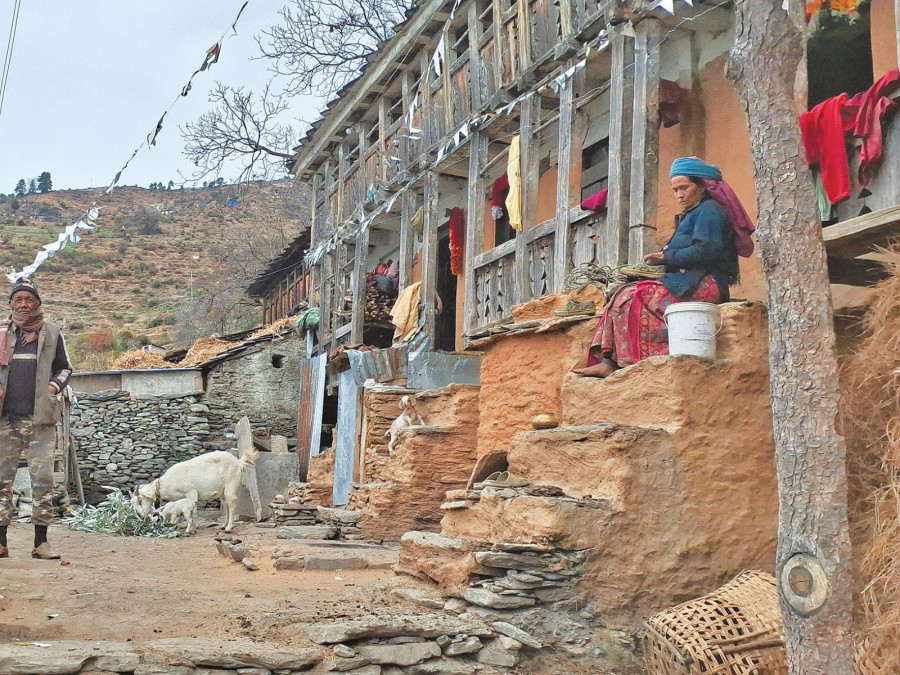
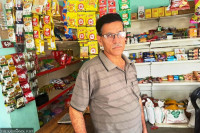
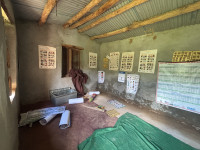
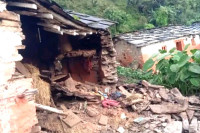
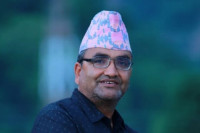
Most families have moved to India cities for work, and the villages have mostly elderly residents and children. An elderly man and a woman pictured this week in front of their homes at Jadepani in Jayaprithvi Municipality in Bajhang. Post Photo: Basant Pratap Singh
Kalu Kami’s house at Jadepani in ward 1 of Jayaprithvi Municipality once buzzed with political hopefuls. During the 2022 general elections, leaders and party workers streamed into his courtyard, eager to win over a family whose collective vote could sway results.
“Sometimes it was leaders, sometimes the party activists. There was always someone at our door. We hardly had time to eat properly. A day or two before polling, they would even post someone here, fearing our votes might be stolen,” said Kalu.
The reason was simple arithmetic. His extended household—five brothers, their wives, sons, nephews and daughters-in-law—accounted for 32 votes. The family voted as one, after internal consultation, making them a prized bloc.
Now, only four eligible voters remain at home. According to Kalu, one on the eve of polling did representatives from two political parties finally turn up at his house to solicit votes. “In the past, candidates themselves would come to seek our support. It felt like an honour for our household. This time, they sent party workers instead,” said Kalu.
Although no candidates visited in person, the family collectively backed the same party they had supported in previous elections. “Even if we did not see the candidate’s face, we discussed it at home and voted for the party we have always chosen,” said Kalu, adding that all four voters in his household cast their ballots for the same party.
The story is repeated next door. Pyaru Sarki’s family once had 27 registered voters. Now just four members remain in the village. “Earlier, one party would arrive and then another. There would be a crowd all day,” he said. “This time, many family members are not here to cast votes. No one has come seeking them either.”
Asked whom he would support in the House of Representative elections, Sarki sounded disillusioned. “What difference does it make? They all make tall promises. Elections come and go, but our hardship remains,” he said, adding that he planned to consult his sons working in Bengaluru (India) before deciding.
Jadepani is home to 47 Dalit families comprising Kami, Damai, Sarki and Okheda by caste. The settlement has 237 registered voters. Yet only 53 are currently present. Twenty-three houses stand locked, their main doors secured with rusting padlocks. The village is inhabited largely by elderly women and children. Most of the registered voters are now in various towns and cities of India for livelihood.
“In past elections, our votes were decisive. Leaders would rush here with assurances and inducements. Now the village is empty. Why would they care about a place without voters?” said Puran Kami, a Dalit right activist. According to him, only two candidates have visited the settlement this campaign. “Families left one after another for India. The village emptied out.”
Jadepani is not an isolated case but emblematic of wider trends across Bajhang, a remote hill district of Sudurpaschim Province long associated with labour migration. While precise, updated migration figures are difficult to obtain, local leaders and residents agree that entire families have increasingly relocated to Indian cities for work, hollowing out villages once animated during election season.
Nirajan Thapa of ward 5 in Khaptad Chhanna Rural Municipality described the changed atmosphere. “There are hardly any people left to vote. Without people, there is no electoral buzz,” said Nirajan. “Earlier, wherever a candidate went, it felt like a mass rally. This time, you see barely 10 or 15 supporters trailing behind.”
In Thapa’s settlement named Chhatarbasti, 192 voters are registered but only 61 are present.
“Earlier, mostly men went to India for work. Now entire families go,” said Chaiti Devi Thapa of Chhatarbasti. Her sons and daughter-in-laws—four votes in total—are in India and did not return to vote due to travel costs. “If they need votes, they should create jobs here,” she vented her ire. “Why should our children quit their work, spend their earnings on travel and vote for leaders who have given us nothing?”
Bajhang has a total 126,903 registered voters—64,614 men and 62,289 women. In the 2022 general elections, around 64,000 votes were cast. Local political actors now predict a significantly lower turnout.
“Every village I visited appeared empty. In some places, there are virtually no people,” said Bhanu Bhakta Joshi, a former minister and former Member of the House of Representatives from Bajhang.
According to preliminary data of the District Election Office in Bajhang, by Thursday evening, voter turnout across Bajhang had reached 46.44 percent. The office said the percentage could rise slightly as reports from some polling centres were still being compiled.
District Election Officer Basanta Bahadur Dhanuk said information had been received confirming that 58,944 votes had been cast across the district by early evening. However, figures from a few remote locations had yet to be updated due to communication difficulties.
“We expect to receive the remaining details overnight. By tomorrow [Friday] morning, we should be able to confirm the exact turnout,” Dhanuk said. Vote counting is scheduled to begin after all ballot boxes are transported to designated counting centres under security arrangements.
Gyan Bahadur Bohara, chairman of Masta Rural Municipality and a leader of the Nepali Congress, shared similar concerns. “Had the election coincided with the Nepali New Year or major festivals like Dashain or Tihar, more people might have returned home and voted. That is not the case now,” he said. “In most villages, only women and the elderly remain. Youths are scarce.”
For residents such as Kalu, however, the arithmetic of democracy feels hollow. The locked doors in Jadepani speak louder than campaign slogans. As families migrate in search of work, political relevance migrates with them.




 14.5°C Kathmandu