Achham palace, rebuilt after Maoist attack, remains unused 14 months after inauguration
Once the centre of government authority, the reconstructed Achham Durbar now stands empty amid delays, political disputes and uncertainty over its future.Menuka Dhungana/TKP
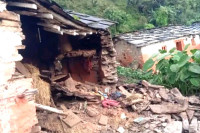
The grandeur of Achham Durbar came to a violent end on the night of February 16, 2002, when then Maoist rebels launched a midnight assault on Mangalsen, the district headquarters of Achham, during Nepal’s insurgency. The palace, the main target of the attack, was left in ruins.
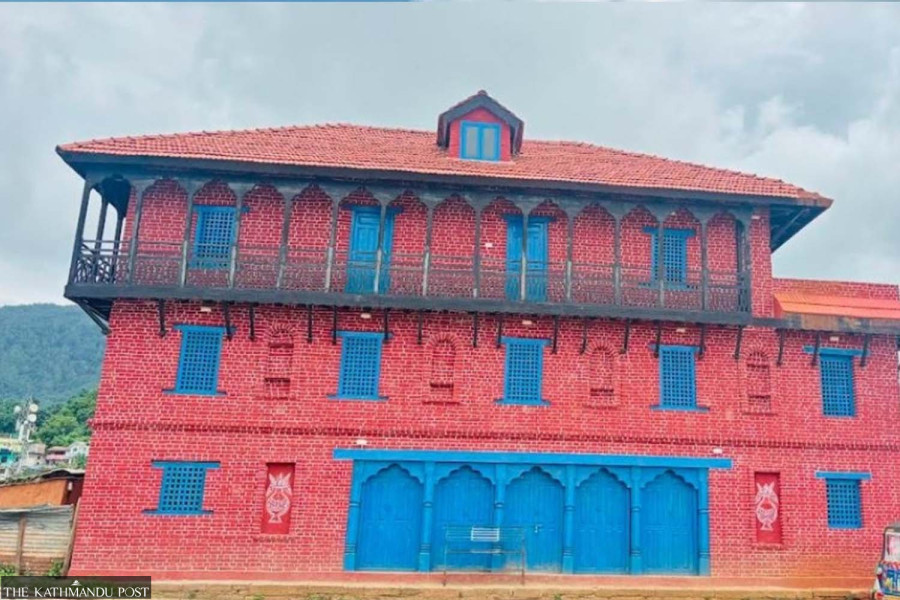
Twenty-four years later, a new palace stands on the same site. But despite taking 16 years to rebuild at a cost of around Rs25 million, the structure remains largely unused and its future unclear.
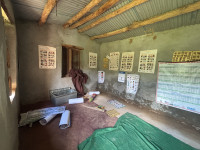
Former deputy prime minister and urban development minister Prakash Man Singh inaugurated the reconstructed palace on March 3, 2025, amid much fanfare. Fourteen months later, the 30-room building still sits empty.
For many residents, the silence surrounding the palace mirrors the trauma left behind by the attack itself.
The foundation stone for reconstruction was laid in 2008. Although the palace has regained its imposing appearance, locals said years of government neglect and political indifference have turned it into a hollow symbol.
For 85-year-old Ratna Dhungana, whose house shares a wall with the palace compound, memories of that night remain vivid.
“Bullets flew as if the sky itself was exploding,” she said while looking out from her window. “People were screaming. I can never forget that night.”
Dhungana said rumours of an impending Maoist attack had circulated earlier that Saturday, prompting families to stay indoors, abandoning even routine tasks such as caring for livestock.
“The rebels’ target was the palace. Since our house was attached to it, we thought we would not survive,” she said.
According to her, Maoist fighters surrounded the palace from five directions, including Balmandir, Naike Tundo, Khulletola, the old prison area and Kudbasti settlement.
Her family faced greater danger because police officers rented rooms in their home.
She recalled rebels accusing the family of hiding police personnel, throwing household items outside and dragging away her son.
“In the end, they opened fire at the back of the house,” she said. “One police officer had lived with us for five years and had become part of the family. I pleaded with them, saying he was my eldest son. That is how I managed to save him. Even today, he still visits me and treats me like his mother.”
Kamman Singh Nagarji, a resident of ward 5 of Mangalsen, said the condition of the reconstructed palace reflects the state’s indifference.
“There was a rush to inaugurate it for political credit,” he said. “The fact that it remains unused 14 months later proves that neglect.”
He said contractors repeatedly cited shortages of timber, delaying the project for years.
“After finally completing construction, the government still could not prepare even a basic operational framework,” he said.
Minraj Bhandari, a resident of ward 8, worked as a cook for police personnel stationed at the palace during the insurgency. He said the celebratory inauguration left him disheartened.
Three of his colleagues, Tikaram Jaisi, Harka Bhandari and Tek Bahadur Thapa, were killed during the attack.
“The first assault on the palace began at 1:22am,” he recalled. “I managed to escape, but my friends were killed.”
He said the families of those killed were not even informed about the inauguration ceremony.
“The whole event was only about political credit over who inaugurated it and under whose tenure,” he said.
During the inauguration ceremony, Singh said the palace should serve as a place where younger generations could learn about the region’s history. But no concrete plan has since emerged.
The palace was rebuilt under the Ministry of Urban Development and formally handed over to the Home Ministry through the district administration office after inauguration.
Chief District Officer Yagya Bahadur Budha said reconstruction itself had not been fully completed, and there was still no operational plan.
“The inauguration process may have been completed, but the palace itself is not fully finished,” he said. “Even now, contractors appear to still be working on parts of it.”
Budha said coordination among federal, provincial and local governments would be necessary because the palace is federal property.
“The quality of some ongoing work is also unsatisfactory,” Budha said. “There is confusion over many aspects.”
So far, the palace has not been used for any major public purpose apart from temporarily housing security personnel deployed from outside the district during parliamentary elections earlier this year.
According to Marichkaji Shrestha, director general at the Ministry of Urban Development, the main palace building covers 320 square metres, while the total palace area spans 960 square metres.
He said the ministry allocated an additional Rs20 million in the previous fiscal year for protective structures and compound walls around the site.
Some residents want the palace turned into a “living museum” documenting Achham’s wartime history and culture, while others have called for government offices to be restored there.
Although a team from the Department of Archaeology has inspected the site, no final decision has been made.
Locals said the historic palace, once a symbol of Mangalsen’s importance after the district headquarters was shifted there from Bayalpata, has become another casualty of political rivalry and bureaucratic delay.
Before the Maoist attack, the palace housed several government offices, including the district administration office, land revenue office and district court. At the time of the assault, only the district administration office remained there.
A total of 122 people were killed in the attack, including 53 soldiers, 59 police personnel, two civil servants, including the chief district officer, and eight civilians.
Construction of Achham Durbar began around 150 years ago during the reign of local ruler Tika Bhuk Shah of Mangalsen and was completed around 1878 under his son, Dal Bahadur Shah.
According to Surat Bahadur Shah, a historian of Achham, the government bought the palace in 1972 from Yogendra Bahadur Shah, son of the Achham king, for Rs90,000. Yogendra Bahadur Shah’s brother, Tapendra Bahadur Shah, an army general, facilitated the sale.
The original palace was a three-storey structure measuring 20 metres in length and 16 metres in width, with 30 rooms.




 15.76°C Kathmandu