Phewa Lake: PM’s push meets decades of encroachment, court orders, and costly reality
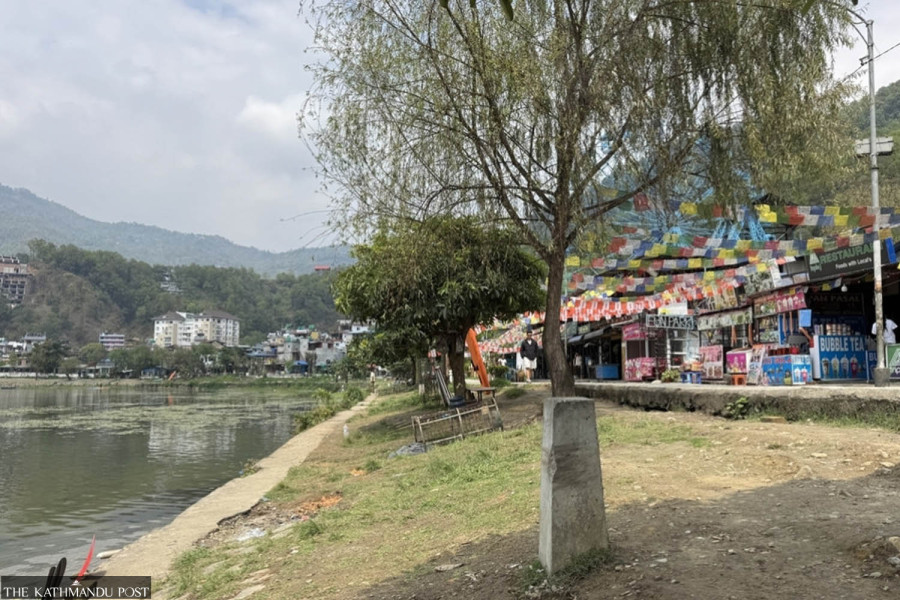
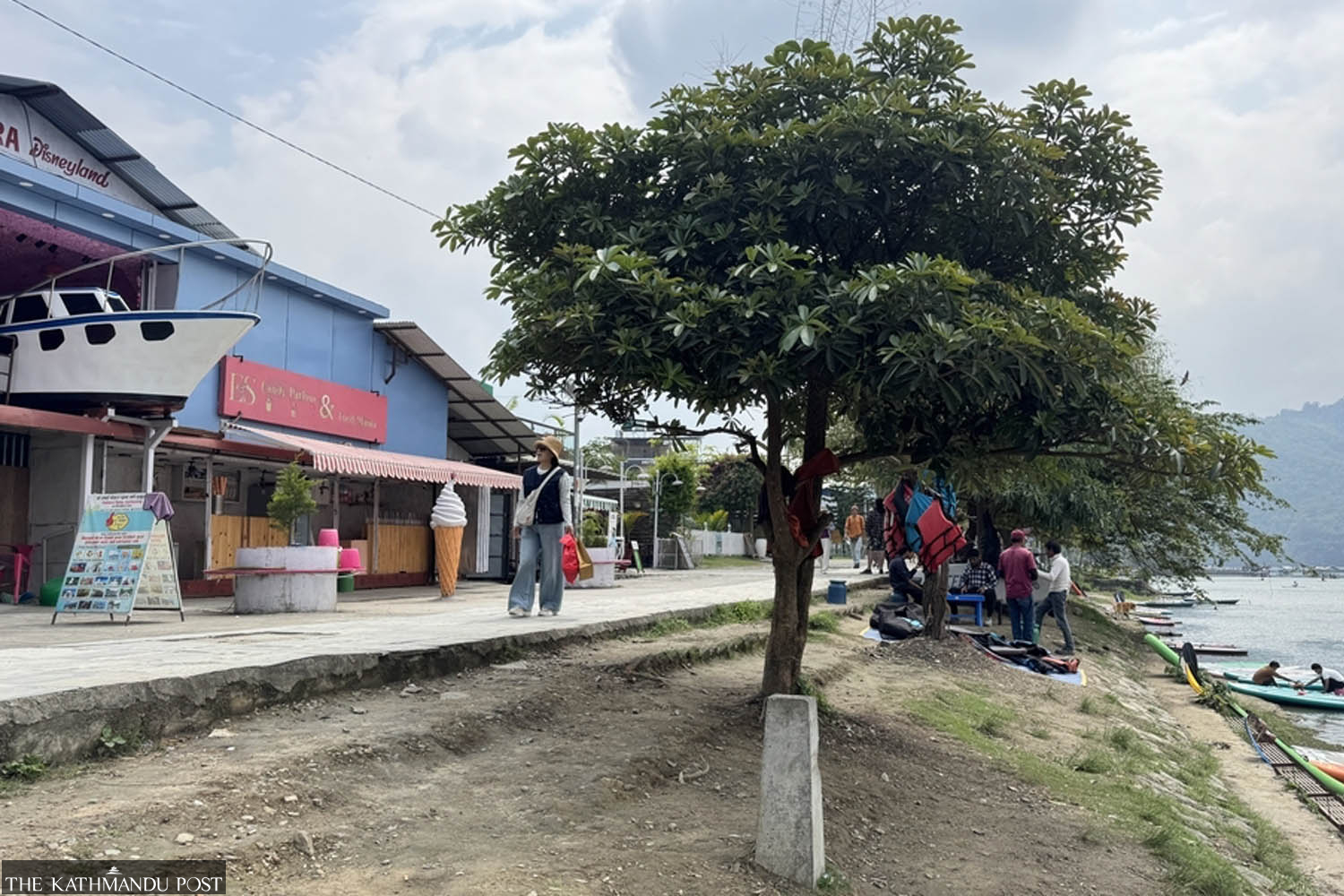
With the Shah government intent on clearing structures around the lake, Pokhara struggles to navigate the legal and financial labyrinth of restoring the iconic lake’s encroached shores. Authorities aim to clear a 65-meter zone around the perimeter of the Phewa Lake. Studies suggest removing structures could cost up to Rs40 billion. Deepak Pariyar/TKP
After the conservation of Phewa Lake was officially integrated into the government's ‘100-point roadmap for administrative reform’, Prime Minister Balendra Shah personally telephoned Mayor of Pokhara Metropolitan City Dhanraj Acharya on Sunday.
He sought a comprehensive progress report regarding the removal of illegal structures around the lake. Acharya provided a concise briefing on the milestones achieved thus far, to which Shah responded with a directive to coordinate closely with the federal tourism minister to expedite the process.
This high-level intervention follows the Shah government’s public commitment to its 100-point agenda. Point 76 of this roadmap specifically mandates the ‘removal of encroachments, restoration, landslide management, source protection, and climate change adaptation in the Phewa Protected Watershed Area.’ The agenda sets an ambitious three-month window to initiate these actions through stakeholder participation to ensure effective protection of the watershed.
The political stakes in Pokhara are uniquely high. Minister for Culture, Tourism and Civil Aviation Khadak Raj Paudel (known as Ganesh), represents Kaski constituency 1. During the 2022 local elections, when Acharya was elected mayor of Pokhara Metropolis, Paudel also contested as an independent candidate under the election symbol of stick—the same symbol that had propelled Shah to Kathmandu’s mayoralty.
Paudel garnered around 3,000 votes in Pokhara, falling short in the mayoral race, and later moved into federal politics. Now, with the lake’s conservation back at the centre of the national discourse, the focus has shifted to the sluggish implementation of successive Supreme Court rulings.
To understand why the implementation remains stalled despite clear judicial mandates to stop encroachment and prevent the lake from being filled by silt, one must examine the complex history of these waters. The current form of Phewa Lake is largely a result of geographical shifts that took place after 1961.
In that year, the Nepal-India Cooperation Mission constructed a dam on the eastern side of the lake, and the government introduced its first land acquisition and compensation policies. Historical records at the dam site suggest the lake spanned 4 square miles (10.36 square kilometres) at that time, though contemporary researchers have struggled to find empirical data to verify this specific figure.
The legal framework for protection began in 1973. Following the approval of the Pokhara Town Plan, a government gazette notification on November 30, 1973 designated Phewa Lake as a protected area. It strictly prohibited any form of construction within 200 feet (60.69 metres) of the lake’s perimeter. By 1974, the government believed the issue of compensation for private land submerged by the lake had been largely resolved.
However, a catastrophic failure of the Phewa dam in 1974 changed everything. As the dam collapsed, the water level receded dramatically, exposing vast tracts of the lakebed at the northern end. This exposed land quickly turned into marshland, which local residents began to cultivate. In 1976, a central survey team arrived in the area. Taking advantage of the receded waters, many local residents managed to register these newly exposed lands as private property during the 1976-1977 land survey.
By the time a new dam was completed in 1981 and the water levels rose again, these “private” plots were once more submerged. A 1981 study by the Nepal government and UNDP subsequently recorded the lake's area at a diminished 5.8 square kilometres.
The 65-metre buffer zone rule, which is currently the subject of intense debate, traces its roots to a 2007 decision by the Kaski District Council. Building on the 1973 town plan, the council moved to prohibit any physical structures within 65 metres of the shoreline.
When this decision was ignored and encroachments intensified, advocates Khagendra Subedi and Ramesh Ghimire filed a writ petition in the Supreme Court on 24 January 2011, naming the Office of the Prime Minister and 15 other government agencies as respondents.
Post file photo
In response, then prime minister Baburam Bhattarai formed a high-level committee led by Bishwa Prakash Lamichhane, chief of Pokhara Valley Town Development Committee, to investigate the encroached land. The 2012 Lamichhane report was a bombshell: it revealed that 1,692 ropani (2498.29 hectares) of lake land had been illegally registered in the names of individuals.
The report detailed how, during the 1976 survey, locals influenced officials to cut plots ranging from 150 to 750 metres in length across what should have been the lake's surface. Approximately 500 ropanis of this land, held by 950 individuals, remains underwater today. Lamichhane’s recommendation was clear: the land ownership certificates for these 1,692 ropani must be quashed.
On April 29, 2018, Supreme Court Justices Om Prakash Mishra and Sapana Pradhan Malla issued a landmark order based on this report. They directed the government to fix the lake’s boundaries within six months, remove structures within the 65-metre zone, and acquire necessary land by paying compensation. Yet, as years passed without action, cases of contempt of court were filed. In 2020, the KP Sharma Oli government formed another committee led by Punya Paudel, which eventually recommended a lake area of 5.726 square kilometres—a figure that was later gazetted.
The conflict escalated further when the then Mayor Man Bahadur GC tried to reduce the buffer zone from 65 metres to 30 metres in 2021. This decision was met with immediate legal challenges. On 20 June 2023, the Supreme Court delivered its final blow to the encroachers. The full text of the verdict, released on 25 September 2023, clarified that the 65-metre zone must be maintained as a “green zone” and that all unauthorised structures—hotels, resorts, and businesses—must be removed within six months.
Crucially, the court ruled that land registered after the 1976 survey was fraudulent. The verdict interpreted the Land Revenue Act 1977 to mean that any public or government land registered by individuals is automatically void. Therefore, no compensation needs to be paid for land registered after 1976. Compensation is only mandatory for those who held valid titles prior to the 1976 survey and have consistently paid land taxes since.
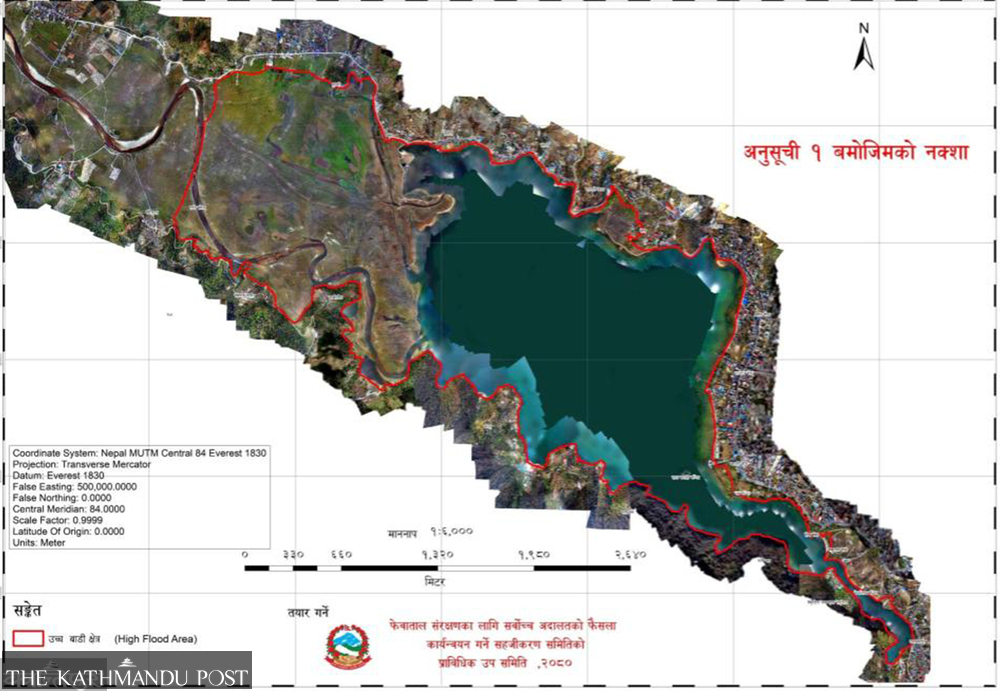
Area of Phewa Lake as determined by the facilitation committee tasked with implementing the Supreme Court of Nepal verdict on its conservation. The revised boundary is based on the lake’s highest recorded water level, in line with the court’s mandamus.
To implement this, a facilitation committee was formed in November 2023 under Gandaki Province Chief Minister Surendra Raj Pandey. A technical sub-committee led by Chief Survey Officer Gangalal Pokhrel was tasked with identifying the lake's highest water level and demarcating the 65-metre boundary. Using DGPS (differential global positioning system) technology and drone surveys, the sub-committee recently determined the lake's area to be 6.343 square kilometres—significantly larger than the previously gazetted figure.
“We have identified 1,055 digital points and installed 611 pillars around the lake to mark the boundary,” explained Prakash Subedi, head of the Pokhara Valley Town Development Committee. Mayor Dhanraj Acharya noted that nearly 4,800 land plots fall within the 65-metre buffer zone. “We are currently distinguishing between public land, fraudulently registered land, and legitimate private land that requires compensation,” Acharya said. He admitted that the recent Gen Z protests, during which the Town Development Committee building was set on fire and vital documents destroyed, have resulted in significant delays.
The financial hurdle is staggering. A 2019 study estimated that if the government implements the 65-metre rule, it would have to demolish 500 permanent structures. Compensation based on government valuation would cost Rs10 billion, while market rates would push the figure above Rs40 billion.
Local entrepreneurs are already fighting back. On May 3, 2024, twenty-two residents, including Surya Bhujel, filed a writ petition in the Supreme Court to halt demolitions. “The government wants to demolish billions of rupees worth of hotels without a clear plan or fair compensation,” Bhujel argued. “The Lamichhane report suggested a 30-metre buffer for certain areas like Lakeside. Why ignore that now?”
While the legal and financial battles rage on, the lake itself is dying. Environmental data from the Ministry of Forests suggests that 142,359 tonnes of soil gets washed into the lake annually. If this siltation continues unchecked, experts warn the lake could vanish within 75 to 100 years.
“We are removing structures on public land already,” Mayor Acharya stated. “But for private land, we need a massive budget to pay compensation. This cannot happen within 100 days.”
As the prime minister’s deadline approaches, Pokhara remains a city divided between the judicial mandate to save its greatest asset and the economic reality of the people who built their lives on its shores.




 14.81°C Kathmandu
.jpg)