Nepal Police is shooting drug suspects more often. It isn’t reducing drug crime.
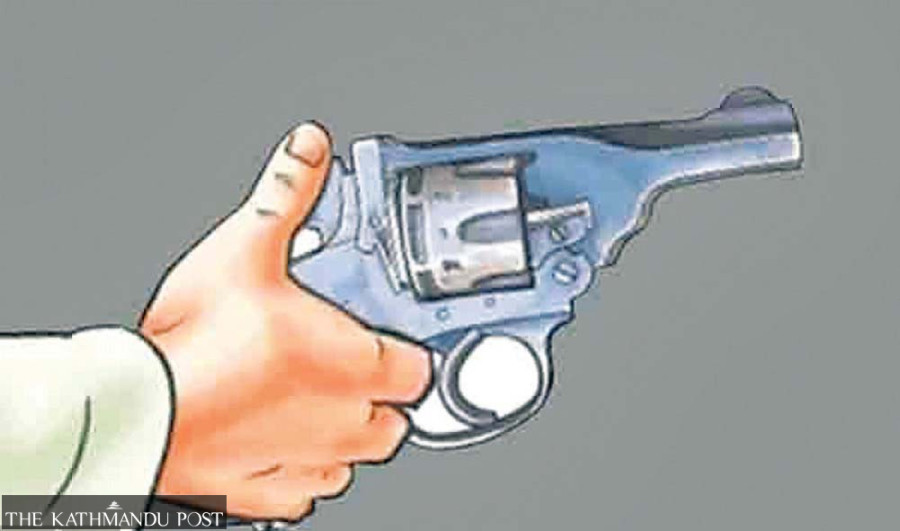
Nepali police have opened fire in 17 drug operations in three years. Officers say the shootings are necessary. The evidence says otherwise. Post Illustration
On the night of April 7, a team from the Narcotics Control Bureau opened fire in Pingalasthan, Kathmandu, while trying to arrest an Indian national, Anil Kumar Paswan. He was shot below the knee and taken to the National Trauma Centre.
Around five hours earlier, there was a similar incident in Kotahawa, Rohini-4, Rupandehi. Police fired shots to detain Bishal Yadav of Khuruhuriya, Rohini Rural Municipality–2, injuring him in the left calf.
The two incidents appear to reflect a broader pattern. Over the past three years, bureau teams have opened fire in 17 separate drug-related operations—six in the fiscal year 2023-24, two in 2024-25, and seven so far in 2025-26. Of those injured or arrested, 11 were Indian nationals. Police say all cases have been pursued under the Narcotics (Control) Act, 1976, and investigations into Paswan and Yadav are underway.
Authorities have offered a consistent explanation in such cases, saying officers fired in self-defence after suspects initiated attacks. In the Pingalasthan incident, Senior Superintendent of Police Krishna Koirala, the bureau chief, said Paswan “pushed and scuffled with police, forcing officers to open fire.”
In the incident in Rupandehi, Deputy Superintendent of Police Krishna Kumar Chand said motorcyclists hurled stones at police, prompting warning shots, and that further firing took place when suspects attempted to flee. “After arresting one drug trafficker, we were trying to trace the main network through him,” Koirala said. “When the team reached Pingalasthan during that operation, he tried to attack the police, leading to the shooting.”
Such incidents have drawn concern from within security agencies as well as from human rights activists.
Former Deputy Inspector General of Police Hemanta Malla Thakuri, a former bureau chief, is not convinced by the police account. “Whether this situation is driven by rising social disorder or an attempt to intimidate, needs to be studied,” he said.
The roots of this approach date back to 2017. On August 7 that year, in Kusunti, Lalitpur, Prabin Khatri — accused of drug trafficking — was killed in a police ‘encounter’. Police said he tried to escape by jumping off a roof when he was shot and was later declared dead at the hospital. Authorities later revealed he was a drug user and had been in rehabilitation.
Mohna Ansari, former member of the National Human Rights Commission, says the case involved excessive force despite the possibility of arrest. “At that time, an investigation was conducted, and recommendations for action were made, I think,” she said. “But I left the commission years ago… and implementation depends on the government.”
NHRC spokesperson Tikaram Pokharel said he was unaware of any complaints filed in recent incidents. “In the past, separate committees were formed, and investigations carried out, and in some cases recommendations for action were made,” he said. “When Kumar Paudel was killed, we clearly stated it was an extrajudicial killing.”
Around the same time, police were also taking an aggressive approach against organised crime. Dinesh Adhikari “Chari”, Kumar Shrestha “Ghaite”, and Manoj Pun were killed in encounters, while some escaped. “Those actions significantly reduced organised crime in the Kathmandu Valley,” a senior investigator said. “Drug trafficking has now reached new heights, and the message that police will act firmly has reached traffickers.”
The belief that those policies worked in the past has become the basis of current practice.
On June 10, 2025, in Tokha-3, Kathmandu, behind Grande International Hospital, police fired four rounds in the air and three aimed shots. Sadik Alam, 38, and Mohammad Manjar Alam, 22, were both shot in the left legs.
According to police, Sadik had earlier been arrested with drugs on September 22, 2023, and had served eight months in the Nakkhu prison before returning to trafficking. His associate Hemanta Bhagat had already been sentenced to 10 years but escaped prison on the second day of the September protests.
Nepal Police spokesperson Abi Narayan Kafle said all fugitives from September 9 are being actively tracked. “Police are continuing the search for fugitives, with those who escaped on September 9 being given priority,” he said.
There are plenty of other, similarly suspicious incidents of police firing.
On February 4, 2025, in Tulasibari, Jhapa, a Bureau team fired six rounds, hitting Indian national Anjar Alam once. Thirty grams of brown heroin were recovered from him, and his brother Yusuf, was also arrested.
On August 14, 2024, in Nepalgunj, Banke, a man from Uttar Pradesh, India, was delivering drugs to a hotel when police arrived. According to police, he attempted to attack officers with a knife and iron knuckles and was shot in the right leg during the operation. Another arrested suspect was only 14 years and 6 months old.
On July 26, 2025, in Bhadrapur, Jhapa, Mohammad Islam was found in suspicious circumstances and was shot below the knee while trying to flee after allegedly attacking police.
Bureau investigators say opium and cannabis are trafficked from Nepal into India, while pharmaceutical and other drugs enter Nepal by exploiting the open border. A senior Nepal Police official said Nepal has repeatedly requested cooperation from Indian authorities on drug control.
However, they say the situation persists due to insufficient support from the Indian side. “For India, this is almost like a business operating on the Nepal side. Senior police officers [in India] are willing to cooperate, but field-level support is lacking,” he said. “We have repeatedly raised this issue.”
Officials say Nepali traffickers sometimes cross into India to smuggle in drugs, while in other cases Indian nationals bring them directly. Bureau investigations have found drugs hidden in speakers, motorcycle fuel tanks, and even ambulances have been used to smuggle cannabis.
However, whether this shooting-based enforcement works in controlling drug trafficking remains a question even within the police.
Thakuri, the former DIG, considers two similar incidents, happening on the same day, worth examining. He questions whether these are coincidences or policy-driven actions. Narconon Nepal director and former Senior Superintendent of Police Basanta Kunwar raises a more direct question. “Government data puts the number of drug users at 134,000,” he said. “But the actual figure is at least one million. If one trafficker supplies to 10 users, that means over a thousand sellers—how many can you shoot?”
As Kunwar points out, despite police firing during arrests, there has been no decline in drug-related arrests or cases over the past three years. Instead, the trend has risen each year.
In 2022-23, police recorded 4,100 cases and arrested 6,186 individuals, including foreign nationals. Seizures included over 20,600 kg of cannabis, along with smaller quantities of hashish, heroin, opium and cocaine.
The following year saw a further uptick, with 4,424 cases and 6,742 arrests. Cannabis seizures jumped to more than 32,500 kg, while heroin and opium confiscations also rose, even as hashish and cocaine hauls showed slight declines.
The upward trend continued in 2024-25, when cases climbed to 5,110 and arrests to 7,943. Cannabis seizures surged to a record 51,439 kg, accompanied by significant increases in heroin and opium, as well as a rebound in hashish and cocaine.
These three years of data show that despite enforcement, drug trafficking has not declined, and the number of offenders continues to rise. Kunwar said Nepal needs a structured system for identifying users, treatment, and rehabilitation rather than relying on force.
Police spokesperson Kafle said the police force is working to intercept cross-border smuggling networks and raise awareness at the local level.
He said most serious crimes are now linked to drug use. “From rape to financial crimes to homicide, drug consumption is linked to many cases. That is why it is being prioritised as a key area of crime control,” Kafle said. “Campaigns including cannabis and opium eradication are also being carried out.”
Police officials, however, maintain that all shooting incidents are situational. “Shots are only fired after police come under attack,” SSP Koirala said.




 14.69°C Kathmandu