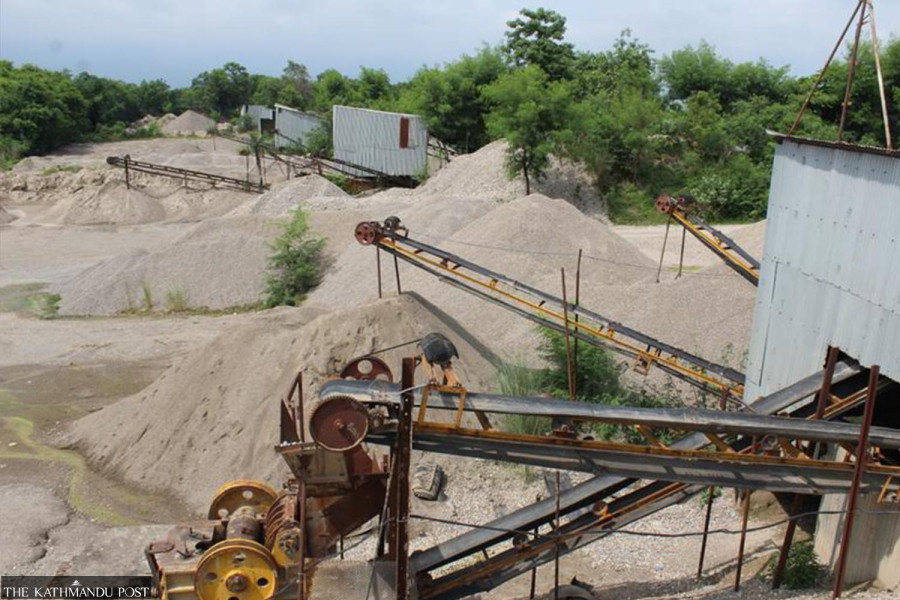
Many crusher plants across Lumbini Province have halted production following a directive from the home ministry to immediately shut down illegal units. Many are reported to have been operating for a long time without renewing registration, while even registered entities have flouted the set standards.
Despite being registered as sand processing units, most of the crushers operating in Lumbini have been churning out sand and pebbles. As a result, operators have shut down units, fearing action, said Gopal Gyawali, chair of the Lumbini Stone and Pebbles Entrepreneurs’ Committee.
Crushers typically obtain permits from local governments to purchase a fixed quantity of riverbed materials, which they process and sell. However, operators have been purchasing smaller quantities through official channels and extracting materials illegally from nearby rivers, prompting the ministry to initiate a process to control such practices.
The ministry’s Peace, Security and Crime Control Division on March 31 wrote to the Police Headquarters and all 12 district administration offices in the province, ordering an immediate closure of illegally operated crusher plants.
The letter issued by division officer Dipak Kumar Acharya said the directive followed complaints from the Gen Z Council, Lumbini.
In response to the directive, the chief district officers (CDOs) in Lumbini have begun collecting details of crusher plants with the help of local governments and police. In the first phase, CDOs have sought information on the operational status and registration of the crushers, while local governments and police have been providing the details.
According to Gyawali, around 120 crusher plants are in operation across six Tarai districts of the province, with the highest number in Dang (45), followed by Rupandehi (34), Kapilvastu (22), Banke (12) and West Nawalparasi (5). Temporary plants operating under the pretext of construction projects are found in the hill districts of Pyuthan, Arghakhanchi and Gulmi.
Most have shut down following monitoring by CDOs. “Many of these units were registered before 2008 with the then Cottage and Small Industries Development Committee under the old standards,” he said. “They are not illegal, but they do not meet the new standards.”
He said that although no formal shutdown order has been issued, crushers halted production fearing action, leading to a shortage of construction materials.
After widespread illegal operations, the government amended the standards related to stone, gravel, sand excavation, sale and management 2020. The revised standards reduced the required distance for operating crusher plants from riverbanks, concrete bridges, highway right-of-way areas, historic lakes, ponds, reservoirs, dense settlements, forests, national parks, reserves, international borders, educational institutions, and sites of religious, historical and archaeological importance, as well as security offices.
Previously, the extraction of riverbed materials required maintaining a distance of one kilometre from dense settlements in the Tarai and 500 metres in the hills. The revised standards now allow crusher operations at a distance of 500 metres from highways in the Tarai and 200 metres in the hills.
Earlier, crusher plants were not allowed within two kilometres of forests, but this has been reduced to 500 metres. The new standards also permit crusher operations at distances of 300 metres from highways, 200 metres from riverbanks and 500 metres from bridges. However, many crusher firms are found to not have complied even with these revised standards.
CDOs plan further action after reviewing compliance with the latest standards, registration status and operational details.
Dipak Raj Nepal, chief district officer of West Nawalparasi, said monitoring has begun to assess whether the crushers are complying with legal standards. “We have increased supervision of documents and operational procedures of all crusher plants in the district,” he said. “After collecting details and conducting inspections, action will be taken against those found operating against the rules.”
Bishwo Prakash Aryal, chief district officer of Dang, said discussions are ongoing on how to proceed after studying crusher plants across the district. According to him, 16 units are operating as stone crushers and 17 as sand processing units in Dang.
“Many appear to have been registered under previous laws but do not meet current standards,” he said. “There is no clarity in the directive on how to deal with such cases, so discussions are ongoing.” He added that although many firms have renewed their registration, they cannot automatically be considered legal.
The shutdown has led to shortages of construction materials for major projects. Construction of the Lumbini Provincial Hospital building, considered a pride project of the provincial government, has been affected.
Contractor Sher Bahadur KC said supplies of riverbed materials have been halted, affecting construction. “We are working on the fourth floor,” he said. “But a lack of riverbed materials has taken a toll.”
Similarly, construction of the Butwal-Gorusinge section of the Butwal-Chandrauta road project has also been affected due to the shortage of materials.
With materials in short supply, the project has reduced its workforce from 1,500 to around 300, said project chief engineer Kulashata Neupane. “There is a severe shortage of riverbed materials and soil,” she said. “Contractors have informed us that they are unable to source materials from anywhere.”
Despite agreements to supply materials in coordination with local governments, she said the Butwal Sub-metropolitan City has not provided necessary help.




 25.92°C Kathmandu