Ruling party apologises to Dalits for historical injustice. But communities demand real change
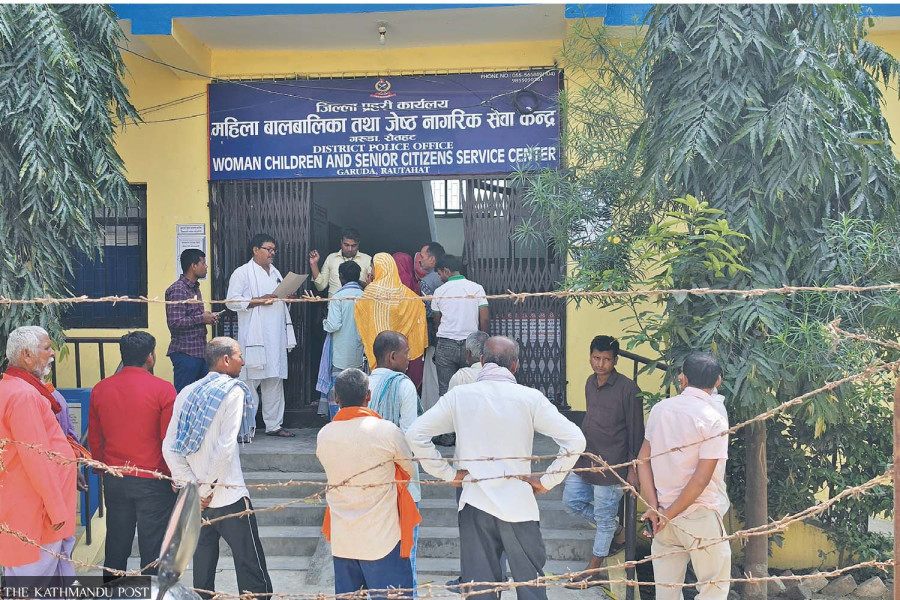
The government had promised to deliver a formal apology within 15 days of assuming office, alongside reform programmes for social justice. Jaruwa Devi Paswan and others at the Women, Children, and Senior Citizen Service Centre in Garuda, Rautahat on Friday, seeking justice after she was assaulted by neighbours when her livestock strayed into their fields. Shiva Puri/TKP
In a landmark move aimed at addressing centuries of systemic oppression, the ruling party has formally decided to issue a public apology to the Dalit and historically marginalised communities. The decision, which appears as the fifth point of the government’s 100-point governance reform agenda, marks the first time the Nepali state has officially acknowledged the institutionalised ‘injustice, discrimination, and deprivation of opportunities’ against these oppressed groups.
The government had earlier pledged to deliver a formal apology within 15 days of taking office, alongside the announcement of reform-oriented programmes designed to foster social justice, inclusive rehabilitation, and historic reconciliation. On Thursday, the chairman of ruling Rastriya Swantantra Party (RSP), Rabi Lamichhane, took to the rostrum of the House of Representatives to offer an apology on behalf of his party and the government.
“No Nepali shall ever have to bow down again in the name of caste. I apologise on behalf of my entire party, the prime minister, and the government,” said Lamichhane before the parliament. “I want to ensure that the value of this apology is now secured by justice.”
While right activists and stakeholders have welcomed the proclamation as a ‘positive and historic step,’ the ground reality—particularly in rural areas—suggests that words from the national capital are struggling to penetrate the deeply entrenched caste hierarchies.
The gap between policy and practice
Even as the state prepares its formal apology, victims of caste-based violence continue to suffer from poor implementation of legal provisions and policies.
Ramhari Shahi Samundri, a prominent activist and central member of Mukti Samaj Nepal, said that the Dalit community continues to face systemic exclusion in Nepali society.
“The state historically institutionalised discrimination through its own laws and policies, causing prolonged suffering for the Dalit community,” he said. “While it is a positive step for the state to acknowledge its past mistakes and offer an apology, the focus must be on translating this gesture into practice.”
He further pointed out that the persistence of discriminatory incidents, even years after Nepal was declared an untouchability-free nation, raises serious questions about the state’s ability to enforce its laws. According to Shahi, the objective should not only be ‘reform’ but the total eradication of discrimination.
To achieve this, Shahi stressed the importance of state-led initiatives to guarantee the Dalit community’s access to education, healthcare, and employment, alongside nationwide social awareness campaigns. “The government must go beyond proclamations. It needs to develop a concrete action plan with fixed timelines and ensure its effective execution," he said.
While the government in Kathmandu was busy announcing apologies and the end of discrimination, Jaruwa Devi Paswan (name changed for protection) of Dewahi Gonahi Municipality in Rautahat district was forced to visit the Women, Children, and Senior Citizen Service Centre in Garuda on Friday, seeking justice for an assault that occurred on January 27.
Paswan said she was brutally beaten by her neighbours, Ramsurath Sah and Dharmanath Sah, after her livestock accidentally entered their fields. “I was beaten simply because my cattle strayed. I demand action against these so-called ‘upper-caste’ individuals,” she said. According to Paswan, she was attacked even while she was apologising and trying to remove her goats from the field.
Sub-Inspector Deepika Ojha, head of the service centre, said that justice has been delayed as the centre initially tried to facilitate a communal discussion to guarantee the victim’s safety and medical expenses. “We have registered the application and the process is moving forward. We hope to conclude this in the next discussion,” said Ojha.
Dharmendra Paswan, a National Assembly member, argues that such incidents are not just disputes between farmers but symptomatic of a deeper malaise. “Physical assault and caste-based discrimination under any pretext is a criminal offence,” he said. “The discrimination against Dalits in Madhesh has not disappeared. I will raise this issue in the National Assembly.”
On October 30 last year, Jhamki Kumari Das (name changed) of Katahariya Municipality was assaulted by her neighbours, Bishwa Yadav and Saroj Kumar, following a dispute between their children.
Immediately after the incident, Das filed a complaint seeking justice at the Women, Children, and Senior Citizen Service Centre in Garuda. According to the centre, the altercation began between children from the Das and Yadav families; however, Das was physically attacked while attempting to break up the fight.
Following her application, the service centre facilitated a discussion between the two parties. The centre reported that the dispute was eventually settled after the Yadav family offered an apology. Both sides signed a mediation agreement, pledging to refrain from further altercations or the use of derogatory language in the future.
Recurring pattern of violence against Dalits
Data suggest a grim picture. According to the Women, Children and Senior Citizen Service Centre in Garuda, 77 cases of social violence against Dalits were registered in the fiscal year 2023-24. This rose to 84 cases in 2024-25. In the current fiscal year of 2025-26, 73 cases have already been registered since July, indicating no decline in caste-motivated hostility.
Rights activist Devaki Nepal points out that while the nature of violence may shift, the underlying intent remains the same. “It is alarming to see the rise in verbal abuse, physical assaults, and the use of derogatory language by those from so-called upper castes,” she said.
One of the most harrowing recent accounts involved a Dalit settlement in ward 5 of Phatuwa Bijayapur Municipality. During the Holi festival in March, a mob of 14 to 15 people, allegedly led by Pasindar Yadav, entered the settlement and launched a coordinated attack.
Lalan Kumar Ram, his father Birja, mother Gayatri, and brother Rajkumar were among those injured. “They attacked us unprovoked under the pretext of election campaigning,” said Lalan. “When we sought justice, the Area Police Office instead detained my father and brother. Where is the justice in that?”
The police claimed they detained the Dalit family members because another individual, Bhubaneshwar Yadav, was found bleeding at the scene. However, the victims maintain they were the primary targets of a caste-motivated assault that left several community members with head injuries requiring multiple stitches.
Segregation in social and religious activities
Caste discrimination in Rautahat extends beyond physical violence into the realm of spiritual and social exclusion. During the Chhath festival at the Chandi riverbank in ward 5 of Chandrapur Municipality, the Dalit community, including Sanu Majhi, reported being barred from sharing the main ghat (riverbank area) with other communities.
“It hurts that the upper-caste people told us to sit separately," said Majhi. “Chhath is supposed to be an inclusive festival where caste does not matter, yet we were forced to put up a separate tent to perform our prayers.” Sixteen Dalit families observed the Chhath festival in separate places along the Chandi riverbank.
Similar reports of segregated Chhath sites have emerged from Rajpaida, where Musahar and Ram communities are designated specific, isolated areas for worship.
Trap of ‘social compromise’
Despite the Caste-Based Discrimination and Untouchability (Offence and Punishment) Act 2011, which criminalises such acts with imprisonment and fines, legal experts say the law is often bypassed through ‘social compromises’.
Advocate Bipin Gautam said that most incidents in Rautahat, a Tarai district of Madhesh Province, are ‘settled’ by village elders before they even reach police. “These forced compromises do not bring justice; they only make the perpetrator more powerful,” said Gautam. “Until the political protection of criminals ends, this cycle will continue.”
According to Sunder Purkoti, spokesperson for the National Dalit Commission, among the seven provinces, Madhesh reports the highest number of Dalit mistreatment cases. “When a community faces injustice, people’s representatives often stand by as silent spectators. The local administration must introduce proactive incentive programmes to reduce discrimination,” he said.
Nepal was formally declared an untouchability-free nation on June 2, 2006. However, nearly two decades later, the gap between the constitutional guarantees and the lived experience of the Dalit community remains vast.
Various reports show how Dalits in urban areas continue to face difficulties in renting apartments, while those in rural areas are frequently barred from public taps and wells. Inter-caste marriages, while legally protected, often result in social boycotts or, in extreme cases, fatal violence, such as the 2020 Soti incident in Rukum West.
Author and researcher JB Bishwokarma has described the state’s decision to offer a public apology as a positive step, acknowledging that discrimination against the Dalit community was historically systematic and planned. He said such an apology is both necessary and meaningful, given that state policies and structures themselves were responsible for creating an environment of exclusion.
Bishwokarma emphasised that since Dalit rights are explicitly enshrined in the constitution, these provisions must be implemented with resolve. He suggested that the government implement a rapid-response mechanism for caste-based crimes, similar to child-protection helplines. “Local governments should also follow the federal government's lead and apologise to their local Dalit communities.”
The government apology aligns with international precedents where states have sought to reconcile with historically wronged populations.
In 1995, New Zealand issued a formal apology to the Maori community for land confiscations and injustices committed during the colonial era. Similarly, in 2009, the United States passed a resolution formally apologising to African Americans for the ‘fundamental injustice, cruelty, brutality, and inhumanity of slavery’.
In the South Asian context, warns rights activist Dhan Kumari Sunar, an apology without a roadmap is hollow. “We have had many declarations in the past that were never implemented,” she said. “The state must ensure proportional representation in all bodies, equal access to education and employment, and turn social inclusion from a policy into a reality.”




 19.98°C Kathmandu