Delays in reaching hospitals cost mothers’ lives in Karnali
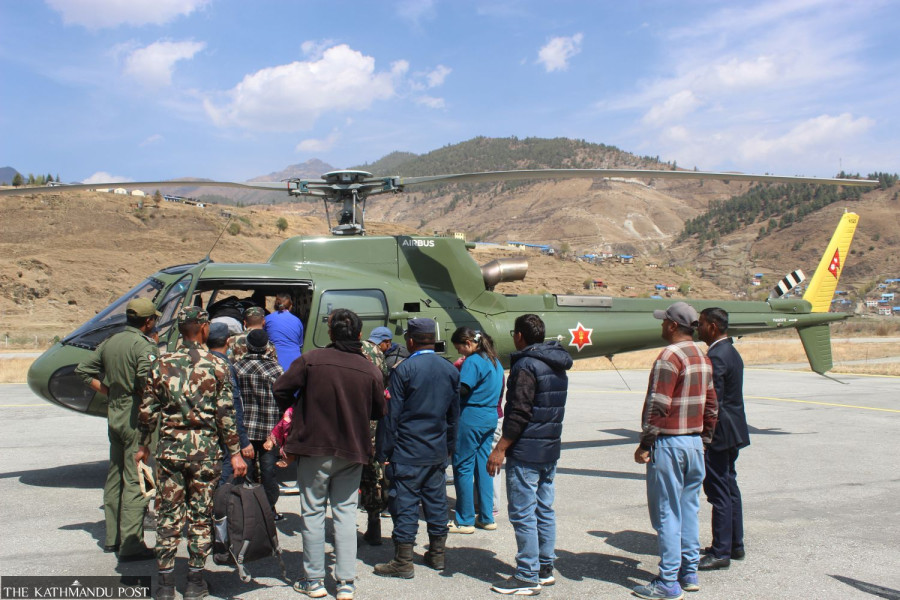
Pregnant and postpartum women often reach hospitals too late in the province, as remoteness and harmful practices prevent timely lifesaving care. An army helicopter that arrived in ward 3 of Tila Rural Municipality in Jumla on March 9 to medivacuate Asmita Nepali after prolonged labour at home. She died after giving birth. DB Budha/TKP
Eighteen-year-old Asmita Nepali from ward 3 of Tila Rural Municipality reached the Karnali Academy of Health Sciences Teaching Hospital on March 9 after enduring prolonged labour at home. By the time she arrived, her condition had already become critical. Although she delivered her baby, she did not survive.
Doctors made repeated efforts to stabilise her condition. “She had severe complications affecting her kidneys and lungs,” said Kamal Thani, director of Karnali Academy of Health Sciences Teaching Hospital. “We kept her in intensive care for three days, but we could not save her.”
As her condition deteriorated, she was airlifted by a Nepali Army helicopter to the Provincial Hospital in Surkhet on March 12, where she was pronounced dead later that night.
According to local residents, Asmita's family initially sought help from traditional healers instead of taking her to a health institution when labour started. “They turned to faith healers first, and by the time they took her to the hospital, it was already too late,” said a local, requesting anonymity.
Asmita’s case is not an isolated tragedy in the area. Just a month earlier, 30-year-old Muga Shahi from ward 1 of Tatopani Rural Municipality died shortly after being taken to the hospital. Her newborn also did not survive. Family members had attempted a home delivery, but when she suddenly lost consciousness, she was rushed to the hospital and placed in intensive care. “Even with ventilator support, we could not save her,” a doctor involved in her treatment said, adding, “The baby had already died on the way.”
According to the health workers, such cases are common in Karnali, where many families do not take women to the hospital immediately after labour begins. “Delays in bringing pregnant women to health facilities put both mother and child at serious risk. By the time they arrive, complications are often beyond our capacity to manage," said Thani.
Harmful postnatal practices have also claimed lives in the rural parts of Karnali, the country's remotest province. In August last year, 22-year-old Mayalaxmi Mahatara from ward 6 of Patarasi Rural Municipality died after inhaling smoke from a fire lit indoors to keep her warm during the postnatal period. She was 11 days postpartum. Despite treatment at the health academy, doctors could not save her.
Geographical remoteness, deep-rooted traditional beliefs and limited access to quality maternal care facilities continue to endanger pregnant women and postpartum mothers across Karnali. Many women still give birth at home, even in settlements located near birthing centres, where services remain underutilised. In more remote villages, fear of supernatural forces on the way and reliance on traditional healers discourage families from seeking institutional care.
Kali Bahadur Thapa of ward 9 of Tila said pregnant women in remote areas are effectively left to fate. “Health facilities are far away, and health workers are not always available on time,” he said. “Even basic medicines are out of reach in remote areas."
Thapa recalled that more than half a dozen women from his village had delivered their babies on the way while being carried to birthing centres. “There are no proper roads, and transport is scarce. Women suffer the most," he added.
According to the Karnali Provincial Health Directorate in Surkhet, as many as 172 maternal deaths have been recorded in the province over the past nine years. Health experts warn that the real figure may be higher due to underreporting in remote areas.
Sabita Khadka, chief of nursing at the Karnali Academy of Health Sciences, said multiple factors contribute to the persistent risks. “Many women do not attend regular antenatal check-ups or take necessary supplements. They often cannot make decisions about their own health and must wait for family approval to seek care," said Khadka.
Women in districts such as Jumla, Humla, Mugu, Dolpa and Kalikot face the highest risks. “They cannot reach hospitals in time, and rescue efforts are often delayed,” said Basmati Rokaya, a resident of ward 9 of Tila. “It feels as though they are left waiting for death.”
Although government policy mandates regular antenatal care and institutional deliveries, implementation in remote regions remains weak, leaving many women in Karnali at high risk.




 13.68°C Kathmandu