



 15.68°C Kathmandu

Fri, Oct 23, 2026
Money
NEPSE falls as flood concerns weigh on insurance, hydropower
The index slips 0.57 percent in a four-session week, erasing about Rs30 billion in market value as thin trading and weak momentum keep the market near key support.
bookmark![]()
![]()
Pritam Bhattarai
Published at : September 5, 2026
Updated at : September 5, 2026 11:12
Kathmandu
The Nepal Stock Exchange remained under pressure last week, with concerns over the financial impact of the Bhotekoshi disaster weighing particularly on insurance and hydropower stocks.
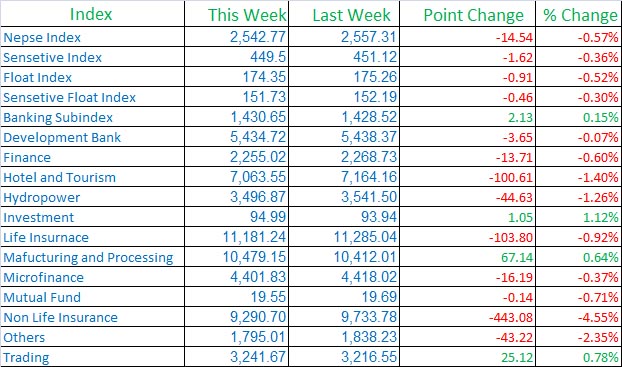
The benchmark index fell 14.54 points, or 0.57 percent, to 2,542.77 over the four trading sessions from August 31 to September 3. The Sensitive Index, which tracks class ‘A’ companies, declined 1.62 points, or 0.36 percent, to 449.50.
Market capitalisation fell by about Rs30 billion to Rs4.37 trillion from Rs4.40 trillion the previous week, erasing roughly Rs30 billion in market value. Turnover also declined 18.51 percent to Rs12.81 billion from Rs15.72 billion.
Ten of the 13 sectoral indices fell, pointing to broad-based selling despite the relatively modest decline in the benchmark.
Technical picture remains weak
NEPSE is trading below its 20-day and 50-day moving averages, indicating that the broader trend remains weak. The relative strength index, or RSI, was around 32, close to oversold territory, suggesting selling pressure could be easing and leaving room for a short-term rebound. The MACD, however, remained negative, signalling that bearish momentum persists.
The 2,500-2,510 area is the key support zone, while 2,590-2,640 represents immediate resistance. A sustained move above the resistance zone, backed by stronger turnover, would provide a stronger signal of a trend reversal.
Insurance and hydropower under pressure
Non-life insurance was the worst-performing sector as investors weighed the potential cost of claims arising from the Bhotekoshi disaster. Life insurance stocks also declined.
Hydropower was another major drag on the market. Concerns over possible damage to projects during the monsoon, along with the prospect of additional shares entering the market as lock-in periods expire, kept investors cautious.
Hotel and tourism stocks also fell on profit-taking, while mutual funds, finance companies, development banks and microfinance companies recorded smaller declines.
Banking was among the few sectors to gain and showed greater resilience than other major sectors. Trading, investment, and manufacturing and processing also advanced.
Chartered accountant and market analyst Manish Aryal said insurance and hydropower remained particularly vulnerable following the disaster. However, he said NEPSE had shown signs of stabilising around 2,500 over the past three sessions.
“If volume supports the market, it could move higher from this point,” Aryal said. He estimated that daily turnover would need to reach around Rs8 billion for a stronger market move.
Trading remains concentrated
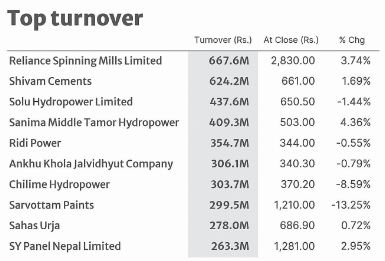
Reliance Spinning Mills recorded the highest turnover at Rs667.6 million, followed by Shivam Cements at Rs624.2 million and Solu Hydropower at Rs437.6 million.
Hydropower stocks dominated trading by volume, with Rasuwagadhi Hydropower recording 1.162 million shares changing hands, followed by Ridi Power with 1.027 million and Shivam Cements with 944,000.
Among individual stocks, Upakar Laghubitta was the biggest gainer, rising 21.51 percent to Rs2,926. Maya Khola Hydropower and Asha Laghubitta gained 9.19 percent and 7.40 percent, respectively.
Pure Energy was the biggest loser, falling 13.80 percent to Rs662, followed by Sarvottam Paints, down 13.25 percent, and Mailung Khola Jal Vidhyut, down 10.77 percent.
Banking key to next move
Aryal said the banking sector could drive the market in the coming weeks because of its substantial weight in NEPSE and its relative resilience during the recent sell-off.
He also said reconstruction spending and increased international assistance could eventually support the market by boosting economic activity and capital mobilisation.
For next week, the outlook remains cautious. A sustained break below 2,500 could trigger further selling, particularly in insurance and hydropower. A rebound would require stronger buying interest and a significant increase in turnover.
With the index near support, the RSI approaching oversold territory and banking stocks showing relative strength, NEPSE has room for a short-term bounce. But unless turnover picks up and the index breaks through the 2,590-2,640 resistance zone, the market is more likely to remain range-bound than enter a sustained recovery.




Most Read from Money

Nepal travel agents threaten to stop selling Thailand trips over visa rules

Why does an hour long flight to Dhangadhi cost more than a flight to New Delhi?
Malaysia rejects Nepal’s demand to open recruitment to all manpower agencies

No school, but a graduation cap for women dairy farmers

Nepal arrests four medical service providers as Malaysia recruitment row deepens
Editor's Picks




E-PAPER | October 23, 2026

×