



 18.82°C Kathmandu
Mon, Oct 19, 2026
Money
Krishnabhir collapse disrupts LPG supply to Kathmandu
Nepal Oil Corporation says it has prioritised household supply but denies banning sales to hotels and restaurants. Businesses warn they may be forced to shut if shortages persist.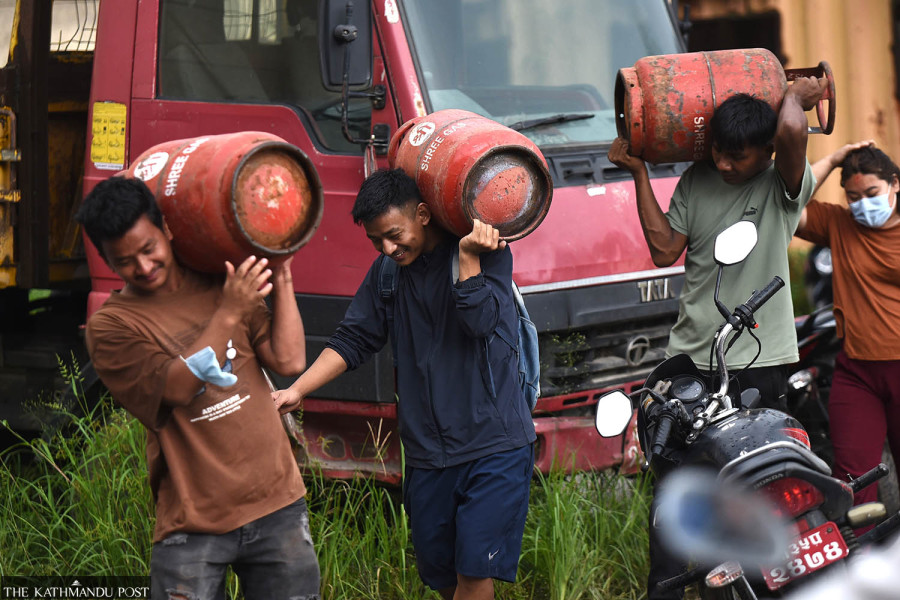
bookmark
Krishana Prasain
Published at : September 3, 2026
Updated at : September 3, 2026 20:12
Kathmandu
A report circulating on Wednesday that cooking gas would be supplied only for household use and not to commercial establishments added to growing uncertainty over LPG supplies amid a crippling shortage across the country.
Nepal Oil Corporation, the state-owned petroleum monopoly, said it had prioritised the distribution of liquefied petroleum gas to people affected by the August 26 disaster, followed by household consumers. But it said it had not issued any notice barring hotels, restaurants and other commercial establishments from obtaining LPG.
“The corporation has not made any official decision. Our main aim is to make supply smooth,” said Manoj Kumar Thakur, deputy director at the corporation.
The Kathmandu Valley normally consumes 35,000 to 40,000 LPG cylinders a day. The disruption of the Prithvi Highway and other major roads linking the capital with the Tarai has severely affected supplies.
“Demand is huge and we can supply it, but the condition of the roads has hampered distribution,” Thakur said.
Officials said it now takes several days to transport LPG to Kathmandu Valley consumers because of the damaged road network.
In a press statement on Thursday, the corporation said it had supplied 24,500 LPG cylinders of different brands in the Kathmandu Valley and would continue deliveries.
Residents of Kathmandu, however, have been struggling to obtain cooking gas since February, with supply disruptions becoming more acute following the recent floods and landslides.
The Bhotekoshi River flood on Wednesday disrupted the Prithvi Highway for three days. The highway then caved in at the Krishnabhir section on Sunday, further disrupting the main supply route into Kathmandu.
It remains uncertain when the highway will fully reopen.
“The import of LPG is normal from India,” Thakur said. “The problem is transportation.”
LPG is transported in bullet tankers, each capable of carrying enough gas to fill around 1,250 cylinders. Four trucks are required to transport the equivalent number of cylinders, according to the corporation.
“The supply will now depend on the road,” Thakur said.
For commercial consumers such as hotels, restaurants, and party palaces, the corporation has said LPG can be supplied directly from factories in Tarai. But the arrangement is difficult for many businesses because of the security and logistical challenges involved in transporting cylinders themselves.
Loaded LPG bullets remain stuck in the Tarai because of the disruption on the highways. At the same time, empty cylinders from around 22 bottling plants in and around Kathmandu Valley have to be transported to the Tarai before being refilled and brought back to the capital.
Restaurant operators said most businesses cannot arrange this process on their own.
“We met Industry Minister Gauri Kumari Yadav Thursday after hearing reports that restaurants and hotels would no longer be supplied LPG. She dismissed the reports and said she was willing to discuss how best to manage supply,” said Sangharsha Bista, president of the Restaurant and Bar Association Nepal.
Bista said it would not be feasible for many restaurants to transport LPG cylinders themselves because of security concerns and logistical difficulties.
“Supplying a cooking gas cylinder is neither a short-term or long-term solution,” he said. “If the government cannot even supply cooking gas from Hetauda, it raises serious questions about the ability of the government in a situation like this.”
Some big hotels and restaurants have already started arranging their own supplies, but this is not an option for most businesses, Bista said.
“If the supply does not improve by the coming week, then restaurants will have no option but to shut down their businesses,” he said.
According to the association, a restaurant typically requires five to six LPG cylinders a day during the tourist season and two to three cylinders during the off-season.
Shiva Prasad Ghimire, immediate past president of the Nepal Liquefied Petroleum Gas Industry Association, said LPG supplies from Tarai districts to Kathmandu had resumed on Wednesday.
“First, empty gas cylinders have to be sent to the Tarai, after which trucks with a capacity of up to 500 cylinders bring the full cylinders back to Kathmandu,” Ghimire said.
“There is a gap between demand and supply, and it has created pressure in the market. It might take a few days to manage the supply to meet daily demand,” he said.
The cylinders supplied to Kathmandu are distributed through authorised distributors, who then sell them to consumers.
According to the LPG industry association, factories in Makawanpur, Parsa, Bara and Nawalparasi have started supplying LPG to the Kathmandu Valley. Initial supplies stood at around 8,000 cylinders and are expected to increase gradually depending on road conditions.
LPG bottling plants closer to Kathmandu remain largely shut because bullet tankers carrying imported gas have been unable to reach them due to cave-ins and landslides along the Prithvi Highway.
Traders said loaded trucks carrying LPG cylinders are entering Kathmandu via the Tribhuvan Highway route from Hetauda through Bhainse and Naubise, while empty cylinders are being sent out through the Kanti Highway.
The disrupted supply chain is also adding to transportation costs.
“The transportation cost to bring cylinders will add Rs100 to Rs105 to the retail price of cooking gas because of the difference in internal transportation costs,” Ghimire said. “We have also reached an agreement with transport entrepreneurs.”
The additional transportation cost will be reflected in the price of cylinders arriving in the market, he said.
An LPG cylinder currently costs Rs2,060.
Krishana Prasain
Krishana Prasain is a business reporter for The Kathmandu Post covering markets. Before joining The Kathmandu Post in 2018, she spent 3 years in New Business Age magazine covering business.


Most Read from Money
Nepal travel agents threaten to stop selling Thailand trips over visa rules

Why does an hour long flight to Dhangadhi cost more than a flight to New Delhi?
Malaysia rejects Nepal’s demand to open recruitment to all manpower agencies

No school, but a graduation cap for women dairy farmers
Nepal arrests four medical service providers as Malaysia recruitment row deepens
Editor's Picks




E-PAPER | October 19, 2026

×