



 20.12°C Kathmandu

Mon, Sep 14, 2026
Money
Nepali pickles find their way to global markets
Exports cross Rs211 million as homegrown brands reach markets from Italy to Australia, while entrepreneurs transform traditional recipes into commercial ventures.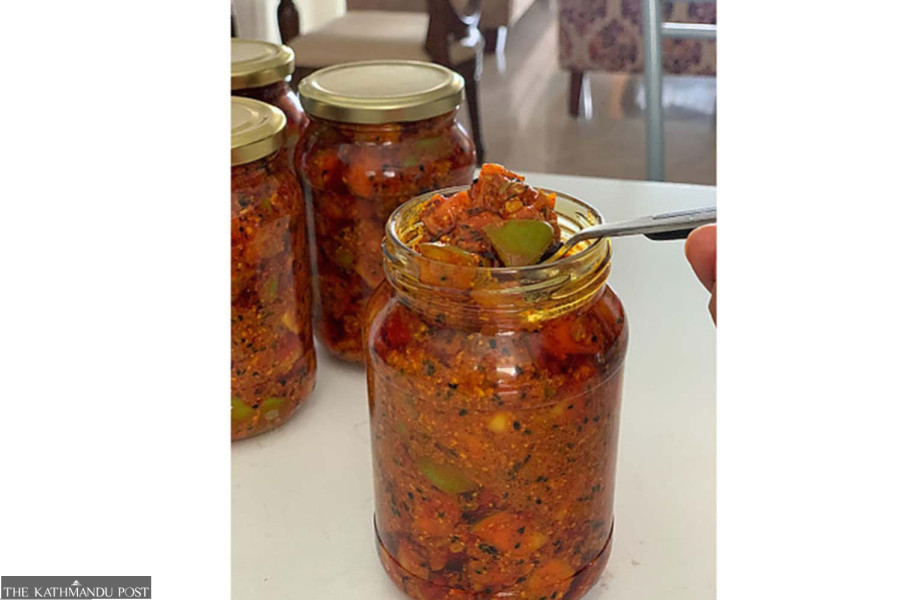
bookmark
Seema Tamang
Published at : July 21, 2026
Updated at : July 21, 2026 10:01
Kathmandu
Nepali pickles are increasingly finding buyers overseas, with exports reaching more than a dozen countries as small-scale entrepreneurs turn traditional kitchen recipes into commercial ventures.
Nepal exported pickles worth Rs211.69 million in the first 11 months of the last fiscal year, according to data from the Department of Customs. The country shipped pickles to Italy, Australia, the United Kingdom, Canada, Japan, South Korea, the United States, Belgium, Mauritius, Denmark, the United Arab Emirates, Malaysia and India during the period.
Italy emerged as the biggest market, importing pickles worth Rs37.38 million, or 57,267 kilograms, during the period. Australia followed with imports worth Rs36.49 million, while the UK bought pickles worth Rs36.11 million.
India, despite being Nepal’s largest trading partner overall, accounted for the smallest share of Nepali pickle exports, with purchases worth only Rs4,000.
However, Nepal’s pickle trade with India is heavily tilted towards imports. Nepal imported pickles worth Rs33.39 million from India during the period. Imports from China stood at Rs84.88 million, while South Korea supplied pickles worth Rs365,000, Japan Rs37,000 and Bhutan Rs2,000, according to customs data.
The department’s figures show that both imports and exports of pickles have been steadily increasing in recent years. During the period, Nepal imported products worth Rs118.67 million.
In fiscal year 2024-25, pickle exports stood at Rs182.64 million, compared with imports worth Rs92.16 million. A year earlier, in fiscal 2023-24, Nepal exported pickles worth Rs150.81 million and imported pickles worth Rs72.16 million.
The growth has been even more striking compared with previous years. In fiscal 2022-23, Nepal exported pickles worth Rs109.84 million and imported Rs100.2 million worth of the product. Exports were valued at Rs38.66 million in fiscal 2021-22, while they were only Rs3.92 million in fiscal 2020-21. During those years, pickle imports stood at Rs76.46 million and Rs25.23 million, respectively.
Behind the rising export numbers is a growing wave of commercial pickle makers, ranging from homemakers and students to former lawmakers, who have transformed a household tradition into a business opportunity.
Sangeeta Pandey, founder of ‘Aama Ko Achar’, started her pickle business with just Rs3,000, using 10 kilograms of dalle khursani (red cherry pepper). Speaking at the ‘Nirbhik Nari’ interaction programme organised by Kantipur a few months ago, Pandey shared that the venture that began on a small scale has now expanded to production measured in tonnes.
“I started with ten kilograms of red cherry pepper. Now we produce tonnes of pickles,” she said. “This year alone, I made 1.5 tonnes of pickle. We bring in tonnes of ingredients such as bamboo shoots, bitter gourd, mangoes and cucumbers to produce.”
Pandey launched the business at the age of 49 as a way to keep herself engaged. Fourteen years later, the enterprise has grown into a recognised brand.
“We should not depend only on our husbands’ earnings. Women should not remain confined to the kitchen,” she said. “I never imagined that a business started with ten kilograms of pickle would grow this far.”
Around 90 percent of Aama Ko Achar’s production is exported, according to Pandey. The brand produces a wide range of traditional Nepali pickles, including mango, fenugreek, flaxseed paste, gundruk, soybean, lapsi, radish and green chilli varieties.
The company also sells spice products such as chicken masala, turmeric, biryani masala, buff masala, tea masala, chat masala and dried meat products.
Former lawmaker Shanta Chaudhary has also entered the pickle business as a source of regular income. Although she started the venture informally about a year ago, she officially launched ‘Shanta Ko Achar Udhyog’ in Dang in 2023.
Chaudhary said she decided to commercialise her pickle-making skills because they could become a sustainable source of income.
“It was not just a hobby. It was a necessity, and that became my motivation,” she said. “I have always enjoyed creating new dishes and making different types of pickles. I should invest my time in the skills I already have.”
She spent only Rs500 when she first started making pickles. The business has since expanded and now employs 35 people.
The growing popularity of Nepali pickles abroad reflects a broader shift in the country’s small and medium enterprises, where traditional food products are increasingly being packaged, branded and marketed to global consumers.



Most Read from Money

A flood of bad news leaves Nepal’s tourist hubs eerily quiet
Heifer Nepal, staff donate Rs10 million to disaster relief fund

How crypto found a ‘legal’ route into Nepal’s relief efforts
LPG crisis deepens in Kathmandu, restaurants on the brink

Germany provides €8 million in assistance to Nepal after Bhotekoshi floods
Editor's Picks

What triggered the Rasuwa flood? Scientists piece together a complex chain of events

The floods keep coming. Nepal keeps starting over

In a settlement destroyed by the Bhotekoshi flood, a disabled couple offer strangers the little they have

Nepal working on detailed assessment as Bhotekoshi flood reconstruction could cost up to $5 billion

Rabindra Dhant gave Nepal a reason to smile. Now his camp wants real action behind the praise
E-PAPER | September 14, 2026

×