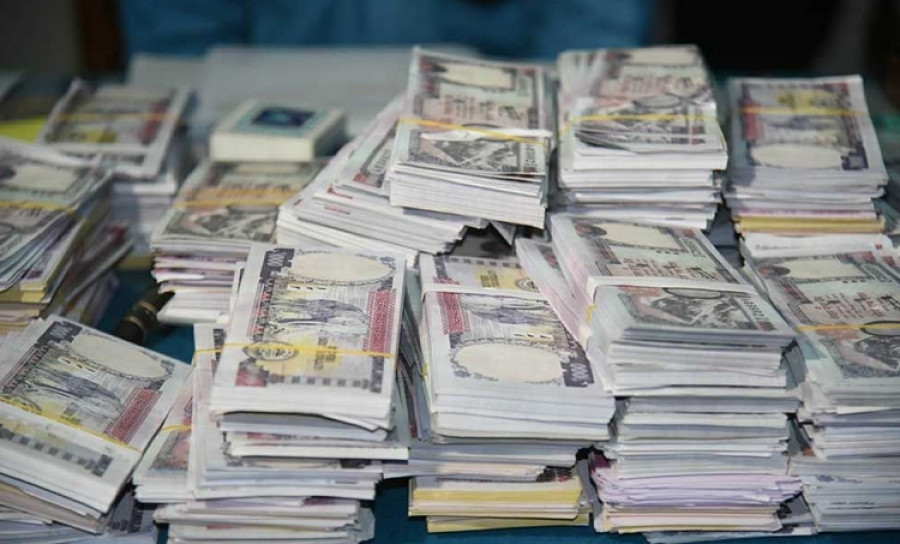
With just a week remaining in the current fiscal year as of July 10, banks and financial institutions are sitting on Rs1.56 trillion in lendable funds, reflecting a persistent surplus of liquidity in the financial system.
The excess liquidity has continued to grow throughout the fiscal year, just as it did in the previous two fiscal years, as deposits have risen steadily, driven by robust remittance inflows, while demand for loans has remained weak.
The sluggish expansion of bank lending is attributed to subdued market demand, slow economic activity, industries operating at only about 42 percent of their capacity, and a stagnant stock market.
Banking experts say these factors have left financial institutions with large volumes of idle funds. Although excess liquidity is not a new phenomenon, having persisted for the past three years, its scale is significantly larger than in previous years.
According to Nepal Rastra Bank, banks and financial institutions had approximately Rs1.56 trillion in excess lendable funds as of July 10. During the same period, total deposits in the banking system stood at Rs8.26 trillion, while the credit-to-deposit (CD) ratio was 71.29 percent.
As per the central bank’s directive, banks are allowed to lend up to 90 percent of their total deposits. Total outstanding loans during the review period amounted to Rs5.94 trillion. Based on these figures, the banking system theoretically has Rs1.56 trillion available for lending by the end of the ongoing fiscal year–July 16 this year.
In practice, however, banks are required to maintain around 20 percent of their deposits in cash and liquid assets, meaning they effectively can lend only up to around 89 percent of deposits. Even after adjusting for this requirement, the banking system still held Rs1.47 trillion in excess liquidity as of July 10.
Nepal Bankers’ Association President Santosh Koirala said the persistent liquidity surplus reflects a broader economic slowdown, with banks unable to expand lending despite being willing to do so because demand for credit remains weak. “Industries are operating at less than half their capacity, and very few new businesses are being established,” Koirala said. “As demand for credit has failed to grow, lending has remained lower than expected. Credit expansion requires stronger economic activity, which in turn depends on increased government spending. Only then will bank lending pick up.”
He added that banks are prepared to extend loans but are constrained by the lack of borrowers.
NRB data show that excess liquidity has remained elevated throughout the fiscal year. It stood at Rs1.01 trillion in the first month of the fiscal year—mid-July to mid-August 2025—and has generally risen with each passing month. The only exception was the period between mid-October and mid-November 2025, when it dipped briefly before resuming its upward trend.
Officials at the central bank acknowledge that weak credit growth has contributed to the mounting liquidity surplus.
“External sector indicators have continued to strengthen, while remittance inflows have remained robust, boosting deposits in the banking system,” said Satyendra Timilsina, head of the research department at the bank. “This has increased liquidity and made liquidity management more challenging.”
Timilsina, however, argues that the liquidity surplus is expected to gradually decline once the measures outlined in the new monetary policy begin to take effect.
The central bank’s continued interventions to absorb liquidity underscore the challenge. At present, NRB withdraws money from the market at least twice a week.
In December, anticipating that excess liquidity would persist, the central bank issued one-year bonds to absorb Rs200 billion, and those securities have yet to mature. Last week, it again issued one-year bonds worth Rs200 billion. As of Tuesday, NRB had already absorbed Rs200 billion through bond issuance, while on Wednesday, it withdrew an additional Rs100 billion for 91 days through a deposit collection instrument. These measures highlight the growing complexity of liquidity management.
Former banker Parshuram Kunwar, a financial sector expert, said subdued market demand has prevented the expected expansion of bank lending.
“Businesses do not borrow money simply to let it sit idle,” he said. “They borrow to start new ventures or expand existing ones, and that requires market demand. Since demand has remained weak, businesses have been unable to expand their operations. Without expansion, there is little need for additional borrowing, leaving banks with idle funds.”
Koirala said the prolonged liquidity surplus also reflects the fact that the new government, despite being in office for more than three and a half months, has yet to restore confidence in the private sector.
“If the government starts awarding contracts and accelerating development projects from the first week of Shrawan [third week of July], government spending will pick up, boosting economic activity and creating demand for bank credit,” he said.
In the current fiscal year starting mid-July last to date, deposits in banks and financial institutions increased by Rs963 billion, while loans expanded by only Rs354 billion. During the same period of the previous fiscal year, deposits had increased by Rs741 billion and loans by Rs422 billion.
The central bank had set a 12 percent credit growth target for the current fiscal year. Koirala said the target is unlikely to be achieved based on lending trends over the first 11 months.
The NRB has targeted 11 percent credit growth for the next fiscal year which would require banks to extend approximately Rs650 billion in additional loans. Analysts warn that the target will also be difficult to achieve unless economic conditions improve significantly.
By the end of 11 months of the ongoing fiscal year, the construction sector saw the highest 15.1 percent expansion, followed by 13 percent in consumer lending and 12.5 percent in transport, communications and public utilities.
Likewise, 6.8 percent has been allocated to industrial production, 4 percent in the service sector, and 0.6 percent in finance, insurance and real estate.
By contrast, lending to the agriculture sector declined by 2.4 percent during the same period.
Among different loan categories, trust receipt (import) loans increased by 36.7 percent, margin loans by 15.8 percent, hire purchase loans by 10.3 percent, real estate loans (including individual housing loans) by 6.3 percent, demand and other working capital loans by 5.8 percent, and term loans by 4.3 percent. However, cash credit declined by 0.3 percent, while overdraft loans fell by 0.4 percent, according to NRB data.
As of mid-June, 14.7 percent of bank lending was backed by current assets (agricultural and non-agricultural commodities), while 63.6 percent was secured by real estate collateral. A year earlier, the shares stood at 14.5 percent and 65 percent, respectively.
Over the past 11 months, lending to the private sector increased by 6.3 percent at commercial banks, 5.6 percent at development banks, and 3.9 percent at finance companies, according to a Nepal Rastra Bank report.




 15.78°C Kathmandu