The government has formally enforced amended standards for environmentally friendly operation of industrial establishments, including brick kilns, cement plants and other furnace-based factories.
Published in the Nepal Gazette, the new standards aim to curb pollution—particularly dust and smoke—generated by these industries.
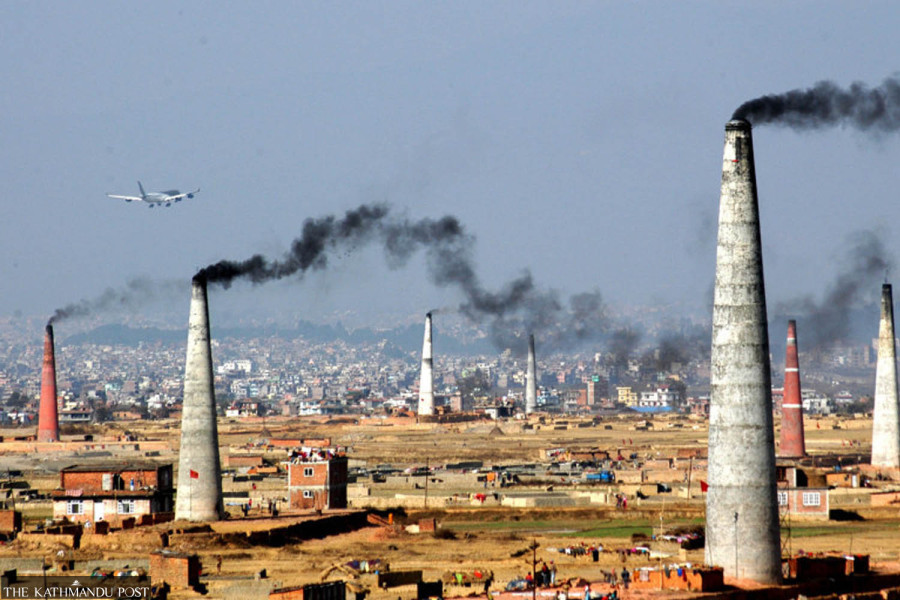
Under the amended Environment Protection Act, 2019, particulate matter emissions from brick factories must not exceed 250 mg/Nm³ (milligrams per normal cubic metre), a standard unit used to measure gaseous pollutants. Nepal currently has around 800 brick kilns in operation.
Particulate matter refers to a mixture of solid particles and liquid droplets—such as dust, soot, smoke and chemicals—suspended in the air, posing significant health and environmental risks.
The standards also prescribe minimum chimney heights for different kiln types. Bull’s Trench Kiln (BTK) natural draft and Hoffmann kilns must have a minimum height of 30 metres. For BTK forced draft (fixed chimney) and Hoffmann forced draft kilns, the minimum height is set at 17 metres, while vertical shaft brick kilns require 15 metres, tunnel kilns 10 metres, and hybrid Hoffmann kilns 7 metres.
Existing brick factories have been given two years from the date of enforcement to comply with the new standards. New brick kilns, however, must mandatorily adopt zig-zag technology—a more efficient and less polluting firing method in which bricks are arranged in a staggered pattern to improve airflow and combustion.
Brick kilns currently operating without zig-zag technology must convert within the two-year compliance window.
The standards also prohibit the use of highly polluting fuels such as petroleum coke, tyres, plastic and related materials.
New brick factories are required to install permanent sampling ports, platforms and ladders for pollution monitoring, while existing units must retrofit these facilities. Operators are also required to spray water regularly, maintain sanitation within factory premises, reuse ash in production, and ensure that vehicles transporting raw materials and finished bricks are properly covered to prevent dust emissions.
For cement factories, the government has set maximum emission limits for pollutants including particulate matter, sulphur dioxide and nitrogen dioxide for both rotary and vertical shaft kilns.
Cement plants must maintain a chimney height of at least 30 metres from the flue gas entry point and install pollution control equipment such as electrostatic precipitators or bag filters. They are also required to build dust containment and suppression systems in dust-generating units.
Additional measures include constructing two-metre-high wind-breaking walls, paving internal roads, maintaining sanitation, spraying water for dust control, and developing green belts around factory premises.
The standards further cover industrial furnaces, setting emission limits for particulate matter, sulphur dioxide, nitrogen dioxide and carbon monoxide. These rules apply to furnaces using solid and liquid fuels, while electric furnaces are required to comply with particulate matter standards only. Emission readings will be normalised to 12 percent carbon dioxide.
Furnace-based industries must maintain chimney heights of at least 15 metres and install heat recovery systems such as recuperators in units processing more than five tonnes daily. Electric furnaces must install bag-filter dust collectors.
“The ministry has updated the standards to address rising pollution levels in the country,” said Shivajee Sharma, an official at the Environment and Biodiversity Division of the Ministry of Forests and Environment.
The Department of Environment will monitor compliance and take action against violators, while the Department of Industry will also conduct inspections as part of the environmental impact assessment approval process, Sharma said.
Industry representatives, however, have raised concerns over the practicality of some provisions.
Krishna Prasad Awal, president of the Federation of Nepal Brick Industries, said that pollution levels from brick kilns—particularly in the Kathmandu valley—have already declined as many operators have upgraded technology.
“The standard refers to bull trench kilns that are no longer in operation. It appears the rules were drafted without sufficient study of the current industry,” said Awal, who owns the KP Itta Udyog in Bhaktapur.
Krishana Prasain is a business reporter for The Kathmandu Post covering markets. Before joining The Kathmandu Post in 2018, she spent 3 years in New Business Age magazine covering business.




 25.92°C Kathmandu