



 22.06°C Kathmandu
Tue, Oct 20, 2026
Money
Halved fuel taxes won’t benefit consumers but will trim NOC losses
Move aims to stabilise supply and settle dues with Indian Oil, but consumers are unlikely to see relief.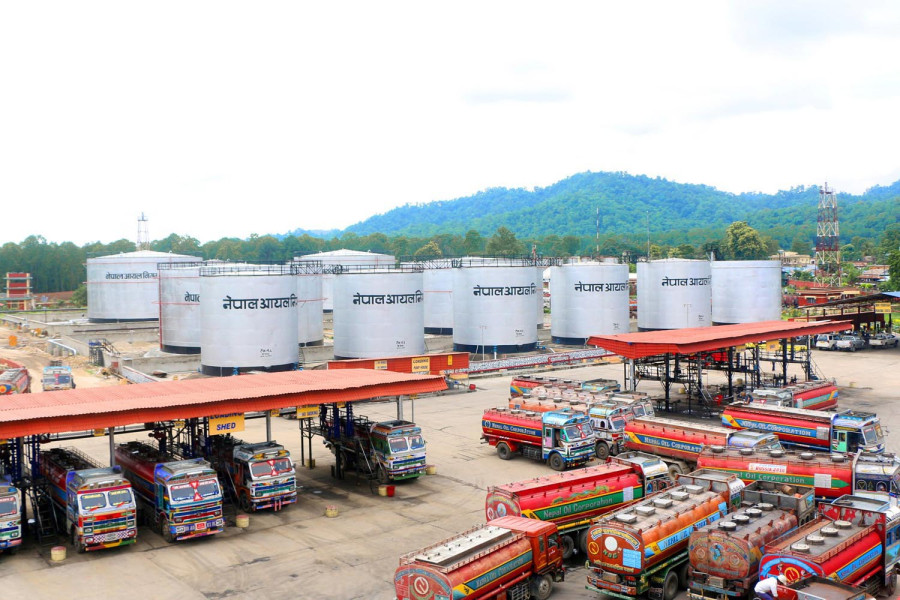
bookmark
Krishana Prasain
Published at : April 7, 2026
Updated at : April 8, 2026 06:52
Kathmandu
With petroleum prices surging in recent weeks due to escalating tensions in West Asia, the government on Tuesday decided to slash taxes—customs duty and infrastructure tax—on fuel by 50 percent in a bid to keep the state-owned oil utility financially afloat.
However, the tax cut will not translate into relief for consumers, according to the Nepal Oil Corporation (NOC). Officials said the measure is intended primarily to offset mounting losses and ensure uninterrupted fuel supply.
“The tax waiver will help us manage losses and ease payments to the Indian Oil Corporation, but it will not bring down retail prices,” said Nagendra Sah, deputy managing director of NOC. “At this point, the relief is marginal.”
The government currently levies Rs10 per litre as infrastructure tax on petrol. Customs duty stands at Rs25 per litre on petrol and Rs12 per litre each on diesel and kerosene.
The decision comes as the NOC grapples with deepening financial strain. Between March 16 and March 31, the corporation reported a loss of Rs416 per cylinder of liquefied petroleum gas. It is also incurring losses of Rs34 per litre on petrol and Rs120 per litre on diesel on a monthly basis.
Despite the tax cut, officials said the reduction is too small to significantly improve the utility’s financial position. According to NOC estimates, its fortnightly loss stands at Rs11.71 billion, which would fall to Rs10.21 billion after the tax waiver—a reduction of Rs1.5 billion.
The corporation has already raised fuel prices three times in less than a month, including the latest hike on April 3, when petrol and diesel/kerosene prices were increased by Rs15 per litre each. Petrol now costs Rs202 per litre in the Kathmandu valley, while diesel is priced at Rs182 per litre.
NOC attributed the repeated price hikes to rising international oil prices. “As the government has adopted an automatic pricing mechanism, domestic prices will decline only when international rates fall,” Sah said.
The corporation has also been drawing from its price stabilisation fund to cushion the impact. Of the Rs20 billion initially available in the fund, around Rs7 billion has already been spent.
Officials say reducing fuel consumption is critical to limiting further losses. Nepal currently consumes around 2,300–2,500 kilolitres of petrol and 4,800–5,000 kilolitres of diesel daily, according to NOC.
To curb consumption and avert a potential fuel crisis, the government has introduced several measures. On Sunday, it reinstated a two-day weekend—Saturday and Sunday—for government offices and educational institutions. Office hours for government agencies, excluding schools, have also been revised to 9 am to 5 pm.
In addition, the Cabinet has decided to prepare a legal framework to facilitate the conversion of petrol- and diesel-powered vehicles into electric vehicles. The government is also considering reintroducing the odd-even rule for vehicles to reduce fuel use.
Following the Cabinet decision, Nepal Rastra Bank issued a notice directing all financial institutions, including infrastructure development banks and the Nepal Clearing House, to comply with the new weekend policy from Monday.
Globally, oil prices continued their upward trend on Tuesday, driven by geopolitical tensions. Prices rose ahead of a deadline set by US President Donald Trump for Iran to reopen the Strait of Hormuz or face possible attacks on key infrastructure.
Brent crude futures rose by $1.39, or 1.27 percent, to $111.16 a barrel, while US West Texas Intermediate crude climbed $3.58, or 3.18 percent, to nearly $116 per barrel, hovering around a four-week high.
Petroleum remains Nepal’s largest import commodity. In the last fiscal year, the country imported petroleum products worth Rs326.14 billion, including petrol worth Rs64.12 billion, diesel Rs128.76 billion, kerosene Rs1.22 billion, aviation fuel Rs18.79 billion and LPG Rs62.58 billion.
Krishana Prasain
Krishana Prasain is a business reporter for The Kathmandu Post covering markets. Before joining The Kathmandu Post in 2018, she spent 3 years in New Business Age magazine covering business.

Most Read from Money

Nepal travel agents threaten to stop selling Thailand trips over visa rules

Why does an hour long flight to Dhangadhi cost more than a flight to New Delhi?
Malaysia rejects Nepal’s demand to open recruitment to all manpower agencies

No school, but a graduation cap for women dairy farmers
Nepal arrests four medical service providers as Malaysia recruitment row deepens
Editor's Picks




E-PAPER | October 20, 2026

×