Karnali has 18,000 MW power potential, but only 10 MW is tapped
Despite vast hydropower potential, Karnali struggles with chronic power shortages as stalled mega projects, weak infrastructure, and unreliable supply leave most households dependent on alternative energy sources.
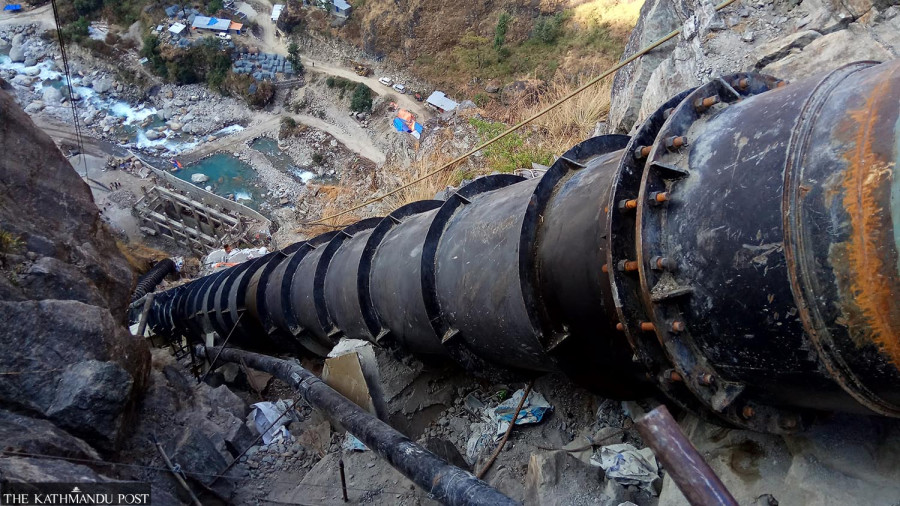
The 500-kilowatt Hildum Small Hydropower Project has provided electricity to around 2,300 households in Kharpunath rural municipality, including Simkot, the headquarters of Humla. However, power supply from the project is disrupted during snowfall and the monsoon season.
Frequent breakdowns of turbine machines and damage to canals leave residents of Humla in darkness for extended periods.
“There is electricity only in name. Even a slight wind or rainfall cuts off the power supply,” said Pitambar Rokaya of Simkot-7. “Without electricity, phone and internet services stop working, and sometimes we are cut off from communication for up to a week.”
Pemba Lama, another local at Simkot, said local traders charge up to Rs100 per hour to charge mobile phones using generators when electricity is unavailable.
Although Karnali Province has an estimated electricity generation potential of 18,000 megawatts, only about 10 megawatts is currently being produced. Due to the lack of sufficient local generation, residents have long been facing irregular power supply and low voltage problems.
Currently, Dailekh produces 8.55 MW, while other districts generate less than 1 MW each: Humla produces 0.50 MW, Mugu and Kalikot 0.40 MW each, Jumla 0.20 MW, and Rukum West 0.35 MW.
Feasibility studies on the Karnali, Tila, and Bheri rivers show a potential of nearly 18,000 MW.
According to the Nepal Electricity Authority’s regional office, 19 projects with a combined capacity of 4,541 MW are under survey, four projects totaling 26 MW have received generation licenses, and seven projects with a capacity of 1,091 MW have applied for survey permits.
Shashibhushan Shah, regional chief of Nepal Electricity Authority, said that most large hydropower projects in Karnali have stalled, forcing reliance on electricity from outside the province. Of the 309,376 households in Karnali, only 135,000 have access to electricity from the national grid, while around 30,000 households rely on micro-hydro.
In Dolpa, construction of the 106 MW Jagdulla semi-reservoir hydropower project by Jagdulla Hydropower Company has yet to begin, even six months after the contract agreement. The agreement was signed last August between the company, China’s Jiangxi Construction Engineering Group Corporation, and ANK Construction Nepal.
The project, estimated to cost Rs13.73 billion, is scheduled for completion within five years, by July 2030.
Sanjay Sapkota, CEO of the Jagdulla Hydropower Company, said that the detailed project report (DPR) and environmental impact assessment (EIA) have already been approved, and around 260 ropanis of land have been acquired. However, delays in design approval have stalled progress.
The project plans to construct a 23-metre-high and 13-metre-long dam on the Jagdulla River in Jagdulla Rural Municipality-1. Water will be diverted through a 6.1 km tunnel to a powerhouse in Mudkechula Rural Municipality-4, generating electricity from a head of about 780 metres.
The project faced initial setbacks when its tender was cancelled in December 2024 due to disputes. It was re-tendered in January 2025, but court cases delayed approval by nearly seven months.
Due to the lack of electricity, residents in Dolpa still rely on traditional oil lamps.
Sobharam Budha of Kaike Rural Municipality-5 said, “Those who can afford it have installed solar panels, but we still depend on pinewood lamps. Our ancestors lived like this, and if things continue the same, our children may not see electricity either.”
The 900 MW Upper Karnali Hydropower Project, awarded to India’s GMR, has yet to secure investment. Similarly, the DPR for the 410 MW Nalagad reservoir project in Jajarkot is still incomplete, while the 688 MW Betan Karnali project has also progressed slowly.
Energy expert Kamal Sharma warned that diverting the Bheri river into the Babai river for the project could have significant environmental impacts in Lumbini Province.
According to the Provincial Planning Commission, 67 percent of Karnali’s population still relies on oil lamps and solar energy. Only 33.39 percent (561,000 people) have direct access to electricity, while the remaining 1.3 million depend on alternative sources.
“As long as electricity does not reach every household, infrastructure development in Karnali will remain incomplete,” said Commission member Ashok Nath Yogi. “If three or four major hydropower projects are completed, Karnali could become self-reliant by exporting electricity.”
The 417 MW Nalagad Hydropower Project in Jajarkot has also been stalled for a long time due to a lack of investment.
Project engineer Padam Thapa said the project would cost Rs123 billion and cannot be completed through domestic investment alone.
Although compensation has been distributed to around 800 families, disputes remain over payments for 555 houses. The DPR, initially scheduled to be completed within two years and seven months, took seven years instead.
The project plans to store 474 million cubic metres of water and construct a reservoir 545 metres wide and 210 metres high, along with an 8.3 km underground tunnel.
Similarly, the Upper Karnali project has remained stalled for years due to financial issues faced by the GMR. Although the Investment Board approved a revised share structure, delays in receiving the full text of a Supreme Court order have halted further financial processes.
Under the new structure, GMR and India’s SJVN will each hold 34 percent shares, IREDA 5 percent, and Nepal Electricity Authority 27 percent. Previously, GMR held 73 percent and NEA 27 percent.
The Betan Karnali Hydropower Project, with a capacity of 439 MW and led by the Employees Provident Fund, is also uncertain. Its Power Purchase Agreement (PPA) is in the final stage, after which financial closure is expected.
The project includes a proposed 140-metre-high dam in Achham and Surkhet, with a reservoir capable of storing 16.16 billion cubic metres of water.
Likewise, construction of the 480 MW Phukot Karnali Hydropower Project in Kalikot has been delayed due to legal disputes. The project is a joint venture between Nepal’s Vidyut Utpadan Company and India’s NHPC.
The agreement was signed during former Prime Minister Pushpa Kamal Dahal’s visit to India, but legal challenges over share allocation have stalled progress. The project involves building a 180-metre-high dam and a 12 km tunnel.
Even the central transmission line remains unreliable, with frequent power cuts and low voltage.
“There is a central line only in name. There isn’t a single day when power doesn’t go out five or six times an hour,” said Pahal Bahadur KC, a local from Birendranagar-6.
Kamala Devkota of Jumla said she still relies on solar power despite having a grid connection. “This electricity is unreliable. Even when it comes, it doesn’t properly light the room. We are forced to use both electricity and solar.”
Due to unreliable electricity supply, large industries have not been established in Karnali.
Padam Shahi, president of the Karnali Chamber of Commerce, said investors are interested but hesitant due to power issues.
“Frequent power cuts, sometimes dozens of times a day, have troubled even ordinary consumers,” he said. Although a 132 kV transmission line was recently connected to Birendranagar, the electricity supply has yet to become reliable.




 24.79°C Kathmandu