Nepal eyes Lumbini revival with major World Bank-backed push
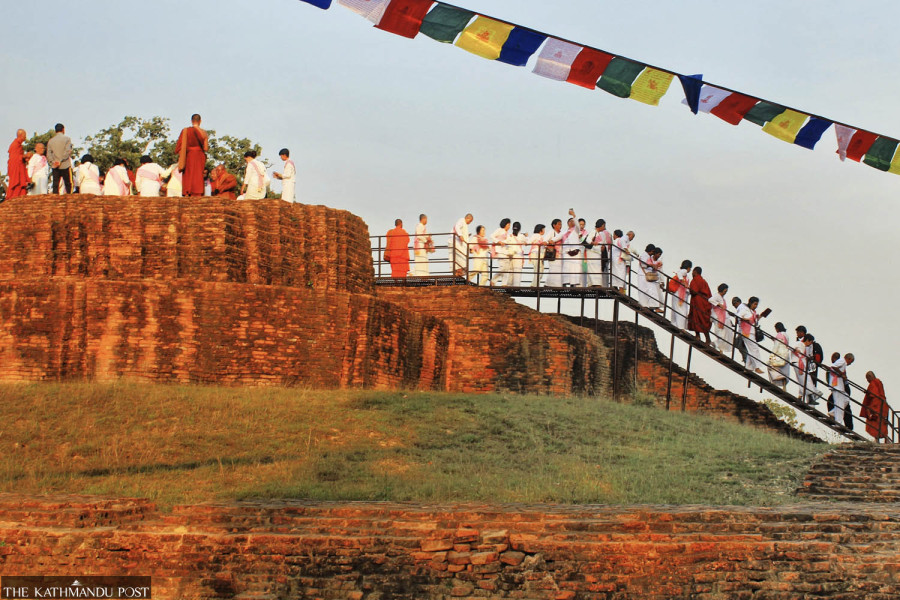
Despite luxury hotels, an international airport, and growing tourism infrastructure, the majority of visitors spend under an hour at the Buddha’s birthplace. Pilgrims at a stupa at Nigrodharam, where Buddha met his father for first time after attaining enlightenment, in Kapilvastu, in this undated photo. Post file photo
The average length of stay of foreign tourists in Nepal is 12 days, but most travellers visiting Lumbini, one of the world’s most iconic Buddhist pilgrimage sites, spend barely 30 minutes at the holy site.
A 2016 survey titled Visitors Survey and Observation found that 72.6 percent of visitors spent only half an hour sightseeing in Lumbini, the birthplace of the Buddha in southern Nepal, which is being developed as an international pilgrimage destination.
Efforts to increase both visitor numbers and duration of stay have repeatedly fallen short. The government’s Visit Lumbini Year campaign in 2012 failed to produce the desired results.
Hopes were revived on May 16, 2022, when Nepal inaugurated its second international airport in Bhairahawa, expecting that improved connectivity would draw foreign tourists to Lumbini—included on the UNESCO World Heritage List in 1997—and help create jobs at home.
Billions of rupees have since been invested in the region, including the development of at least half a dozen five-star hotels and dozens of other star-rated properties.
However, the outcome has been the opposite of what was envisioned. While a few international flights operated initially, they largely carried Nepali migrant workers rather than foreign tourists. Visitor inflows failed to meet expectations tied to the airport project.
Now, Nepal is preparing an even more ambitious push to establish Lumbini as a major global Buddhist pilgrimage hub.
The World Bank has approved an $85 million loan to support the Greater Lumbini Area Development Project, aimed at boosting tourism, creating jobs, and strengthening the country’s position as a spiritual destination.
According to the multilateral lender, the recently commissioned Gautam Buddha International Airport offers an opportunity to enhance regional connectivity and integrate Lumbini into broader Buddhist circuits across South and Southeast Asia.
The Ministry of Finance has forwarded the project proposal to the Ministry of Law for review before it is presented to the Cabinet, said Finance Secretary Ghanashyam Upadhyaya. “The new government may approve the proposal,” he said.
The project seeks to create tourism-related jobs in western Nepal by improving infrastructure and marketing, with active private sector participation, he said.
At its core is the Greater Lumbini Buddhist Circuit, linking Lumbini with Ramgram, Tilaurakot (ancient Kapilavastu), Devdaha and other key sites. Together, these locations offer a dense cluster of cultural, archaeological and spiritual assets within a relatively compact area, with the potential to be developed into an integrated tourism destination.
“Government investment in infrastructure is a welcome move,” said Chandra Prakash Shrestha, president of the Siddhartha Hotel Association. He noted that the private sector has already invested billions in the region and expects the state to now deliver the supporting infrastructure needed to attract visitors.
Shrestha also expressed optimism about the incoming government led by the Rastriya Swatantra Party (RSP), saying the operation of the international airport in Bhairahawa is among its top priorities. “The new government should assess why the airport failed to perform as expected,” he added.
The World Bank says the project will generate broad-based benefits for communities, businesses and institutions across the Greater Lumbini Area.
Direct beneficiaries include around 312,000 residents, particularly women, youth and disadvantaged groups, who are expected to gain from improved urban infrastructure, public spaces and tourism-linked livelihoods.
An estimated 2,000 tourism-related micro, small and medium enterprises and workers will benefit from increased visitor flows, stronger market linkages and targeted capacity-building initiatives.
The project is also expected to improve the experience of around 1.17 million annual visitors through upgraded facilities and better-managed heritage sites, while generating indirect economic benefits for approximately 665,000 people in surrounding communities.
Additionally, about 400 government employees will receive technical support and training to strengthen destination management and inter-agency coordination.
The initiative targets three main visitor segments. First are pilgrimage and heritage tourists, for whom Lumbini is the primary destination. For this group, the focus will be on enhancing site experiences and encouraging longer stays.
Second are cultural travellers visiting Nepal and India who currently see Lumbini as an optional stop. The project aims to improve connectivity, marketing and tourism products to make Lumbini a more compelling destination for them.
Third, the plan seeks to tap into new markets by positioning Lumbini as a broader cultural tourism hub, expanding beyond its traditional identity as a pilgrimage site.
Four key sites have been prioritised based on their economic potential, cultural significance and proximity to local communities: the Lumbini Master Plan Area, Tilaurakot, Devdaha and Ramgram. These sites will be developed as a cohesive circuit aligned with the broader Lumbini Master Plan.
The project allocates $66 million for critical tourism infrastructure, including climate-resilient facilities, heritage conservation, improved connectivity and enhanced visitor amenities.
A further $15 million will support destination planning, including the development of a climate-informed tourism strategy, strengthening of local value chains, and support for small businesses, particularly women-led enterprises.
The private sector is expected to play a central role in diversifying tourism offerings, improving service quality and attracting higher-value visitors.
Despite its potential, Nepal’s tourism sector continues to underperform. The country ranked 105th out of 140 economies in the World Economic Forum’s 2024 Travel and Tourism Competitiveness Index, lagging behind regional peers such as India and Sri Lanka.
Challenges include weak infrastructure, seasonal tourist flows, low visitor spending, an informal workforce, limited private sector confidence, poor inter-agency coordination and chronic underinvestment. Tourism accounts for just 0.7 percent of the national budget.
In 2023, average daily spending per visitor in Nepal stood at just $41, compared to a regional average of $100 to $150.
Lumbini alone attracted over 1.17 million visitors in 2024, most of them domestic tourists. The number dropped to 1.11 million in 2025.
Nepali and Indian visitors accounted for about 65 percent and 26 percent of the flow respectively, followed by smaller shares from Sri Lanka, Thailand and China.
While Nepal’s tourism identity has long been associated with Himalayan adventure, Lumbini represents a significant opportunity to expand into cultural and spiritual tourism.
The province’s economy remains largely agriculture-based, but the food and accommodation sector has emerged as the second-largest contributor to provincial GDP, reflecting the growing importance of tourism.
Visitor motivations in Lumbini vary widely. Nearly half come for Buddhist pilgrimage, followed by spiritual and leisure tourism. However, most still spend only a few hours at the site due to limited attractions beyond the core heritage area.
This has led to what experts describe as “hit-and-run” tourism—characterised by low spending, limited job creation and missed economic opportunities.
Pilgrimage tourism, while dominant in volume, generates relatively low economic returns. Around 1.1 million annual pilgrims support just 48,000 jobs—equivalent to one job for every 23 visitors—far below the national average of one job per six visitors.
With average daily spending of just $15 per pilgrim, the segment contributes the least to domestic value addition despite its scale, underscoring the urgency of transforming Lumbini into a more diversified and high-value destination.
Sangam Prasain is Business Editor at The Kathmandu Post, covering tourism, agriculture, mountaineering, aviation, infrastructure and other economic affairs. He joined The Kathmandu Post in October 2009.




 12.65°C Kathmandu