



 19.27°C Kathmandu

Mon, Oct 5, 2026
Money
Nepal clears way for E10 petrol blend, eyes Rs6 bn yearly savings
A decade after India began ethanol mixing, Nepali officials have moved forward amid concerns over food security and engine performance from the biofuel’s component.
bookmark
Sangam Prasain
Published at : February 23, 2026
Updated at : February 23, 2026 06:35
Kathmandu
A decade after India began blending ethanol with petrol, Nepal is preparing to cut its costly oil imports by mixing domestically produced ethanol into imported fuel.
According to Indian media reports, India introduced ethanol blending in 2014, starting at 1.5 percent.
By 2017, it had increased the blend to 10 percent, known as E10. In April 2023, India rolled out 20 percent ethanol-blended petrol, or E20, nationwide, becoming one of the fastest adopters among ethanol-using nations.
The Indian government says the programme saved $12.09 billion in crude oil imports over a decade and avoided 54.4 million tonnes of carbon emissions—equivalent to taking 12 million petrol cars off the road annually.
But the gains have come with trade-offs.
India ramped up ethanol production by diverting sugarcane, maize and rice for fuel, reducing grain availability for people and livestock and shifting land away from food crops. Following India’s roll-out of E20, the policy has faced backlash from sections of consumers and farmers.
In Tibbi, in Hanumangarh district of Rajasthan, protests against the construction of an ethanol factory turned violent on December 11 last year, with injuries reported among protesters and police.
Consumers in India have also complained that ethanol, a drier and more corrosive fuel than pure petrol, reduces fuel efficiency and affects engine performance, particularly in older vehicles, and leads to more frequent visits to fuel stations and repair workshops.
Ethanol blending is widely practised in countries such as Brazil, Thailand and the United States.
In Nepal, stakeholders on Sunday said blending 10 percent ethanol (E10) would benefit multiple sectors of the economy, although concrete evidence to substantiate the projected gains remains limited.
On December 26, the Cabinet approved the “Order on the Use of Ethanol Blended in Petrol, 2026,” allowing the Nepal Oil Corporation to blend up to 10 percent domestically produced ethanol into imported petrol.
The initiative aims to cut the country’s soaring fuel import bill—potentially saving over Rs6 billion annually, according to the oil utility. The plan had been under discussion for nearly two decades.
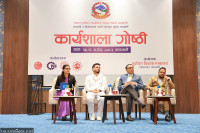
Speaking at a function organised by the Society of Economic Journalists-Nepal (SEJON) on Sunday, stakeholders said both the government and private sector are ready to move forward.
Minister for Industry, Commerce and Supplies Anil Kumar Sinha, who champions the project, said blending 10 percent ethanol in petrol could reduce Nepal’s annual petrol imports by around Rs6 billion.
“Blending 10 percent ethanol in petrol could cut annual petrol imports by 130 million litres,” he said. “This would save nearly Rs6 billion in foreign currency each year. That savings can help set in motion a distinct economic cycle at the local level.”
He described ethanol blending as an important step towards cleaner energy and said the decision had reached implementation after prolonged study and discussion.
Nepal’s annual petroleum imports totalled Rs326.14 billion in the last fiscal year, making it the country’s largest import item. The government collected Rs129.43 billion in taxes from petroleum imports. Of the total, petrol imports amounted to 746,420 kilolitres worth Rs64.12 billion.
However, several reports suggest that ethanol derived from food crops may fail to cut carbon emissions, as farming and processing can generate substantial greenhouse gases. Critics within policy circles also raise concerns about powerful business interests influencing the initiative. They question whether Nepal can secure enough domestic raw materials to sustain production.
“The domestic farm produce is not even sufficient to feed the population. Even sugarcane production is limited. The project is unjustifiable,” one insider said, adding that Nepal may ultimately have to import raw materials at scale to sustain production.
The government rejects such claims, saying food grains will not be used for ethanol production and only by-products such as molasses will be utilised.
Minister Sinha expressed confidence that ethanol production would boost agricultural output, particularly of sugarcane, expand the use of agricultural land and energise the domestic economy.
He acknowledged challenges in establishing new industries, ensuring industrial security, generating employment and securing adequate raw materials.
Govinda Prasad Karki, secretary at the Office of the Prime Minister and Council of Ministers, said the government had paved the way for blending up to 10 percent ethanol by issuing the formation order and outlining procedures.
He said the policy was advanced as its positive aspects outweighed the negatives and because it revived a long-stalled initiative. The order defines raw materials, price determination mechanisms, the roles of Nepal Oil Corporation and private industries, and the responsibilities of quality control agencies.
“No energy source is entirely beneficial,” Karki said, adding that the government had analysed both positive and negative aspects.
He insisted the decision was not driven by industrial or political interests and expressed confidence that the policy, initiated under a previous government and endorsed by the interim administration, would continue.
He likened ethanol blending to producing petrol domestically using Nepal’s own raw materials. Citing Brazil, he said ethanol there is cheaper than regular petrol due to government incentives and domestic production.
“Price determination is not done at the whim of a single secretary,” he said. “A committee comprising experts and stakeholders will decide based on market conditions.”
Karki stressed that to safeguard food security, grains used as food would not be permitted for ethanol production and that strict monitoring would be enforced. He said the programme would create jobs and raise farmers’ incomes.
Chandika Prasad Bhatt, managing director of Nepal Oil Corporation, said ethanol could be produced from molasses from sugar mills, Napier grass, unused agricultural and forest biomass, straw, maize cobs, wheat husk and yam. “Grains meant for food are prohibited. Ethanol produced by industries must be sold exclusively to Nepal Oil Corporation.”
A committee led by the secretary of the Ministry of Industry, Commerce and Supplies will determine the purchase price of ethanol, subject to Cabinet approval. Nepal Oil Corporation will draft separate procurement regulations.
Bhatt said ethanol blending would reduce carbon emissions and help maintain a cleaner environment. But he acknowledged significant challenges, particularly making ethanol price-competitive with petrol and ensuring adequate supply given Nepal’s limited current production capacity.
He stressed the need to attract investors and raise public awareness about ethanol’s use and benefits.
Madhav Timilsina, president of the Consumer Rights Investigation Forum, said the policy could benefit sugarcane farmers and generate employment but warned that consumer rights must remain central.
“There must be no compromise on fuel quality after ethanol blending. What mechanism will ensure and monitor purity above 99.5 percent? How will this affect vehicle mileage? Consumers deserve clear answers,” he said.
He also highlighted the global “food versus fuel” debate, cautioning against diverting farmland from food production.
Shivaram Pokharel, joint secretary at the Ministry of Industry, Commerce and Supplies, said ethanol blending would not harm vehicle engines and would instead reduce carbon emissions. He emphasised the need for public awareness campaigns to address consumer concerns as Nepal prepares to join the global shift toward blended fuels.
Shashikant Agrawal, president of the Nepal Sugar Mills Association, said that although the formation order has finally been issued after two decades, detailed procedures are still pending.
“We have long demanded this issue, and the government addressed it after 20 years. But it has yet to bring the procedure. How many more years will it take?” he asked.
According to Agrawal, 12 sugar mills could produce up to 360,000 litres of ethanol daily—20,000 to 30,000 litres per mill—if sufficient raw materials are available. Domestic sugar mills could supply ethanol equivalent to around 3 percent of total petrol imports.
Some mills already have distillery tanks required to produce alcohol from molasses, from which ethanol is produced after further processing. Mills without such facilities would require substantial additional investment—Rs250 million to upgrade existing distilleries and up to Rs750 million for new installations and production capacity.
Sangam Prasain
Sangam Prasain is Business Editor at The Kathmandu Post, covering tourism, agriculture, mountaineering, aviation, infrastructure and other economic affairs. He joined The Kathmandu Post in October 2009.

Most Read from Money

In Nepal’s premium rental market, the dollar is everywhere but on paper
Malaysia weighs raising minimum wage to RM2,000
All three major Nepal-China crossings hit by monsoon disruptions ahead of Dashain
Why was Nepal’s stock market shut on Monday
Nepal lost Rs10 billion in India’s import squeeze. New Delhi seeks investigation before easing curbs
Editor's Picks

What triggered the Rasuwa flood? Scientists piece together a complex chain of events

The floods keep coming. Nepal keeps starting over

In a settlement destroyed by the Bhotekoshi flood, a disabled couple offer strangers the little they have

Nepal working on detailed assessment as Bhotekoshi flood reconstruction could cost up to $5 billion

Rabindra Dhant gave Nepal a reason to smile. Now his camp wants real action behind the praise
E-PAPER | October 05, 2026

×