



 14.81°C Kathmandu
Sat, Oct 24, 2026
Money
Nepal’s share market faces unprecedented lockdown as regulators battle industry over trading rules
Proposed restrictions in shares raise the question: Is Nepal building a more robust securities system or creating lasting restrictions on capital flow unlike anywhere else?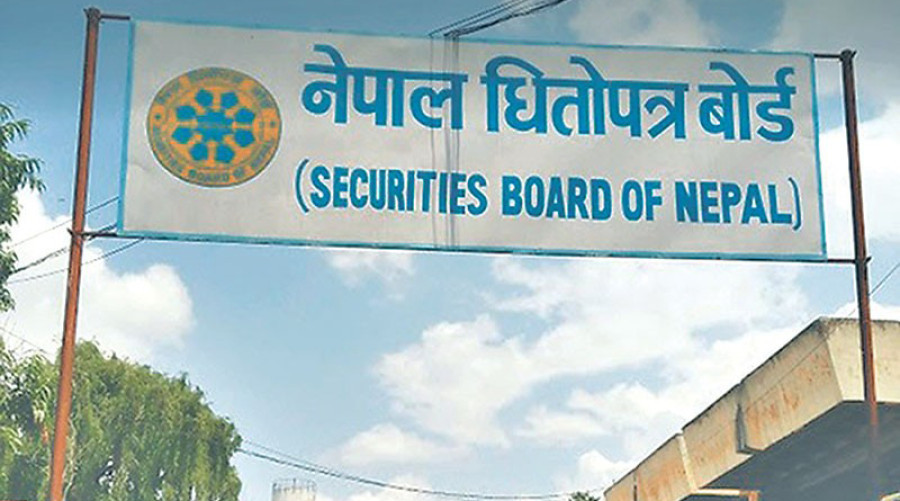
bookmark
Yagya Banjade
Published at : February 10, 2026
Updated at : February 11, 2026 10:11
Kathmandu
A regulatory dispute over how to classify company shares has frozen Nepal’s stock market expansion and threatens to lock up billions of rupees of promoter capital, revealing deep fractures in the country’s efforts to build a modern securities system.
At the heart of the controversy is whether promoter shares and public shares of listed companies should be assigned separate International Securities Identification Numbers (ISINs), the unique codes used globally to track securities. Nepal’s Central Depository Services (CDSC) has proposed requiring dual ISINs across all sectors, a system that critics say exists nowhere else in the world and would effectively create permanent restrictions on promoter capital.
The Securities Board of Nepal (SEBON) has been unable to resolve the dispute after months of deliberation. Sources say the Board’s Law Enforcement Committee has questioned whether CDSC even has the legal authority to impose such a significant policy change through a directive, suggesting it requires amendments to the Companies Act and multiple other laws.
“It’s already very late to decide on this matter,” SEBON Chairman Santosh Narayan Shrestha told the Post. “The dispute about whether two ISINs are needed or one is enough should now be resolved; it shouldn’t linger anymore.”
Since January, approximately a dozen companies with pending IPOs have been unable to list their promoter shares, caught in regulatory limbo as officials debate the issue behind closed doors.
Nepal currently operates a two-tiered system. Banks, financial institutions and insurance companies must maintain separate ISINs for promoter and public shares even after the standard three-year lock-in period, requiring central bank approval to convert shares. All other sectors use a single ISIN with automatic conversion when the lock-in expires at midnight on the three-year anniversary.
CDSC now wants to extend the banking sector’s restrictions to every listed company, from hydropower developers to cement manufacturers. The proposal has drawn fierce opposition from business groups and promoter shareholders, while retail investor associations argue it is necessary to prevent market manipulation.
The Independent Power Producers’ Association (IPPAN) says the directive would affect 870 million shares worth Rs87 billion ($640 million) across 58 companies, with the energy sector bearing the brunt. The amount is a “rough calculation” claimed by the organisation’s chairman Ganesh Karki, but the exact figure has not been independently confirmed.
“Companies can sell promoter shares to the public after the three-year lock-in period, and based on that they have made capital plans for project or business expansion,” said IPPAN Chairman Ganesh Karki. “Now that promoter shares cannot be sold even after the lock-in period, all capital plans of companies become stuck.”
The government’s target of producing 28,500 megawatts of electricity within 10 years could become “impossible”, IPPAN warns, as energy developers find their capital permanently locked.
Business leaders say the proposed system has no international precedence. In India, Bangladesh, and Pakistan, regulators use single ISINs with electronic flags and disclosure requirements to track promoter shares, rather than structural separation.
“The rule that promoter shares cannot be sold exists nowhere in the world except Nepal,” said Chandra Prasad Dhakal, president of the Federation of Nepalese Chambers of Commerce and Industry. “At a time when [banking law] needs to be corrected, making the same arrangement for companies in other sectors again is not right.”
Kamalesh Kumar Agrawal, chairman of Nepal Chamber of Commerce, called the dual-ISIN proposal “impractical, investment-unfriendly” and warned it would weaken investor confidence. “In Nepal’s immature capital market, such arrangements will add confusion and insecurity in the investment environment,” he said.
Retail investor groups tell a different story. They say the current single-ISIN system has enabled illegal trading and allowed promoters to dump shares en masse when lock-ins expire, destabilising prices.
“Due to CDSC’s system or some other reason, shares of some companies with the same ISIN in the market have been found to be bought and sold even before the lock-in period ended,” said Keshav Prasad Shrestha, president of Nepal Share Market Investors Association. “The Securities Board has already taken action against two promoter shareholders.”
Officials at SEBON shared the names of the two companies, both in the hydropower sector, with the Post, but requested that they be withheld due to pending action. They still refused to divulge details for exactly when and how many shares were traded, how they detected the violation, and what kind of penalties were imposed. The board is “studying the details received”, the source told the Post.
Share Market Investors Association argues that Nepal’s “flagging code” system—meant to electronically mark locked shares—simply does not work. “If someone wants to do mischief in between, they can even trade lock-in period shares and many such incidents are happening in the market,” Shrestha told the Post. Neither Shrestha nor officials at CDSC could explain why the flagging system fails in Nepal while such a system works in other countries, including India.
Then there is a separate concern: the current system allows all promoter shares to convert to public shares automatically at midnight when lock-ins expire, oversupplying the market. Dual ISINs would force a more gradual conversion process, advocates of the new system say.
A Securities Board study found that most hydropower promoters exit “as soon as the ‘lock-in’ period ends,” suggesting they lack confidence in their own projects’ long-term returns. The study found evidence of promoters pledging locked shares to banks, then selling them after automatic conversion while still pledged.
In an interview, CDSC Managing Director Pravin Pandak defended the dual-ISIN proposal as legally sound and technically necessary, dismissing opposition as based on “rumours”.
“Until today, most listed companies in the capital market including banks, financial institutions and hydropower companies are in dual ISINs,” she said, arguing that single ISINs were only given “under the influence of listed companies due to lack of law”.
Pandak said that single ISINs create false statistical records, showing zero percent promoter ownership when promoters actually control 80 percent of shares. “Such false data goes to general investors, the government and all stakeholders, so the responsible body of the capital market itself would be deceiving everyone,” she said.
Under the proposed system, Pandak insisted, conversion after the lock-in period would be straightforward: companies would amend their articles of association, notify stakeholders, and request conversion from CDSC. No fees are charged for this, according to Pandak, and approval is not even needed from anywhere except sector-specific regulators where applicable. At the moment, this applies to all sectors except banking and insurance.
The Securities Central Depository Services Regulations give CDSC authority to issue operational directives, Pandak noted, though SEBON’s Law Enforcement Committee has questioned whether such a significant policy change exceeds that authority.
The controversy has exposed a deeper dysfunction: a decade-old banking law that was supposed to let bank promoters exit but has never been implemented.
The Bank and Financial Institutions Act (BAFIA), enacted in 2015, allows bank promoters to sell shares after 10 years while maintaining 51 percent promoter ownership. Nepal Rastra Bank, the central bank, has never implemented the provision.
Central bank officials acknowledge that the delay has caused a panic among shareholders of banking and financial institutions. “It needs to be implemented gradually and it will make the market more flexible,” said Guru Prasad Paudel, spokesperson for the central bank. However, he did not say why the bank has not been able to implement the provision so far.
The failure has created a chicken-and-egg problem for the central bank’s separate push to bar anyone owning more than 1 percent of a bank from taking loans from any financial institution — an effort to separate “bankers” from “businesspeople.” Central bank Governor Biswo Nath Poudel warned Parliament in June 2025 that the changes would be “as if an earthquake hit the financial system.”
But if promoters cannot exit their banking investments, separating bankers from businesspeople becomes impossible.
“That provision has not been implemented,” Dhakal of FNCCI said. “At a time when that law needs to be corrected, making the same arrangement for companies in other sectors again is not right.”
The Securities Board’s Law Enforcement Committee, coordinated by a joint secretary from the Law Ministry, has returned the directive with suggestions including that major policy changes require legislative amendments rather than administrative directives.
The Board of Directors discussed the issue on Monday but reached no conclusion, SEBON sources said, with agreement only to reach a conclusion in the next meeting. The date for the next meeting has not been announced.
In August 2025, after months of deadlock, the finance ministry convened an emergency meeting with SEBON, CDSC, and Nepal Stock Exchange officials. The meeting was chaired by the finance secretary, who ordered SEBON officials to “stop lingering” and make a decision based on “what’s good for the market”—either enforce dual-ISIN or drop the idea entirely.
Meanwhile, companies wait. Those with IPOs approved but shares not yet listed cannot access the promoter capital they expected. Those planning future expansions cannot determine whether their financial models remain valid.
“This number is growing,” Karki said of the affected capital. “All capital plans of companies become stuck.”
Badri Prasad Pyakurel, CEO of National Commerce Merchant Banking, downplayed concerns. “Since CDSC is going to make arrangements for two ISINs only to separate promoter and public shares for the lock-in period, stakeholders don’t need to panic,” he said, arguing that conversion afterward would be routine.
But pressed on specifics, even CDSC’s Pandak acknowledged the dual-ISIN system would require companies to follow “prescribed procedures” and obtain approval from “sector-specific regulators where applicable”—precisely the type of discretionary approval process that has left banking sector promoters unable to exit for over a decade.
Yagya Banjade
Banjade covers government finance, banking, capital markets, and the economy for Kantipur Daily.





Most Read from Money

Why does an hour long flight to Dhangadhi cost more than a flight to New Delhi?

Nepal travel agents threaten to stop selling Thailand trips over visa rules

Malaysia rejects Nepal’s demand to open recruitment to all manpower agencies

No school, but a graduation cap for women dairy farmers

Nepal arrests four medical service providers as Malaysia recruitment row deepens
Editor's Picks




E-PAPER | October 24, 2026

×