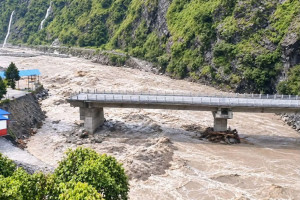
1,200MW storage project regains focus as local residents push for progress in building hydroelectricity plant. The Budhigandaki river in northern Gorkha in this undated photo. Shutterstock
It's election season, and once again the much-awaited Budhigandaki hydropower project is back on the national agenda, creating renewed buzz and political attention.
The proposed 1,200-megawatt project, with an estimated cost of nearly $3 billion including inflation and interest during its proposed eight-year construction period, is Nepal’s largest reservoir-type hydropower scheme.
Insiders describe it as a long-term energy security project, particularly because it is expected to generate 1,408 gigawatt hours (GWh) of electricity during the dry season, when Nepal faces acute power shortages and relies heavily on imports from India.
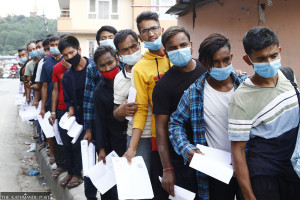
Against this backdrop, a signature campaign was launched in Dhading, the project site, during the Dhading Festival on January 31. The campaign, which will continue until February 8, aims to put pressure on the government to finally move the long-stalled project forward.
Local residents say the campaign is intended to push authorities into action, especially after the government recently finalised the project’s investment modality. This development has raised new optimism among communities that have waited decades for the project to take off.
Envisaged as a cornerstone of Nepal’s energy security for generations, the Budhigandaki project has remained in limbo due to prolonged uncertainty over its financing model and the geopolitical sensitivities surrounding it.
The storage-type plant, which will store water during the monsoon and generate electricity in the dry months, was first identified during the Gandaki Basin Study in the late 1970s, followed by a pre-feasibility study in 1984.
Participants of the signature campaign say the project has repeatedly featured in election manifestos of major political parties but has never progressed beyond promises.
The Dhading Chamber of Commerce and Industry, which is spearheading the campaign, says this time, it is determined to ensure tangible outcomes.
Chandra Prasad Dhakal, president of the Federation of Nepalese Chambers of Commerce and Industry (FNCCI), became the first person to add his signature to the campaign. Following the signing, he urged the government to immediately advance the construction process, stating that the private sector is ready to cooperate in taking the project forward.
On January 18, the government approved the long-pending investment modality of the project, clearing a key hurdle for its transition into the construction phase. Including inflation and interest costs during construction, the total project cost is estimated at Rs406 billion.
Under the approved financial structure, 70 percent of the project cost will be financed through debt and the remaining 30 percent through equity. The construction period has been estimated at eight years.
Once completed, the project is expected to generate 338 million units of electricity annually—141 million units in the dry season and 197 million units during the rainy season. The proposed electricity purchase rates stand at Rs12.40 per unit in the dry season and Rs7.10 per unit in the wet season.
Annual revenue from power generation is projected at Rs31.48 billion.
The electricity generation licence for the project is proposed to be valid for 50 years. If construction is completed within the stipulated eight years, the plant would generate electricity for the remaining 42 years of the licence period.
So far, the government has already invested Rs45 billion in the project, which will be converted into equity shares. Under the proposed equity structure, the 30 percent equity position will be shared as follows: the Ministry of Energy will hold a 50 percent stake, the Ministry of Finance 30 percent, and the Nepal Electricity Authority 20 percent.
The project company also plans to issue energy bonds worth Rs30 billion.
To fund the project, the government has already collected Rs168 billion by imposing a tax on petroleum products. In May 2015, a levy of Rs5 per litre was imposed specifically under the Budhigandaki project heading. According to the Nepal Oil Corporation, more than Rs22 billion was collected under this heading. In fiscal year 2018-19, the tax was rebranded as ‘infrastructure development tax’ and raised to Rs10 per litre.
Ramkumar Dallakoti, president of the Dhading Chamber of Commerce and Industry, said the signature campaign is intended to push the government to build the project at any cost. He said the project would not only transform Dhading and Gorkha districts but also benefit the national economy through job creation and business growth, making its immediate construction imperative.
Dallakoti expressed frustration that despite the displacement of centuries-old trade routes in northern parts of Dhading and Gorkha, the long-held dream of local communities to see the project materialise remains unfulfilled. He said the campaign aims to draw the attention of concerned authorities and resolve issues caused by prolonged delays.
Around 50,000 residents from 23 former village development committees (local units) in Dhading and Gorkha have already agreed to relocate for the project. However, repeated postponements have deprived them of development opportunities, leaving many frustrated. Locals say they were prepared to leave their ancestral homes for a project of national pride, only to see it stalled for years.
Yamnath Danai, chair of Jwalamukhi rural municipality, accused the federal government of neglecting the project, echoing widespread local anger.
From its inception, the Budhigandaki project has been mired in controversy, particularly over geopolitics.
At various stages, it has been linked to Chinese state-owned companies, triggering concerns in some quarters about debt exposure, strategic influence and long-term control over critical infrastructure. Nepal’s delicate position between China and India has turned the project into a symbol of how major infrastructure initiatives can become entangled in regional rivalries.
Critics argue that repeated policy reversals have had less to do with technical or financial feasibility and more with shifting geopolitical calculations and changes in government. Insiders, however, contend that labelling Budhigandaki as a geopolitical project has unfairly delayed a scheme crucial for Nepal’s energy security, water regulation and economic growth.
Located about 2 kilometres upstream of the Trishuli–Budhigandaki confluence at the border of Gorkha and Dhading districts, roughly 80 kilometres west of Kathmandu, the project has undergone multiple studies over the decades.
It was first identified in 1978 by Snowy Mountains Engineering Corporation, an Australian government-owned company at the time, and initially conceived as a 200–300 megawatt storage project. A pre-feasibility study in 1984 recommended an installed capacity of 600 megawatts.
After a gap of nearly 26 years, the Nepal Electricity Authority re-evaluated the project in 2010-11. A final feasibility and detailed design study conducted by France’s Tractebel Engineering in 2015 proposed a 1,200-megawatt plant with six 200-megawatt Francis turbines.
Despite this, the project has been repeatedly pulled back and forth by successive governments.
In 2017, the then Pushpa Kamal Dahal-led government awarded the contract to build the project to China Gezhouba Group Corporation (CGGC) without competitive bidding, adopting the engineering, procurement, construction and financing (EPCF) modality.
The decision was overturned in November 2017 by the Sher Bahadur Deuba government, which cited procedural flaws in the awarding of the contract. Following the cancellation, the Deuba administration announced plans to develop the project using domestic financial resources through the state-owned Nepal Electricity Authority.
The project was again drawn into political controversy in September 2018, when the KP Sharma Oli-led government reversed the earlier decision and opted to re-engage the Chinese developer, effectively abandoning plans to rely on internal financing.
In April 2022, the Deuba administration once again revoked the licence issued to CGGC and declared that the project would be constructed by mobilising domestic resources.
Following the latest policy reversal, a committee led by then National Planning Commission vice-chair Swarnim Wagle was formed to explore financing options for the project. The committee recommended that the government develop Budhigandaki on its own, with viability gap funding covering about one-third of the total project cost.
Although the Cabinet approved the committee’s report and agreed in principle to provide the gap funding, the decision was never formally minuted as the Deuba government fell before it could be implemented. The subsequent Oli-led administration, which had publicly criticised Deuba for scrapping the deal with the Chinese company, disowned its predecessor’s decision, once again leaving the project in uncertainty.
As elections approach again, locals say patience is running thin.
Yadunath Sapkota of Khahare in Tripurasundari Rural Municipality urged the government to either immediately begin construction or ensure sustained development in the area, which he said has lagged for years in the name of the project.
The signatures collected in the ongoing campaign will be submitted to the government, as locals hope that this time, Budhigandaki will finally move beyond promises and politics.
Sangam Prasain is Business Editor at The Kathmandu Post, covering tourism, agriculture, mountaineering, aviation, infrastructure and other economic affairs. He joined The Kathmandu Post in October 2009.




 15.33°C Kathmandu