



 14.81°C Kathmandu
Sat, Oct 24, 2026
Money
Gold soars past Rs300,000 per tola
Price of the metal hit a historic high in Nepal, driven by geopolitical tensions, currency volatility and strong domestic demand, while silver also rallies as supply tightens.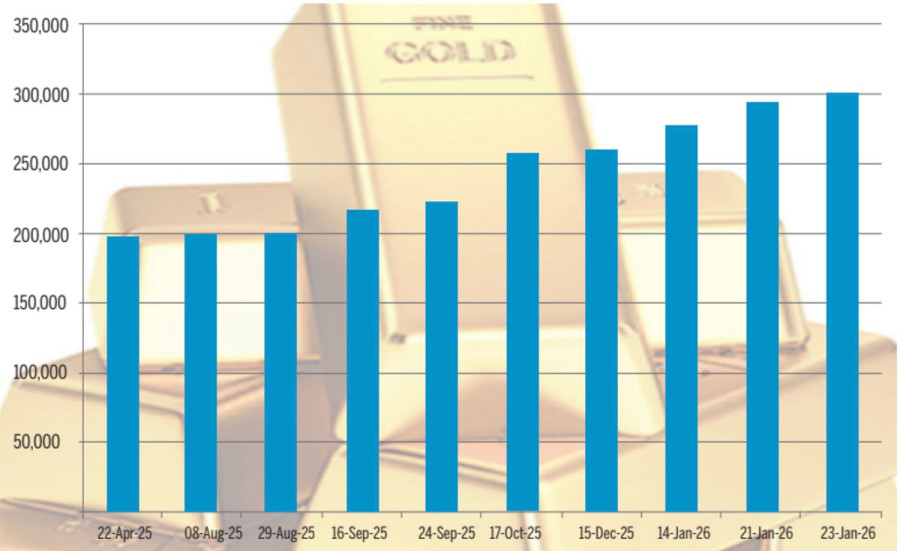
bookmark
Krishana Prasain
Published at : January 24, 2026
Updated at : January 24, 2026 10:35
Kathmandu
Gold prices continued their relentless climb, crossing Rs300,000 per tola in the domestic bullion market for the first time, buoyed by global tensions and mounting economic uncertainty.
On Friday, the last trading day of the week, gold jumped by Rs9,200 per tola to Rs301,400 per tola, according to the Federation of Gold and Silver Dealers’ Association. Over the past year, the price of the precious metal has surged by Rs141,400 a tola.
In the international market, spot gold traded at $4,957.1 per ounce on Friday after scaling a record high of $4,966.59 earlier in the day.
International bullion analysts say the rally is being driven by persistent economic and geopolitical risks. “As we do not expect these risks to fade in the near term, we believe gold still has further upside potential,” Adarsh Diwe, a Mumbai-based consultant at Metals Focus who tracks South Asian bullion markets, told the Post.
He said the lingering uncertainty around US policy, sustained geopolitical tensions, and growing concerns over sovereign debt in major industrialised economies are reinforcing gold’s role as a diversification asset.
Gold is widely viewed as a hedge against currency market volatility. Traditionally, it moves in the opposite direction of the US dollar, as weakness in the dollar makes dollar-priced gold cheaper for holders of other currencies, and vice-versa. Recent trade tariffs imposed by US President Donald Trump have triggered a global trade war, rattling currency markets worldwide.
The policy stance of global central banks has also played a key role in shaping gold’s trajectory. Lower interest rates reduce the opportunity cost of holding gold, which does not yield interest, making it more attractive to investors.
Large buyers and institutional investors typically source gold from major banks, while prices in the spot market are determined by real-time supply and demand. Spot gold refers to the current market price at which the metal can be bought or sold for immediate delivery.
“Based on the current trend, the price of gold and silver is expected to continue rising. At this point, we have no idea where the bullion price will break and how much further it will go,” said Arjun Rasaili, president of the federation.
He added that unless the US changes its foreign policy stance, gold prices are likely to stay on an upward trajectory. Domestic bullion traders say gold could soon reach Rs325,000 per tola.
Despite record-breaking prices, demand remains strong. Traders say consumers continue to buy gold in anticipation of further gains. The ongoing wedding season has also provided a modest boost to demand, Rasaili said.
At the same time, the trend of people selling their old gold jewellery has declined, increasing the need for imported gold. “There would be no demand for imported gold if buyers sold their gold,” Rasaili said.
Reflecting rising demand, gold imports jumped by 137.52 percent in the second quarter of the current fiscal year compared to the same period last year. According to the Department of Customs, Nepal imported 1,104 kilograms of gold worth Rs19.67 billion in the first six months of the current fiscal year until mid-January, up from 726 kilograms in the same period last year.
In response, Nepal Rastra Bank, the central bank, increased the daily gold import quota to 25 kg, from 20 kg in October.
“Demand has also been fuelled by people investing in gold as prices break records almost daily,” Rasaili said, adding that the domestic bullion market currently sells 15 to 20 kg of gold each day. Traders say many people are withdrawing savings to invest in gold and silver.
Much of the demand is for coins and pure wire rings, locally known as beruwa aunthi, which are favoured for their assured resale value.
Source: Fenegosida
In Nepal, individuals are not allowed to buy raw or bar gold directly from the central bank, commercial banks or bullion traders. While the central bank authorises commercial banks to import up to 20 kg of gold per day, traders can buy only one kg at a time from banks.
Meanwhile, silver has emerged as the “new gold” in recent months, traders say. There is a growing shortage of silver in the market amid strong demand.
Silver was priced at Rs6,190 per tola on Friday, up by Rs320 per tola in a single day. Over the past year, silver prices in the Nepali market have risen by Rs4,295 per tola.
Silver imports have surged sharply, jumping by 362.32 percent in the review period. Nepal imported 59,617 kg of silver worth Rs14.87 billion in the first six months of the current fiscal year, compared to 23,569 kg in the same period last year.
According to Metals Focus, the rally in silver prices has been driven largely by global supply tightness. A metal consultant said inventories at the Chicago Mercantile Exchange in the US have risen significantly amid tariff-related uncertainty, while non-exchange-traded inventories in London have fallen to multi-year lows.
“As a result, a liquidity squeeze, combined with strong investment demand in several markets, is pushing prices higher,” Diwe said. “However, once clarity emerges on tariffs and metal begins to flow out of the US, prices could ease.”
To address rising demand, the central bank last month raised the payment limit for silver imports to $500,000 from $100,000 for traders, and to $2 million per month for industrial use.
Bullion traders said silver is mostly sold in granules, typically packed in 25-kg bags.
Krishana Prasain
Krishana Prasain is a business reporter for The Kathmandu Post covering markets. Before joining The Kathmandu Post in 2018, she spent 3 years in New Business Age magazine covering business.




Most Read from Money

Why does an hour long flight to Dhangadhi cost more than a flight to New Delhi?
Nepal travel agents threaten to stop selling Thailand trips over visa rules
Malaysia rejects Nepal’s demand to open recruitment to all manpower agencies

No school, but a graduation cap for women dairy farmers
Nepal arrests four medical service providers as Malaysia recruitment row deepens
Editor's Picks




E-PAPER | October 24, 2026

×