Nepal-China commerce talks in Lhasa to focus on border trade bottlenecks
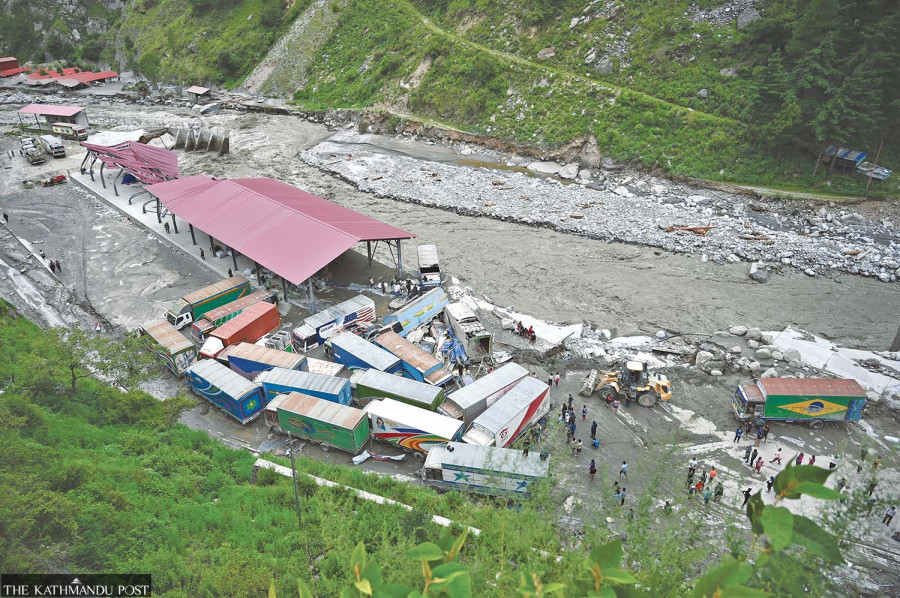
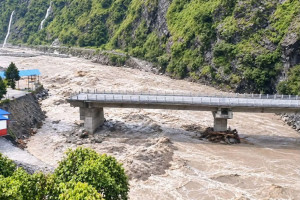
Kathmandu seeks smoother container movement, reconstruction of key bridges and dry ports, and easing of border pass restrictions as traders complain of slow dispatch.A scene of devastation at Nepal’s Timure customs yard after flashfloods in July last year. Post file photo
Nepal and China are set to hold a commerce secretary-level meeting in Lhasa next week, with trade facilitation, border infrastructure, and management of key transit points high on the agenda.
The third meeting of the Nepal-China Coordination Mechanism on Border Trade and Cooperation will take place on January 20-21 in Lhasa.
Commerce Secretary Ram Prasad Ghimire will lead the Nepali delegation, while the Chinese side will be headed by a vice chairman from the Lhasa municipal government.
Officials say Nepal will press China to allow the dispatch of more cargo containers through the Kerung and Tatopani border points, responding to long-standing complaints from traders about slow and irregular movement of goods.
“As traders have been complaining about the limited number of containers being dispatched from both Kerung and Tatopani, we will request the Chinese side to increase container movement,” said an official at the Ministry of Industry, Commerce and Supplies.
The Rasuwagadhi border point has resumed operations since January 1 following the installation of a temporary (Bailey) bridge.
The crossing had been disrupted after a flash flood in the Lhende River on July 8 last year swept away the Miteri Bridge at Kerung, one of Nepal’s main trade gateways to China.
It took nearly six months for China to set up a temporary bridge. Nepal’s customs point at Rasuwagadhi lies about 24 kilometres south of Kerung.
Despite the reopening, traders say the flow of cargo remains far below normal levels.
The temporary bridge cannot support the passage of large containers, resulting in fewer vehicles being cleared. Traders also complain that only a limited number of border passes are being issued.
Under the current work procedure, only local residents and migrants living in Rasuwa district are eligible for border passes.
“Nepal will request China to allow cross-border access for traders from other districts, as there have been frequent demands to ease the pass system,” the official said.
Nepal will also seek China’s support for the construction of a permanent Miteri Bridge at Kerung, citing its strategic importance as a major trade gateway.
In addition, Kathmandu plans to request Chinese assistance in developing road infrastructure at border points including Olangchung Gola, Kimathanka, Hilsa and Simkot.
Another key agenda item will be the dry port at the Korala border point in Mustang. Nepal will urge China to expedite the revision and completion of the detailed project report (DPR).
The DPR, prepared by the Nepal Intermodal Transport Development Board, was handed over to Chinese officials, who said four months ago that they would revise it and propose a new design. The Korala dry port project is estimated to cost Rs1.5 billion.
Nepal will also raise the issue of reconstructing the Rasuwa dry port, which was severely damaged by last summer’s flood. Beijing had halted construction after the flash flood destroyed more than 90 percent of the under-construction facility.
All physical infrastructure was washed away, leaving only one building standing. The Chinese government had already spent about Rs1.5 billion, roughly half of the total project cost.
China is Nepal’s second-largest trading partner after India. Nepal’s total trade with the northern neighbour stood at Rs343.73 billion last fiscal year, with the trade deficit widening to Rs338.47 billion.
According to the Department of Customs, Nepal’s imports from China increased 14.16 percent to Rs341.10 billion in the fiscal year ended mid-July. Major imports included smartphones, electric vehicles, iron and steel coils, apples, diammonium phosphate, laptops and notebooks, dyed knitted or crocheted fabrics, garlic, readymade garments and footwear.
Exports to China rose marginally by 1.93 percent to Rs2.63 billion in the same period. Nepal mainly exported carpets, scourers, felt products, tracing cloth, statues made of precious metals, medicinal herbs, wood, musical instruments, readymade garment and yarsagumba.
Traders say prolonged disruptions at Kerung and limited vehicle movement at Tatopani last year severely affected imports, including of electric vehicles, during the festive season. Some traders even described the situation as an unofficial blockade.
They said food items imported for festivals since Teej in the rainy season have remained stranded at the Chinese side of the border due to the slow pace of container clearance. Despite repeated requests from Nepali officials to ease trade and allow regular vehicle movement, traders say the problem persists.
Nepal and China have two key trade routes: Rasuwagadhi–Kerung and Tatopani–Zhangmu, also known as Khasa. Kerung lies about 190 kilometres from Kathmandu, while Tatopani is around 115 kilometres away.
The Tatopani–Khasa border point reopened on May 29, 2019, after remaining closed for four years following the 2015 earthquakes.
The Rasuwagadhi–Kerung customs point, which was later upgraded to an international checkpoint allowing third-country nationals to cross, reopened in July 2020.
Krishana Prasain is a business reporter for The Kathmandu Post covering markets. Before joining The Kathmandu Post in 2018, she spent 3 years in New Business Age magazine covering business.




 20.85°C Kathmandu