Government sets quality standards for masyaura and chhurpi for first time
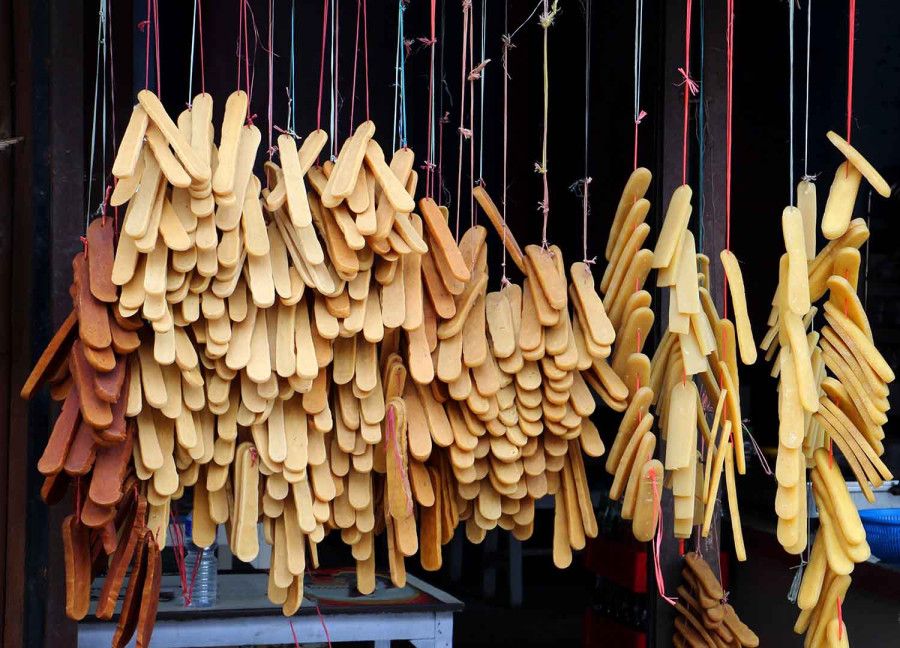
New standards aim to ensure food safety, support exports and align traditional Nepali foods with international requirements. Chhurpi must be clean, unadulterated and free from fungus, pests, decay, stones, sand, glass, plastic, metal, hair, straw or any other debris. Shutterstock
For the first time, the government has set quality standards for two traditional Nepali foods—masyaura and chhurpi—seeking to ensure food safety and support their growing export potential.
The Ministry of Agriculture and Livestock Development on Monday approved the standards, which have been published in the Nepal Gazette, the government’s official publication.
The Department of Food Technology and Quality Control had proposed the standards in 2024 amid rising domestic consumption and overseas demand for the products.
The Quality Determining Committee formed under Nepal’s Food Act—now the Food Safety and Quality Act—had forwarded the draft standards for notification to the World Trade Organisation (WTO), officials said.
The notification process involved sharing sanitary and phytosanitary (SPS) details to ensure the products are safe for consumption.
SPS measures are intended to protect producers and consumers from specific health and safety risks and are governed by the WTO’s Agreement on the Application of Sanitary and Phytosanitary Measures.
Along with the Technical Barriers to Trade Agreement, the framework seeks to allow governments to apply standards without resorting to disguised protectionism.
Although responses under the WTO process generally take at least 90 days, it took the government nearly two years to publish the standards in the Gazette.
Bal Kumari Sharma, spokesperson for the department, said the delay was due to changes in the food law in line with evolving global practices, which also altered provisions related to food preparation, processing and standard formulation.
Masyaura, a fermented traditional food, has been gaining popularity among the Nepali diaspora, with many people sending it abroad as gifts. The standard defines masyaura as fermented, sun-dried or mechanically dried vegetable balls made from minced black lentils combined with yam and taro plants.
Under the standard, masyaura should not contain grains, soybeans or other food items. It must be clean, dry, insect-free and free from decay and excess moisture.
Moisture content should be up to 11 percent, total ash up to 4 percent by dry weight and total protein not exceeding 15 percent by dry weight.
Ash refers to the inorganic mineral residue remaining after laboratory analysis and is used as an indicator of food quality and processing.
Masyaura must not contain inorganic or harmful substances such as stones, sand, glass, plastic fragments, mud or metal, nor should it be prepared using external colours, fragrances or Class II synthetic preservatives.
Standards for contaminants, toxins and residues will be determined by the government, while production, packaging, storage and transportation will be regulated by the agriculture ministry.
Packaging materials must be food grade, clean and properly labelled, with ingredients clearly listed.
Nepal exported 42 tonnes of masyaura worth Rs8.30 million in the last fiscal year ended mid-July, mainly to the United States, Japan and Italy.
The government has also set standards for chhurpi, a protein-rich hard cheese traditionally produced in the highlands, as demand rises in international markets. The standard will also apply to chhurpi used as dog chew, a fast-growing export item.
Chhurpi is prepared using traditional techniques involving boiling milk, separating whey, shaping and drying the solids, and smoking the product for about a month. The standards apply to all types of chhurpi made from single or mixed milk of cow, yak and buffalo.
Chhurpi containing milk fat of 5 percent or more will be categorised as high-fat, while products with less than 5 percent milk fat will fall under the low-fat category, which is increasingly preferred in dog chew markets. Both categories must have moisture content not exceeding 14 percent, and crude milk protein must be at least 60 percent by dry weight.
The product must be clean, unadulterated and free from fungus, pests, decay, stones, sand, glass, plastic, metal, hair, straw, cloth or any other debris. It should also be free from living or dead pests and livestock dirt.
Nepal exported 2,610 tonnes of dog chew worth Rs4.51 billion in the last fiscal year, with the United States as the largest market, followed by Canada.
Producers failing to meet the standards will face penalties under existing laws. Producing substandard food can result in up to six months’ imprisonment, a fine of up to Rs300,000, or both. If food is found adulterated, the punishment can be up to five years’ imprisonment, a fine of up to Rs500,000, or both.
Krishana Prasain is a business reporter for The Kathmandu Post covering markets. Before joining The Kathmandu Post in 2018, she spent 3 years in New Business Age magazine covering business.




 16.67°C Kathmandu