



 14.81°C Kathmandu
Sat, Oct 24, 2026
Money
Wide wholesale-retail price gap keeps veggies out of common person’s reach
Wholesale prices have dropped sharply at Kalimati, but weak market monitoring has allowed retailers to keep prices high, consumer rights activists say.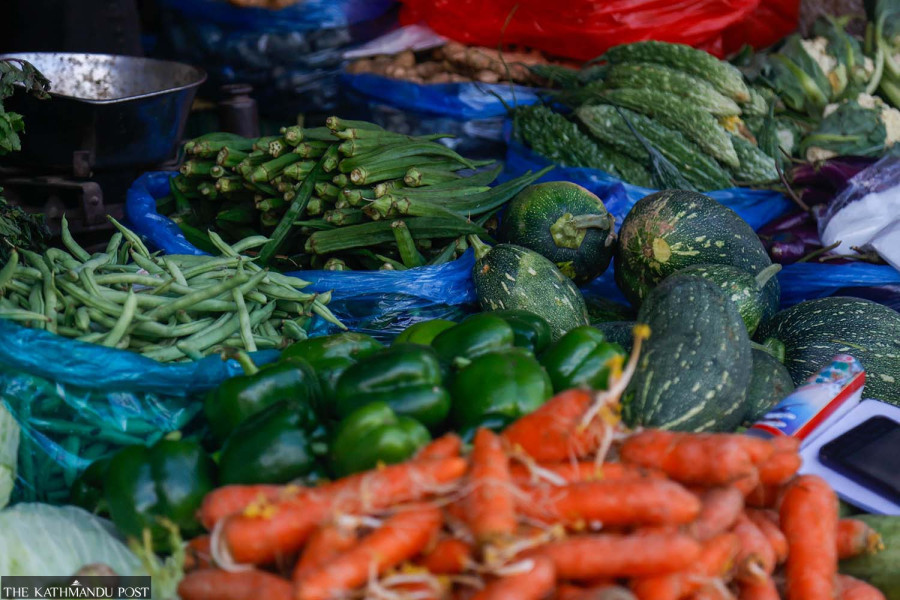
bookmark
Krishana Prasain
Published at : January 4, 2026
Updated at : January 4, 2026 07:04
Kathmandu
The gap between wholesale and retail prices of vegetables has been widening, with consumers bearing the brunt of weak market monitoring and inspection.
Market insiders say the government has failed in its responsibility—particularly of regulating markets—allowing middlemen and retailers to rake in profits. While wholesale prices at the Kalimati Fruits and Vegetable Market have fallen for most vegetables, retail prices have refused to come down proportionately.
For instance, the wholesale price of local and Tarai cabbage at Kalimati has dropped by around 40 percent. On Friday, local cabbage was priced at Rs40 per kg and Tarai cabbage at Rs30 per kg. In retail markets, however, cabbage was selling for Rs90 to Rs100 per kg—more than double the wholesale rate.
Likewise, wholesale prices of local and Tarai cauliflower declined by 12.86 percent and 16.67 percent to Rs61 per kg and Rs50 per kg, respectively. In retail outlets, cauliflower costs between Rs160 and Rs170 per kg.
Eggplant prices at the wholesale level declined by 13.15 percent to Rs55 per kg and by 9.43 percent to Rs60 per kg. Yet consumers have to cough up Rs110 to Rs120 per kg in retail markets.
Consumers say vegetables have become increasingly expensive despite the fall in wholesale prices. Many complain that spending over Rs1,000 on vegetables does not meet household needs for more than two or three days.
“I bought two kilos of cauliflower, two kilos of cabbage and one kilo of carrot, which cost me nearly Rs700,” said Madan Bidari, a vegetable buyer in Kalanki on Friday morning.
Bidari, who works in the private sector, said tomatoes routinely cost him over Rs100 per kg. “Onion prices are always on the high side,” he added.
Consumer rights activists say the failure of local governments to carry out regular market inspections has left consumers exposed to inflated prices of essential goods. They argue this reflects an absence of effective state intervention to protect consumers.
“Despite the Local Government Operation Act, 2017 and the Consumer Protection Act, 2018 clearly mandating market inspections and even allocating budgets for this purpose at the local level, local governments do not seem serious about doing their duties,” said Prem Lal Maharjan, president of the National Consumer Forum. “This negligence has directly hit consumers’ pockets.”
The Department of Commerce, Supplies and Consumer Protection, meanwhile, lacks the manpower and resources to conduct market inspections across all local governments.
“Two years ago, we filed complaints with the Prime Minister’s Office, the Home Ministry and the Ministry of Industry, Commerce and Supplies, citing the failure of local governments to conduct market inspections,” Maharjan said.
Following the complaint, the home ministry issued a circular instructing rural municipalities to conduct market inspections at least once a month, municipalities three times a month, sub-metropolitan cities once a week and metropolitan cities daily.
However, no local government has been effectively conducting market inspections, which is why price gaps and distortions continue to grow, according to consumer rights activists.
Wholesale prices of most vegetables—including tomato, potato, carrot, cabbage, cauliflower, eggplant, cowpea, French bean, sword bean, bitter gourd, bottle gourd, squash and green leafy vegetables—have declined over the past month. Yet even seasonal vegetables are selling for more than Rs100 per kg in retail markets.
Activists also blame the Kalimati Fruits and Vegetable Market Development Board for failing to regulate prices. According to rules, the board needs to take necessary initiatives to control market prices.
“To control prices, the board should direct major buyers inside Kalimati and warn them against selling vegetables at higher-than-approved prices,” Maharjan said. “But such enforcement is not happening.”
Daily vegetable arrivals at the Kalimati market have declined by 11.11 percent to about 800 tonnes.
Central bank data show that vegetable inflation declined by 14.43 percent in the first four months of the current fiscal year ended mid-November, compared to the same period last year.
The central bank’s Economic Activities Study report, published on Thursday, said vegetable output increased by 10.1 percent in the last fiscal year, while fruit production declined by 3.3 percent. The area under vegetable cultivation expanded by 5.4 percent in the review period.
Despite these trends, retail prices remain high. The wholesale price of big tomatoes declined by 8.82 percent to Rs77.50 per kg, although their price increased by 4.76 percent within a month, to Rs110 per kg. In retail markets, big tomatoes are selling for Rs160 to Rs170 per kg, while local tomatoes cost Rs140 to Rs150 per kg.
Onion wholesale prices have surged by 69.35 percent to Rs52.50 per kg, with retail prices ranging from Rs70 to Rs80 per kg.
Similarly, the wholesale price of seasonal carrots—both local and Tarai—dropped by 45.45 percent and 48 percent to Rs75 per kg and Rs65 per kg, respectively. In retail markets, however, carrots are priced at Rs160 to Rs170 per kg.
Krishana Prasain
Krishana Prasain is a business reporter for The Kathmandu Post covering markets. Before joining The Kathmandu Post in 2018, she spent 3 years in New Business Age magazine covering business.





Most Read from Money

Why does an hour long flight to Dhangadhi cost more than a flight to New Delhi?

Nepal travel agents threaten to stop selling Thailand trips over visa rules
Malaysia rejects Nepal’s demand to open recruitment to all manpower agencies

No school, but a graduation cap for women dairy farmers

Nepal arrests four medical service providers as Malaysia recruitment row deepens
Editor's Picks




E-PAPER | October 24, 2026

×