In June 2024, Beijing made a high-profile announcement. During the 16th round of the Nepal–China diplomatic consultation mechanism meeting held in Kathmandu, China unveiled plans to promote Nepal as a key destination for Chinese travellers, declaring 2025 as ‘Visit Nepal Year in China’.
Informally, senior Chinese officials pledged to bring at least 500,000 Chinese tourists to Nepal. The reality, however, fell far short.
Despite the diplomatic fanfare, arrivals from China registered negative growth.
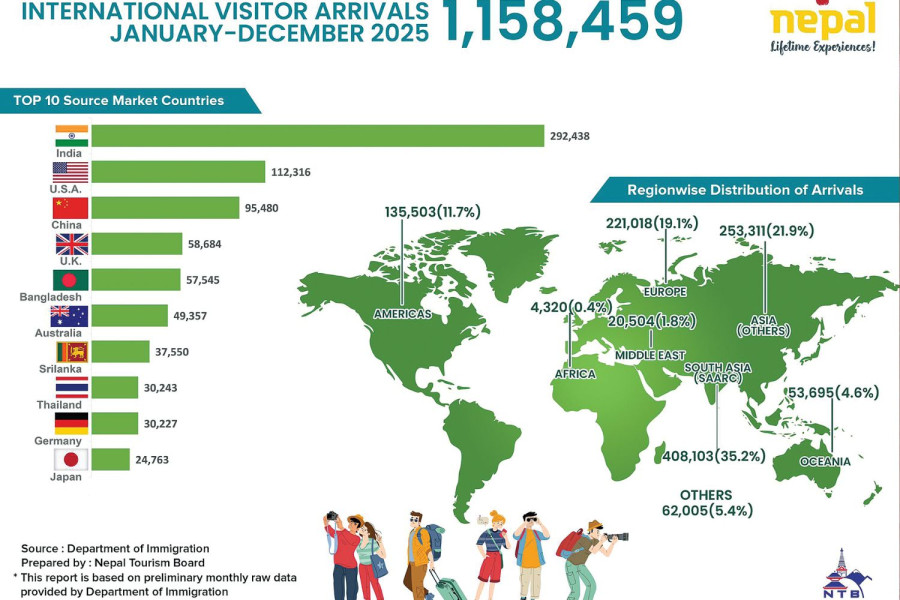
In 2025, Nepal welcomed just over one million tourists for the third time since the pandemic, posting a marginal year-on-year growth of 1 percent.
Tourism entrepreneurs had initially hailed the Chinese announcement as an unprecedented show of soft power diplomacy, noting that Beijing had never extended such a commitment to any other country.
Many believed it would provide a much-needed boost to Nepal’s struggling tourism sector.
That optimism has since faded.
According to the Department of Immigration, arrivals from China fell 6.3 percent year-on-year to 95,480 visitors last year.
“What went wrong is obvious,” said Mani Raj Lamichhane, a director at the Nepal Tourism Board, the official tourism promotion body. “The marketing and promotional segment was poorly planned. We did conduct promotional activities in different Chinese cities, but they failed to generate demand.”
In December 2024, Nepal and China issued a joint statement committing to support a range of tourism promotion initiatives. Nepal agreed to facilitate activities organised by the China Cultural Centre, while China expressed interest in hosting signature events such as the China Festival and Happy Spring Festival in Nepal.
Both sides also agreed to support large-scale cultural, sports and tourism events, including the Pokhara International Mountain Cross Country Competition and the China–Nepal Friendship Dragon Boat Festival, as well as film festivals.
“A number of these planned events were cancelled due to the Gen Z protest in September,” Lamichhane said.
In March last year, the Pokhara Tourism Council, an umbrella body of tourism entrepreneurs, partnered with China’s Sichuan Airlines to launch charter flights between Chengdu and Pokhara.
The inaugural flight on March 18 brought 128 passengers from Sichuan Province and returned the same day with 126 Nepali passengers.
But the momentum did not last.
After the first flight, one-way occupancy averaged just 50 to 55 passengers. “After seven or eight flights, the service was discontinued,” Lamichhane said. “Tour operators in China say there is simply no demand for Nepal in their market.”
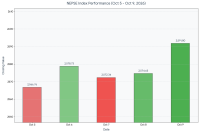
Chinese arrivals to Nepal crossed the 100,000 mark for the first time in 2013, largely due to improved air connectivity. According to tourism ministry data, about 93 percent of Chinese tourists were first-time visitors.
In 2014, Nepal received 123,805 Chinese visitors. However, the 2015 earthquakes and India’s blockade led arrivals from China to plunge by 47.76 percent to 64,675. The road at the Tatopani border point—once a major entry route for Chinese tourists—was also blocked.
On December 25, 2015, Nepal announced a free visa policy for Chinese tourists, granting them the same treatment as visitors from South Asia. Implemented in January 2016, the policy helped revive arrivals.
Chinese tourist numbers rose steadily thereafter, with Nepal recording its strongest growth—46.8 percent—in 2018, when arrivals reached 153,633.
In October 2019, Chinese President Xi Jinping visited Nepal, raising hopes of a tourism surge. Xi became the first Chinese president to visit Nepal since 1996 and pledged to encourage Chinese travel to the country.
“Nepal is the first South Asian country to be designated an approved destination for Chinese tourists,” Xi wrote in an article published in Nepali newspapers during his visit.
That year, Nepal received a record 169,543 Chinese tourists. Then the Covid pandemic hit.
Chinese arrivals collapsed to 19,257 in 2020. In 2021 and 2022, just 6,198 and 9,599 Chinese nationals—mostly diplomats or travellers stranded in third countries—visited Nepal as Beijing enforced prolonged lockdowns.
In March 2023, after three years, China finally allowed its citizens to travel to Nepal as tourists. That year, 60,878 Chinese visited Nepal, while total international arrivals crossed one million for the first time since the pandemic.
Booking trends for January this year remain weak, according to tour operators.
“All this shows that the marketing was ineffective, especially considering that Beijing itself had announced Visit Nepal Year in China,” Lamichhane said.
China was not the only source market to shrink.
Arrivals from India, Nepal’s largest tourist source, dropped 8 percent year-on-year to 292,438, according to the Nepal Tourism Board, though India remained the top contributor.
The decline came despite China reopening Tibet to Indian pilgrims for the Kailash Manasarovar Yatra after a five-year ban.
Tour operators cite a series of bus and air crashes in 2024, along with rising airfares, as key deterrents—a trend that continued into 2025.
Multiple developments over the past year compounded pressure on Nepal’s tourism industry.
On November 8, 2024, the Civil Aviation Authority of Nepal announced that Tribhuvan International Airport would be closed daily from 10 pm to 8 am until March 31, 2025, for taxiway expansion.
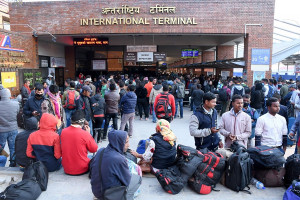
The decision to shut the country’s main international gateway for 10 hours a day took a heavy toll, triggering the first decline in tourist arrivals in February since the post-Covid recovery began.
A supply-demand mismatch sent airfares soaring, with ticket prices to popular destinations—including major labour markets in West Asia and Southeast Asia—quadrupling. Many travel plans and events were cancelled or postponed.
After a difficult spring, tourist flows thinned further during the autumn peak season following violent anti-corruption protests led by Gen Z youths in early September.
Seventy-seven people were killed as protesters torched government offices, politicians’ residences and businesses.
Several luxury hotels, including the Hilton and Hyatt Regency Kathmandu, were also set ablaze, sending black plumes of smoke into the sky.
The unrest toppled the government within 24 hours, leading to the formation of an interim administration mandated to hold elections on March 5—two years ahead of schedule. The crisis struck the tourism industry at the worst possible moment, just as the peak season began.
The World Bank now estimates that the Gen Z uprising will cap Nepal’s economic growth at 2.1 percent in the current fiscal year ending mid-July 2026.
In response, the Nepal Tourism Board has revived its digital reassurance campaigns—#NowInNepal, #NepalNow and WE ARE IN NEPAL NOW—first used after the 2015 earthquakes and during the Covid-19 pandemic.
The campaigns feature foreign tourists in Nepal holding placards with the hashtags, while the board has begun livestreaming major tourist sites in the Kathmandu Valley to reassure international partners and woo back visitors.
Nepal received 1.15 million tourists last year, up just 1 percent from 1.14 million in 2024, when arrivals had grown by 13 percent over 2023. The figures remain below the pre-pandemic peak of 1.2 million visitors.
Sangam Prasain is Business Editor at The Kathmandu Post, covering tourism, agriculture, mountaineering, aviation, infrastructure and other economic affairs. He joined The Kathmandu Post in October 2009.




 24.79°C Kathmandu