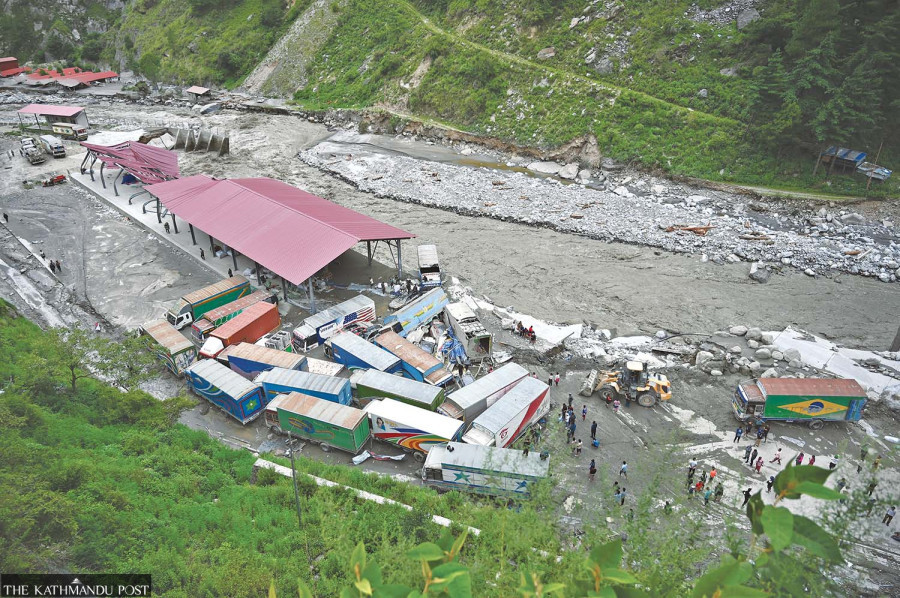
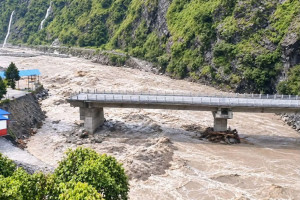
Nearly completed, the facility at Rasuwagadhi was swept away in July floods, and resumption remains uncertain. Almost 80 percent of the construction work at the Rasuwa dry port had been completed before the July flood. Post file photo
Beijing has decided to halt the construction of the Rasuwa dry port at the northern border point after a flash flood in July destroyed more than 90 percent of the under-construction facility. Officials privy to the matter say Beijing has not elaborated on the reason for the halt.
“The Chinese government wrote to the Ministry of Foreign Affairs three months ago, deciding to halt the construction of the dry port. It is not clear whether China will resume the project,” said Ashish Gajurel, executive director of the Nepal Intermodal Transport Development Board, which oversees dry port facilities in the country.
According to the board, almost 80 percent of the construction work at the Rasuwa dry port had been completed before the July flood. All physical infrastructure was swept away, with only one building standing.
“The Chinese government had already spent Rs1.5 billion, about half of the total project cost, in the dry port,” said Gajurel.
The flash flood that hit Rasuwagadhi on July 8 also swept away the Nepal–China Friendship Bridge, also known as the Miteri Bridge, halting trade and cross-border movement.
Around 25 containers parked at the dry port went missing, and about 90 newly imported electric vehicles were swept away or severely damaged in the disaster.
With the installation of a temporary truss bridge, the Rasuwagadhi border point has come into partial operation from Sunday and is scheduled to resume full operations from January 1.
Construction of the Rasuwa dry port began in May 2019, with a completion deadline of May 2022. However, the Covid pandemic delayed the work.
On May 12, 2019, the board signed an agreement with Tibet Fuli Construction Group Company Limited to build the inland container depot at Timure in Rasuwa, a location that straddles a major trade route with China. The Chinese company was supposed to complete the facility within 30 months.
The Rasuwa dry port was a gift from the Chinese government. The planned facility was designed to accommodate 350 container trucks and include a warehouse, parking lot, customs building, post office, and quarantine facility.
The project was being built on 165 ropani (8.39 hectares) of land, located about 2.5 kilometres from the Nepal–China border.
Meanwhile, progress on another dry port in Korala, Mustang along the Nepal–China border has also been slow.
“We prepared the detailed project report (DPR) a year ago. As Beijing is eager to build this dry port as well, Chinese officials have taken the report prepared by the board,” said Gajurel.
Four months ago, China said it would revise the DPR and come up with a new design, he added.
The construction of the Korala dry port is estimated to cost Rs1.5 billion. China has extended its road network to the Korala border point to broaden its long-term business ties with Nepal, according to Nepali officials. However, the Covid pandemic stalled progress in enhancing trade connectivity between Nepal and China.
The Korala customs point, located at an altitude of 4,650 metres in upper Mustang, was opened for international trade in September. The border point was officially inaugurated in November 2023.
In the far-west, construction of the Dodhara Chandani dry port has begun. The work was handed over on site to an Indian construction company in June, and the project is expected to be completed by December 2028, three years from the starting date.
The construction was to formally begin only after the prime ministers of Nepal and India lay the foundation. However, following the abrupt ouster of the KP Oli administration by the Gen Z protests in September, it remains unclear when the foundation-laying event will be held, according to the board.
“However, construction of the boundary wall, soil filling, and foundation work for structures has already started,” said Gajurel.
The Dodhara Chandani dry port is being built by the Indian government at a cost of Rs3.80 billion. Once completed, it is expected to serve as a key trade gateway to India from Nepal’s far-western region.
Located about 245 kilometres from New Delhi and roughly 1,200 kilometres from Gujarat, the port is expected to facilitate trade with Indian states such as Rajasthan, Uttarakhand, Punjab and Haryana. It will also provide Nepal with access to Jawaharlal Nehru Port in Mumbai, enhancing foreign trade opportunities and reducing transportation costs.
Meanwhile, the board has conducted a feasibility study for a dry port in Jaleshwar.
Jaleshwar customs is located at Maliwara in ward 3 of Jaleshwar Municipality, at a border point between Nepal and India. Industrialists and traders have been urging the government to upgrade the Jaleshwar customs point as a major transit hub for goods imported from third countries to Kathmandu, arguing that it would significantly reduce transportation costs.
Krishana Prasain is a business reporter for The Kathmandu Post covering markets. Before joining The Kathmandu Post in 2018, she spent 3 years in New Business Age magazine covering business.




 24.79°C Kathmandu